The Hajj, Step by Step — The Authenticated Ḥanafī Method
Quick reference · Ḥanafī method
Ḥajj at a glance
New to Ḥajj? Read the full day-by-day method below. Just need a refresher? It's all here.
🔔 Before you go — arrange & verify on Nusuk
- Ḥajj permit, visa, tents and transport are arranged through Nusuk / your approved operator.
- The meningitis ACWY vaccine is mandatory; complete it in good time.
- Tamattuʿ & Qirān owe a shukr sacrifice — most pay by the official coupon scheme.
- Stay near the Ḥaram and pre-book your transport.
The five days
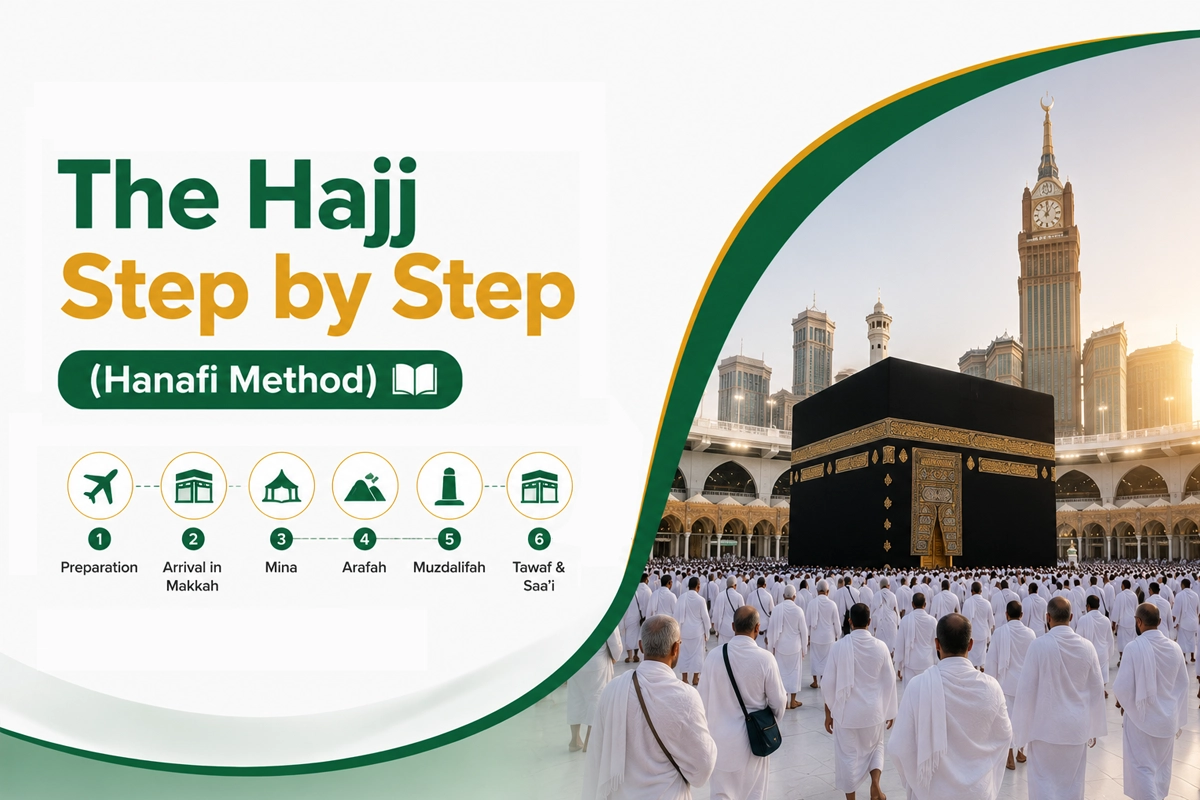
- 8th · Minā — tie iḥrām, move to Minā, five prayers, overnight.
- 9th · ʿArafah — the wuqūf from zawāl to sunset. “The Ḥajj is ʿArafah.”
- Night · Muzdalifah — Maghrib + ʿIshāʾ together, gather pebbles, dawn wuqūf.
- 10th · Naḥr — ramī, sacrifice, shave, then ṭawāf al-ziyārah.
- 11th–13th · Minā — stone all three pillars each afternoon.
- Farewell — ṭawāf al-wadāʿ, the last act in Makkah.
The three ways
- Tamattuʿ — ʿUmrah first, release, fresh iḥrām for Ḥajj on the 8th; sacrifice due. (Most pilgrims.)
- Qirān — one iḥrām for both, no haircut until the 10th; sacrifice due. (Most virtuous.)
- Ifrād — Ḥajj alone; no sacrifice owed.
The 10th — strict order
- Ramī of Jamrat al-ʿAqabah (talbiyah stops).
- The sacrifice (Tamattuʿ & Qirān).
- Ḥalq / qaṣr — the first release.
- Ṭawāf al-ziyārah (+ saʿī) — the farḍ of the day.
Reversing ramī → sacrifice → shave obliges a dam.
Don't slip
- Don't leave ʿArafāt before sunset; don't pray Maghrib there — join it at Muzdalifah.
- On the 11th–13th, stone only after zawāl.
- Don't shave until the sacrifice is confirmed.
- Takbīr al-tashrīq after every farḍ, Fajr of the 9th → ʿAṣr of the 13th.
Short answer
Ḥajj is five days in Dhul-Ḥijjah: on the 8th you enter iḥrām and go to Minā; on the 9th you make the wuqūf at ʿArafah (the standing that IS the Ḥajj, from zawāl to sunset); that night you stop at Muzdalifah; on the 10th come four acts in strict order — stoning Jamrat al-ʿAqabah, the sacrifice (for Tamattuʿ and Qirān), shaving/trimming, and the ṭawāf al-ziyārah with saʿī; on the 11th–13th you stone all three pillars each afternoon after zawāl; and before leaving Makkah you make the farewell ṭawāf. This guide gives the authenticated Ḥanafī method for all three ways — Tamattuʿ, Qirān and Ifrād — with every duʿā.
Key takeaways
- ✓Ḥajj has three ways: Tamattuʿ (ʿUmrah first, then a fresh iḥrām for Ḥajj), Qirān (both in one iḥrām) and Ifrād (Ḥajj alone) — fix it by the niyyah at the mīqāt.
- ✓The farḍ core is the standing at ʿArafah (9th) and the ṭawāf al-ziyārah — miss either and there is no Ḥajj.
- ✓Stay in ʿArafāt until the sun has fully set; leaving early obliges a dam, and Maghrib is joined with ʿIshāʾ at Muzdalifah.
- ✓On the 10th keep the strict order: ramī of al-ʿAqabah → sacrifice → shave/trim → ṭawāf al-ziyārah; reversing it obliges a dam.
- ✓Do not shave before the sacrifice is confirmed (Tamattuʿ & Qirān owe it; the mufrid does not and goes straight to the razor).
- ✓On the 11th–13th all three pillars are stoned only AFTER zawāl — seven pebbles each; morning pebbles do not count.
- ✓The takbīr of tashrīq is wājib once aloud after every farḍ from Fajr of the 9th to ʿAṣr of the 13th.
- ✓Women say the talbiyah softly, never do raml or the jog, and may leave Muzdalifah after midnight; the farewell ṭawāf is waived in menstruation.
Quick facts
- School
- Ḥanafī
- Days
- 8–13 Dhul-Ḥijjah
- The Ḥajj is
- ʿArafah (9th)
- Three ways
- Tamattuʿ · Qirān · Ifrād
- Farḍ core
- ʿArafah + ṭawāf al-ziyārah
- 10th order
- Ramī · Naḥr · Ḥalq · Ṭawāf
- Stoning 11–13
- After zawāl
- Sacrifice
- Tamattuʿ & Qirān
The shape of the five days
Ḥajj is five days walked in the footprints of Ibrāhīm عليه السلام and of the Messenger of Allah ﷺ. On the 8th of Dhul-Ḥijjah you enter iḥrām and move to Minā; on the 9th you stand at ʿArafah — the standing is the Ḥajj — and sleep that night under the open sky of Muzdalifah; on the 10th come four acts in strict order: the ramī of the great pillar, the sacrifice, the shaving of the head, and the ṭawāf al-ziyārah; on the 11th and 12th you stone all three pillars each afternoon; and before leaving Makkah you circle the House once more in farewell — the ṭawāf al-wadāʿ.
In the Ḥanafī reckoning, two things are the farḍ core after the iḥrām itself: the standing at ʿArafah and the ṭawāf al-ziyārah — miss either and there is no Ḥajj. Around them stand the wājibāt — Muzdalifah, the saʿī, the ramī, the sacrifice of the mutamattiʿ and the qārin, the shaving, the farewell ṭawāf — whose omission wounds the Ḥajj and obliges a remedy, but does not destroy it. Everything else is sunnah and adab, light to carry and heavy on the scales.
On this page
- I — The three ways of Ḥajj
- II — The iḥrām of Ḥajj on the 8th
- III — 8th: Minā, the day of Tarwiyah
- IV — 9th: ʿArafah, the Ḥajj itself
- V — The night at Muzdalifah
- VI — 10th: the day of sacrifice
- VII — 11th–13th: Minā and the ramī
- VIII — The farewell ṭawāf
- Mistakes that cost pilgrims dearly
- Sources & method
Part I — The three ways of Ḥajj: choose your road to the 8th
The Sharīʿah opens three doors into the same Ḥajj, and the Prophet's ﷺ Companions entered by all three on the Farewell Pilgrimage. They differ only in how the iḥrām is tied and whether an ʿUmrah rides with it; from the morning of the 8th onward, every pilgrim walks the identical five days. Settle it before the mīqāt, for the niyyah at the mīqāt is what fixes it. Rafīq-e-Ḥajj
1 · Ḥajj al-Tamattuʿ the way of most pilgrims
At the mīqāt you tie iḥrām for ʿUmrah alone, within the months of Ḥajj — Shawwāl, Dhul-Qaʿdah, and the first days of Dhul-Ḥijjah. You perform the ʿUmrah, shave or trim, and leave iḥrām completely: ordinary clothes, ordinary life in Makkah, ṭawāf after ṭawāf as nafl. Then on the 8th (or the night before) you tie a fresh iḥrām for Ḥajj from your own lodging — no return to any mīqāt — as Part Two sets out. Because you have enjoyed (tamattuʿ) the ease between two worships, the shukr sacrifice on the 10th is wājib upon you. This is the way nearly every scheme pilgrim performs, and the way the rest of this guide narrates by default. Rafīq-e-Ḥajj
2 · Ḥajj al-Qirān the most excellent, for the able
At the mīqāt you tie one iḥrām for ʿUmrah and Ḥajj together, and it will not open until the 10th of Dhul-Ḥijjah. Make the intention for both:
The niyyah of Qirān, at the mīqāt
اَللّٰهُمَّ إِنِّيْ أُرِيْدُ الْعُمْرَةَ وَالْحَجَّ فَيَسِّرْهُمَا لِيْ وَتَقَبَّلْهُمَا مِنِّيْ
Allāhumma innī urīdul-ʿumrata wal-ḥajja fa-yassirhumā lī wa taqabbalhumā minnī.
O Allah, I intend the ʿUmrah and the Ḥajj together — so make them both easy for me, and accept them both from me.
Muʿallim al-ḤujjājOn reaching Makkah the qārin performs the ʿUmrah first — its ṭawāf and its saʿī — then the ṭawāf al-qudūm below. His talbiyah, silenced at the first istilām of the ʿUmrah's ṭawāf, resumes when the ʿUmrah is complete and continues to the first pebble of the 10th. Like the mutamattiʿ, he owes the shukr sacrifice. In the Ḥanafī school Qirān is the most virtuous of the three, precisely because its iḥrām is the longest carried. Rafīq-e-Ḥajj
3 · Ḥajj al-Ifrād Ḥajj alone
At the mīqāt you tie iḥrām for Ḥajj alone, with the niyyah of Part Two — اَللّٰهُمَّ إِنِّيْ أُرِيْدُ الْحَجَّ فَيَسِّرْهُ لِيْ وَتَقَبَّلْهُ مِنِّيْ — and no ʿUmrah rides with it. On arrival the mufrid performs the ṭawāf al-qudūm below and then simply remains in iḥrām, praying and circling the House in his two sheets, until the 10th. He owes no shukr sacrifice — a nafl sacrifice is beloved but nothing is due — and this is the natural way of those who arrive only days before the Ḥajj, of the people of Makkah and the mīqāt zone, and of the one sent for Ḥajj-e-Badal unless instructed otherwise. Rafīq-e-Ḥajj
On arrival — the ṭawāf al-qudūm Qirān & Ifrād only
For the qārin (after his ʿUmrah) and the mufrid, the ṭawāf of arrival is the sunnah of entering the House's presence: seven rounds with iḍṭibāʿ, the usual niyyah at the line, and the two rakʿah after. And here lies a mercy worth taking: if you intend to perform the saʿī of Ḥajj straight after this ṭawāf, do raml in its first three rounds and walk the seven lengths now — then nothing of it remains for the crowded 10th, and your ṭawāf al-ziyārah that day will be seven calm rounds without raml. The mutamattiʿ has no ṭawāf al-qudūm — his ʿUmrah ṭawāf stood in its place. Rafīq-e-Ḥajj · Muʿallim al-Ḥujjāj
Part II — The iḥrām of Ḥajj: 7th night or 8th morning
The mutamattiʿ, released from his ʿUmrah, has been living in Makkah in ordinary clothes. For Ḥajj he does not return to any mīqāt: the iḥrām of Ḥajj is tied from wherever he is staying within the Ḥaram — the hotel room itself suffices. The sunnah time is the morning of the 8th before setting out for Minā, though tying it on the 7th, or earlier, is valid; many groups now instruct it the night before to match the bus schedule, and there is no harm in that. Muʿallim al-Ḥujjāj
1 · Ghusl, the two sheets, two rakʿah
Exactly as at the ʿUmrah: trim the nails and hair before this iḥrām (nothing may be cut after it), perform ghusl — or at least wuḍū — put on the two unstitched sheets, and pray two rakʿah nafl of iḥrām with the head covered, provided it is not a makrūh time. Sūrah al-Kāfirūn in the first rakʿah and al-Ikhlāṣ in the second is the sunnah. Women pray in their ordinary modest dress. Ḥayāt
2 · Intend Ḥajj — then the talbiyah binds it
After the prayer, bare the head (men) and make the intention of Ḥajj alone — the ʿUmrah is already behind you. Say it with the tongue in these words, or in your own language:
The niyyah of Ḥajj
اَللّٰهُمَّ إِنِّيْ أُرِيْدُ الْحَجَّ فَيَسِّرْهُ لِيْ وَتَقَبَّلْهُ مِنِّيْ
Allāhumma innī urīdul-ḥajja fa-yassirhu lī wa taqabbalhu minnī.
O Allah, I intend the Ḥajj — so make it easy for me, and accept it from me.
Muʿallim al-ḤujjājThen recite the talbiyah three times — men aloud, women softly — and with its first words the iḥrām of Ḥajj is tied:
The Talbiyah — recite three times, then constantly
لَبَّيْكَ اللّٰهُمَّ لَبَّيْكَ، لَبَّيْكَ لَا شَرِيْكَ لَكَ لَبَّيْكَ، إِنَّ الْحَمْدَ وَالنِّعْمَةَ لَكَ وَالْمُلْكَ، لَا شَرِيْكَ لَكَ
Labbayk Allāhumma labbayk, labbayka lā sharīka laka labbayk, innal-ḥamda wan-niʿmata laka wal-mulk, lā sharīka lak.
Here I am, O Allah, here I am. Here I am — You have no partner — here I am. Truly all praise, all favour and all sovereignty are Yours. You have no partner.
Ṣaḥīḥ al-Bukhārī & Muslim3 · Optional: the saʿī of Ḥajj in advance Tamattuʿ
The saʿī of Ḥajj normally follows the ṭawāf al-ziyārah on the 10th — the most crowded day of the year. The Ḥanafī manuals record a merciful ease: once the iḥrām of Ḥajj is tied, you may perform one nafl ṭawāf — with iḍṭibāʿ and raml, since a saʿī will follow it — and then the saʿī of Ḥajj immediately after, with its usual niyyah. Done now, it is not repeated on the 10th. If the crowds or your strength concern you, take this ease; if not, leave the saʿī in its original place. Muʿallim al-Ḥujjāj
Part III — Minā, the day of Tarwiyah (8 Dhul-Ḥijjah)
4 · Set out for Minā, labbayk on your tongue
The sunnah is to leave for Minā after sunrise on the 8th, so that Ẓuhr is prayed there. Today the buses and the train move on the schedule of the ḥamlah, sometimes in the night before — this forfeits nothing obligatory; keep the sunnah where you can and keep your peace where you cannot. On the way, fill the road with talbiyah, and ask as the pilgrims of every age have asked:
Setting out for Minā, say
اَللّٰهُمَّ إِيَّاكَ أَرْجُوْ وَلَكَ أَدْعُوْ، فَبَلِّغْنِيْ صَالِحَ أَمَلِيْ، وَاغْفِرْ لِيْ ذُنُوْبِيْ، وَامْنُنْ عَلَيَّ بِمَا مَنَنْتَ بِهِ عَلٰى أَهْلِ طَاعَتِكَ، إِنَّكَ عَلٰى كُلِّ شَيْءٍ قَدِيْرٌ
Allāhumma iyyāka arjū wa laka adʿū, fa-ballighnī ṣāliḥa amalī, waghfir lī dhunūbī, wamnun ʿalayya bimā mananta bihī ʿalā ahli ṭāʿatik, innaka ʿalā kulli shay'in qadīr.
O Allah, in You alone is my hope, and to You alone I call: bring me to the good that I long for, forgive me my sins, and favour me as You have favoured the people of Your obedience — truly You have power over all things.
Muʿallim al-Ḥujjāj5 · Five prayers in Minā
The sunnah of this day is simply to be in Minā and to pray five prayers there — Ẓuhr, ʿAṣr, Maghrib, ʿIshāʾ and the Fajr of the 9th — each at its own time, in congregation in the tent. Whether you pray full or shortened depends on your journey and your stay; your group's ʿālim will have determined it — behind an imam who prays full, always complete the four. Ḥayāt
6 · A night of gathering strength
Spend the night of the 9th in Minā — a sunnah muʾakkadah. There is no special rite here: talbiyah, istighfār, the Qurʾān, and honest sleep, for tomorrow is the day for which you crossed the world. The Prophet ﷺ did exactly this — rested at Minā, then moved after sunrise. Muʿallim al-Ḥujjāj
After every farḍ prayer, Fajr of the 9th → ʿAṣr of the 13th
اَللهُ أَكْبَرُ اَللهُ أَكْبَرُ، لَا إِلٰهَ إِلَّا اللهُ، وَاللهُ أَكْبَرُ اَللهُ أَكْبَرُ، وَلِلّٰهِ الْحَمْدُ
Allāhu akbar, Allāhu akbar, lā ilāha illallāh, wallāhu akbar, Allāhu akbar, wa lillāhil-ḥamd.
Allah is the Greatest, Allah is the Greatest; there is no god but Allah; and Allah is the Greatest, Allah is the Greatest, and to Allah belongs all praise.
ʿUmdat al-ManāsikPart IV — ʿArafah, the standing that is the Ḥajj (9 Dhul-Ḥijjah)
The Messenger of Allah ﷺ said: اَلْحَجُّ عَرَفَةُ — “The Ḥajj is ʿArafah.” Whoever is present within its boundaries for even a moment between the zawāl of the 9th and the dawn of the 10th has caught the Ḥajj; whoever misses it entirely has missed the Ḥajj itself, whatever else he performed. Everything in this day is arranged around one act: standing before your Lord as a beggar who owns nothing. Jāmiʿ al-Tirmidhī
7 · After sunrise, move to ʿArafāt
Pray Fajr in Minā, say the takbīr of tashrīq, and after sunrise set out with talbiyah, takbīr and durūd filling the bus. A ghusl before the wuqūf is sunnah — at the tent if water allows, otherwise wuḍū is enough. Entering the plain, say:
Entering ʿArafāt, say
اَللّٰهُمَّ اغْفِرْ لِيْ وَتُبْ عَلَيَّ، وَأَعْطِنِيْ سُؤْلِيْ، وَوَجِّهْ لِيَ الْخَيْرَ أَيْنَمَا تَوَجَّهْتُ
Allāhumma-ghfir lī wa tub ʿalayya, wa aʿṭinī su'lī, wa wajjih liyal-khayra aynamā tawajjaht.
O Allah, forgive me and turn to me in mercy; grant me what I ask of You; and turn goodness my way wherever I turn.
Muʿallim al-Ḥujjāj8 · Ẓuhr and ʿAṣr — the Ḥanafī ruling
Combining Ẓuhr and ʿAṣr at Ẓuhr's time on this day is, for the Ḥanafīs, only behind the imam of the Ḥajj in Masjid Namirah, with its conditions met. The pilgrim praying in his tent — as nearly all now do — prays Ẓuhr at Ẓuhr's time and ʿAṣr at ʿAṣr's time, each with jamāʿah in the camp. This is the ruling of the manuals and of Muftī Taqī ʿUthmānī's fatāwā, and it removes all confusion on the day itself. Fatāwā ʿUthmānī · Muʿallim al-Ḥujjāj
9 · The wuqūf — from zawāl to sunset
The moment the sun crosses its zenith, the wuqūf has begun. Stand if you can — facing the qiblah, hands raised as a beggar raises them — sit when you tire, but keep the heart standing. There is no fixed liturgy: talbiyah, takbīr, istighfār, durūd in abundance, and duʿā after duʿā in any language, for yourself, your parents, and every believer by name that you can remember. Weep; and if the eyes are dry, take the posture of weeping. This is the hour for which the whole journey was made. Ḥayāt wa Ghunyah
The master-duʿā of this day — the Prophet ﷺ said the best duʿā is the duʿā of the day of ʿArafah
لَا إِلٰهَ إِلَّا اللهُ وَحْدَهُ لَا شَرِيْكَ لَهُ، لَهُ الْمُلْكُ وَلَهُ الْحَمْدُ، وَهُوَ عَلٰى كُلِّ شَيْءٍ قَدِيْرٌ
Lā ilāha illallāhu waḥdahū lā sharīka lah, lahul-mulku wa lahul-ḥamd, wa huwa ʿalā kulli shay'in qadīr.
There is no god but Allah, alone, without partner. His is the sovereignty and His is all praise, and He has power over all things.
Jāmiʿ al-TirmidhīAnd from the Prophet's ﷺ own duʿā at ʿArafah
اَللّٰهُمَّ لَكَ الْحَمْدُ كَالَّذِيْ نَقُوْلُ وَخَيْرًا مِّمَّا نَقُوْلُ، اَللّٰهُمَّ لَكَ صَلَاتِيْ وَنُسُكِيْ وَمَحْيَايَ وَمَمَاتِيْ، وَإِلَيْكَ مَآبِيْ، وَلَكَ رَبِّ تُرَاثِيْ، اَللّٰهُمَّ إِنِّيْ أَعُوْذُ بِكَ مِنْ عَذَابِ الْقَبْرِ، وَوَسْوَسَةِ الصَّدْرِ، وَشَتَاتِ الْأَمْرِ، اَللّٰهُمَّ إِنِّيْ أَعُوْذُ بِكَ مِنْ شَرِّ مَا تَجِيْءُ بِهِ الرِّيْحُ
O Allah, to You belongs all praise — as we say it, and better than we can say it. O Allah, Yours is my prayer and my rite, my living and my dying; to You is my return, and Yours, my Lord, is all that I shall leave behind. O Allah, I take refuge in You from the punishment of the grave, from the whispering of the breast, and from the scattering of my affairs; O Allah, I take refuge in You from the evil of whatever the wind brings.
Jāmiʿ al-Tirmidhī10 · Hold the plain until the sun has set
Leave as the Prophet ﷺ left — bis-sakīnah, with tranquillity, reins drawn in, harming no one in the crowd. The talbiyah continues through the night.
Part V — Muzdalifah, a night on the open ground
11 · Maghrib and ʿIshāʾ together, in ʿIshāʾ's time
On arrival, before unrolling anything, the prayer: Maghrib and ʿIshāʾ combined in the time of ʿIshāʾ — one adhān, one iqāmah, three rakʿah of Maghrib then immediately four of ʿIshāʾ, with the sunnahs and witr offered after both. This combining is wājib here for whoever can manage it; it is the only night of the year the Ḥanafīs join two prayers. Then the ground is your bed: the Prophet ﷺ slept here until dawn, and sleep itself, tonight, is worship. ʿUmdat al-Manāsik
12 · Gather the pebbles
Collect the pebbles for the ramī from the ground of Muzdalifah — this is the preferred place, though any clean ground suffices. The size is a chickpea or date-stone, no larger; washing them is mustaḥabb. Count forty-nine if you will leave Minā on the 12th, seventy if you may stay for the 13th — and gather a handful extra for the ones that miss. Muʿallim al-Ḥujjāj
13 · Fajr in the first darkness, then the wuqūf
Pray Fajr at its earliest time — earlier than on any other day, by the sunnah of this morning — then stand facing the qiblah for the second wuqūf of the Ḥajj. This standing, for any moment between dawn and sunrise, is wājib; Allah Himself commanded it: فَاذْكُرُوا اللهَ عِنْدَ الْمَشْعَرِ الْحَرَامِ — “remember Allah at the Sacred Landmark” (al-Baqarah 2:198). Praise, takbīr, talbiyah, and duʿā until the sky is bright: Ghunyat al-Nāsik
In the wuqūf of Muzdalifah, ask
اَللّٰهُمَّ إِنِّيْ أَسْأَلُكَ أَنْ تَرْزُقَنِيْ فِيْ هٰذَا الْمَكَانِ جَوَامِعَ الْخَيْرِ كُلِّهِ، وَأَنْ تُصْلِحَ شَأْنِيْ كُلَّهُ، وَأَنْ تَصْرِفَ عَنِّي الشَّرَّ كُلَّهُ
Allāhumma innī as'aluka an tarzuqanī fī hādhal-makāni jawāmiʿal-khayri kullih, wa an tuṣliḥa sha'nī kullah, wa an taṣrifa ʿannish-sharra kullah.
O Allah, I ask You to grant me in this place every good, gathered all together; to set right the whole of my affair; and to turn away from me every evil, all of it.
Muʿallim al-ḤujjājMove off for Minā just before the sun rises — the Prophet ﷺ departed while the morning was still pale — and quicken the pace through the valley of Muḥassar, where the army of the elephant was destroyed.
Part VI — Yawm al-Naḥr, four acts in strict order (10 Dhul-Ḥijjah)
Today, for the mutamattiʿ and the qārin, four acts follow one another in an order that is itself wājib: first the ramī of the great pillar, then the sacrifice, then the shaving, then — with more room in its timing — the ṭawāf al-ziyārah. Reversing ramī, sacrifice or shaving obliges a dam in the Ḥanafī school; hold the sequence and the day is simple. Ghunyat al-Nāsik
14 · Ramī of Jamrat al-ʿAqabah — and the talbiyah falls silent
Go to the largest pillar, nearest Makkah — al-ʿAqabah alone today. The sunnah time is between sunrise and zawāl; the permitted time runs to the end of the night, and the weak stone at night by the exemption above. Stand at least five cubits back, take the pebbles one by one between thumb and forefinger, and with the very first throw the talbiyah stops forever — its work is done. With each pebble say:
With every pebble, say
بِسْمِ اللهِ، اَللهُ أَكْبَرُ، رَغْمًا لِّلشَّيْطَانِ وَرِضًى لِلرَّحْمٰنِ
Bismillāh, Allāhu akbar, raghman lish-shayṭāni wa riḍan lir-Raḥmān.
In the name of Allah — Allah is the Greatest — in defiance of Shayṭān, and for the pleasure of the Most Merciful.
Muʿallim al-ḤujjājSeven pebbles, each thrown separately, each landing inside the basin — one that falls short is simply thrown again. When the seventh lands, leave without pausing for duʿā: at this pillar, on this day, the sunnah is to walk away. Ḥayāt
15 · The sacrifice — and the trap in its timing Tamattuʿ & Qirān
Now the dam al-shukr: a sheep or goat, or a seventh share of a camel or cow, slaughtered within the Ḥaram during the days of naḥr. For the mutamattiʿ and qārin it is wājib — gratitude for two worships in one journey; the mufrid owes none, though a nafl sacrifice is beloved. Almost everyone today pays through the official coupon schemes, and that is perfectly valid — but it creates one danger: Aḥkām-e-Ḥajj
16 · Ḥalq or qaṣr — the first release
Sacrifice confirmed, the head: for men shaving the whole head (ḥalq) is the superior sunnah — the Prophet ﷺ prayed three times for the shaved and once for the trimmed — and trimming (qaṣr) must take at least a fingertip's length from at least a quarter of the head; a few snipped strands release nothing. A woman gathers her hair and cuts slightly more than a fingertip's length from the ends, in privacy. Ghunyat al-Nāsik
17 · Ṭawāf al-Ziyārah — the farḍ of the day
This ṭawāf is a pillar of the Ḥajj: without it the Ḥajj never completes, though a lifetime pass. Its wājib window is the 10th, 11th or 12th — after that it remains farḍ and must still be performed, but a dam attaches to the delay. It is seven rounds exactly as you learned at the ʿUmrah — the same niyyah at the line, the same istilām of the Stone in each round, the same رَبَّنَا آتِنَا in each closing arc — save that today you are in your own clothes: no iḍṭibāʿ, and raml only if your saʿī is still to come. Ḥayāt
At the Black-Stone line, the niyyah
اَللّٰهُمَّ إِنِّيْ أُرِيْدُ طَوَافَ بَيْتِكَ الْحَرَامِ فَيَسِّرْهُ لِيْ وَتَقَبَّلْهُ مِنِّيْ
Allāhumma innī urīdu ṭawāfa baytikal-ḥarāmi fa-yassirhu lī wa taqabbalhu minnī.
O Allah, I intend the ṭawāf of Your Sacred House — so make it easy for me, and accept it from me.
ḤayātThen the two rakʿah of the ṭawāf behind Maqām Ibrāhīm, and Zamzam to your fill.
18 · The saʿī of Ḥajj — the second release
If your saʿī of Ḥajj is already behind you — the mutamattiʿ by the ease of step 3, the qārin or mufrid after the ṭawāf al-qudūm — nothing remains here. Otherwise perform it now, exactly as at the ʿUmrah — the ninth istilām, the āyah at the foot of Ṣafā, the niyyah facing the House, seven lengths ending at Marwah, men jogging between the green lights, women never: ʿUmdat al-Manāsik
On Ṣafā, facing the House
اَللّٰهُمَّ إِنِّيْ أُرِيْدُ السَّعْيَ بَيْنَ الصَّفَا وَالْمَرْوَةِ فَيَسِّرْهُ لِيْ وَتَقَبَّلْهُ مِنِّيْ
Allāhumma innī urīdus-saʿya baynaṣ-Ṣafā wal-Marwati fa-yassirhu lī wa taqabbalhu minnī.
O Allah, I intend the saʿī between Ṣafā and Marwah — so make it easy for me, and accept it from me.
Ḥayāt19 · Return to Minā for the night
The nights of the 11th and 12th belong in Minā — a sunnah muʾakkadah the Prophet ﷺ never left. Sleeping instead in the Makkah hotel breaks no wājib in the Ḥanafī school, but it trades the very nights of Minā, which come once in a lifetime, for a mattress. Return if you possibly can. Muʿallim al-Ḥujjāj
Part VII — The days of Minā: three pillars each afternoon (11–13 Dhul-Ḥijjah)
20 · The ramī of the 11th — only after zawāl
On the 11th and 12th all three pillars are stoned, seven pebbles each, twenty-one in the day — and in the Ḥanafī school the time begins only at zawāl: pebbles thrown in the morning of these two days count for nothing and must be repeated. The order is sunnah and beloved: first the small pillar (al-Ṣughrā) by Masjid al-Khayf, then the middle (al-Wusṭā), and last al-ʿAqabah — each pebble with the same words: بِسْمِ اللهِ، اَللهُ أَكْبَرُ، رَغْمًا لِّلشَّيْطَانِ وَرِضًى لِلرَّحْمٰنِ. ʿUmdat al-Manāsik
21 · The two standings of duʿā
Here the sunnah reverses the 10th: after the small pillar, step aside out of the crowd, face the qiblah, raise the hands and make long duʿā — the length of reciting Sūrah al-Baqarah, say the manuals, and the Prophet ﷺ stood so long his companions wondered. The same after the middle pillar. After al-ʿAqabah — nothing: throw and go. Two long standings, one silence; such is the transmitted pattern. Ṣaḥīḥ al-Bukhārī · Ghunyat al-Nāsik
In the standing after the first and second pillars — and whenever the ramī of a day is complete
اَللّٰهُمَّ اجْعَلْهُ حَجًّا مَّبْرُوْرًا، وَسَعْيًا مَّشْكُوْرًا، وَذَنْبًا مَّغْفُوْرًا
Allāhumma-jʿalhu ḥajjan mabrūrā, wa saʿyan mashkūrā, wa dhanban maghfūrā.
O Allah, make it a Ḥajj accepted, an effort appreciated, and sin forgiven.
Muʿallim al-ḤujjājThe rest of these days is deliberately empty — “days of eating, drinking and remembrance” — so fill the tent hours with takbīr, Qurʾān, and the duʿā list you carried from home. The takbīr of tashrīq continues after every farḍ.
22 · The 12th: stone after zawāl, then the choice
The 12th repeats the 11th exactly: twenty-one pebbles after zawāl, the same order, the same two standings. Then the road divides. Leaving Minā for Makkah before sunset of the 12th closes your ramī with no debt. If sunset finds you still in Minā, leaving in the night remains permitted though disliked without excuse — but if you are still there at Fajr of the 13th, the ramī of the 13th becomes wājib and you must stay to throw it. Ghunyat al-Nāsik
23 · The 13th — for those who stay
Staying for the 13th is not a penalty but the fuller sunnah — the Prophet ﷺ himself completed it. Its twenty-one pebbles may be thrown after Fajr in the Ḥanafī school, though after zawāl remains superior; then Minā is folded up and the pilgrim returns to Makkah with his Ḥajj complete, nothing left but farewell. Muʿallim al-Ḥujjāj
Part VIII — Ṭawāf al-Wadāʿ, the farewell
24 · The last act before the journey home
For every pilgrim who came from beyond the mīqāts, one wājib remains: a farewell ṭawāf, the last thing done in Makkah before travel. Seven ordinary rounds in ordinary clothes — no raml, no iḍṭibāʿ — with the usual niyyah at the line, the two rakʿah after, and Zamzam drunk standing, facing the House. Any ṭawāf performed after the ziyārah can stand in its place, but performing it deliberately, as goodbye, is the adab of the House. Shopping and packing afterwards do not harm it; only do not let long residence intervene. ʿUmdat al-Manāsik
25 · Leave the way the Prophet ﷺ returned
Stand a last moment where you can see the Kaʿbah. Cling to the Multazam if the crowd allows, or face it from afar; praise Allah for a bounty He gave to so few of His slaves; ask Him that this not be the last visit; and walk out normally — facing forward, weeping if the tears come. On the journey home, at every rise of the road, say what he ﷺ said returning from this very Ḥajj:
The duʿā of the return journey
آيِبُوْنَ تَائِبُوْنَ عَابِدُوْنَ سَاجِدُوْنَ، لِرَبِّنَا حَامِدُوْنَ، صَدَقَ اللهُ وَعْدَهُ، وَنَصَرَ عَبْدَهُ، وَهَزَمَ الْأَحْزَابَ وَحْدَهُ
Āyibūna tā'ibūna ʿābidūna sājidūn, li-rabbinā ḥāmidūn; ṣadaqallāhu waʿdah, wa naṣara ʿabdah, wa hazamal-aḥzāba waḥdah.
Returning, repenting, worshipping, prostrating — praising our Lord. Allah has been true to His promise, has given His slave victory, and has routed the confederates, He alone.
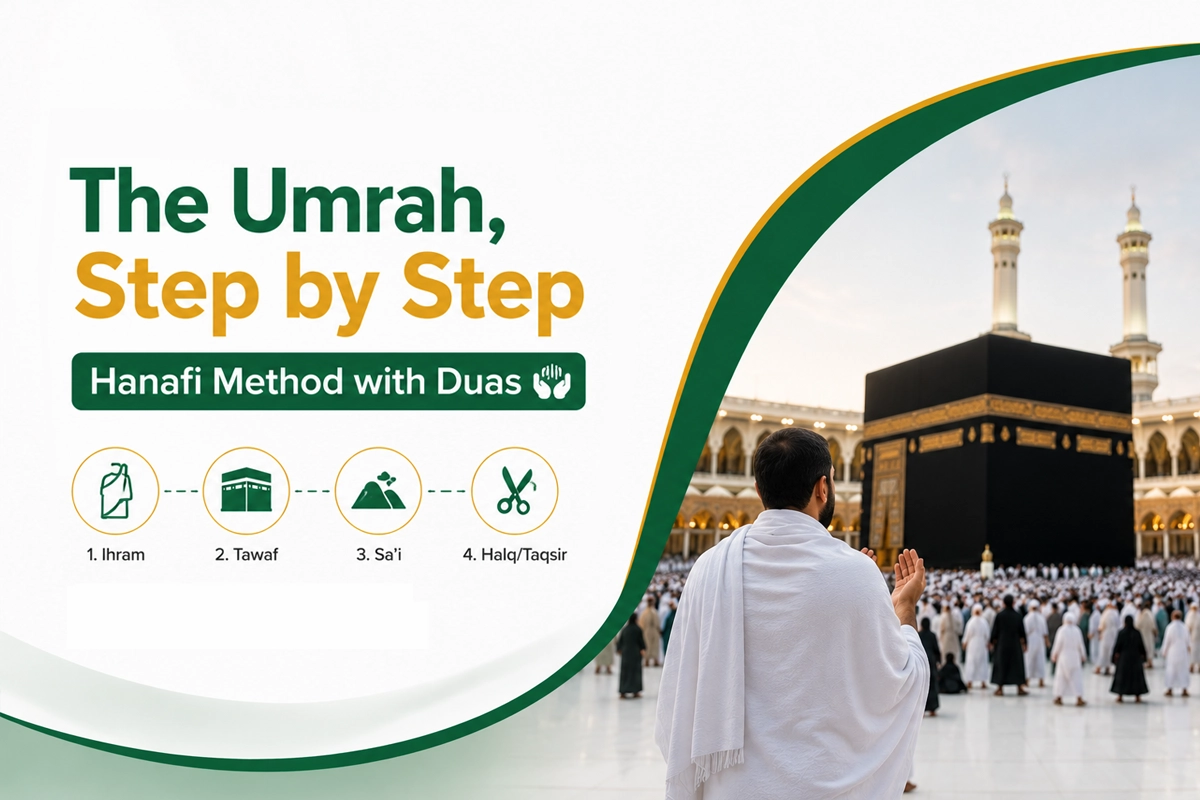
Ṣaḥīḥ al-Bukhārī & MuslimAnd if the road bends toward Madīnah al-Munawwarah — as every heart hopes — the presenting of the salām at the Rawḍah is set out step by step in the companion guide, The Umrah, Step by Step.
Mistakes that cost pilgrims dearly
- Praying Maghrib at ʿArafāt or on the road. Tonight Maghrib belongs to Muzdalifah, joined with ʿIshāʾ in ʿIshāʾ's time; prayed earlier it must be repeated there.
- Slipping out of ʿArafāt before sunset. The bus that leaves at ʿAṣr to “beat the rush” takes a wājib with it — remaining until the sun has set is obligatory, and leaving early obliges a dam.
- Standing in Batn ʿUranah. The valley beside Masjid Namirah is outside ʿArafāt; a whole wuqūf spent there is no wuqūf. Check the yellow boundary boards.
- Missing the dawn at Muzdalifah without excuse. The wājib wuqūf lies between Fajr and sunrise. Women, the old and the ill leave after midnight by the Prophet's ﷺ own dispensation — the able-bodied do not.
- Stoning the three pillars before zawāl on the 11th or 12th. In the Ḥanafī school those pebbles simply do not count; the ramī must be repeated after zawāl, else a dam follows.
- Shaving before the sacrifice is confirmed. The order ramī → naḥr → ḥalq is wājib. With coupon schemes, the razor waits for the scheme's confirmed time — reversing it costs a dam.
- A few snipped strands at the barber. Qaṣr must shorten at least a quarter of the head by a full fingertip; token strands leave the pilgrim in iḥrām while he thinks himself free.
- Delaying ṭawāf al-ziyārah past sunset of the 12th. The ṭawāf stays farḍ forever — it never lapses — but the delay itself now carries a dam. The 10th to the 12th is its proper window; the spouse remains forbidden until it is done, however long that takes.
- Throwing shoes, bottles, or all seven pebbles in one fist. One fist equals one pebble. The pillar is a marker, not the devil in person; fury at it wounds only the Muslims beside you.
- Deputing the ramī out of mere dislike of crowds. Deputation is for those genuinely unable — the bedridden, the wheelchair-bound cut off from the basin. For the able it discharges nothing.
- The qārin's haircut after his ʿUmrah. Cutting releases nothing — the Ḥajj iḥrām runs unbroken to the 10th — it only wounds the iḥrām and obliges a dam. In Qirān, the scissors wait for the day of sacrifice.
- Counting a Ramaḍān ʿUmrah as the ʿUmrah of Tamattuʿ. Only an ʿUmrah performed within the Ḥajj months of the same journey creates Tamattuʿ and its sacrifice; otherwise the Ḥajj stands alone as Ifrād, with no shukr dam owed.
- The mufrid waiting in iḥrām for a sacrifice he does not owe. The shukr dam belongs to Tamattuʿ and Qirān alone; the mufrid's order is the pebbles, then straight to the razor.
- Forgetting the takbīr of tashrīq. Once, aloud, after every farḍ from Fajr of the 9th to ʿAṣr of the 13th — twenty-three prayers, wājib on pilgrim and non-pilgrim alike, and the most widely abandoned wājib of the season.
Sources & method
This guide renders the Ḥajj — in all three of its ways — exactly as the Ḥanafī manuals of the subcontinent teach it, in the same sequence a muʿallim walks his pilgrims through the five days:
- رفیق حج — Rafīq-e-Ḥajj of Muftī Muḥammad Rafīʿ ʿUthmānī رحمه الله, late President of Dārul ʿUlūm Karāchī (in English, Companion of Hajj) — the primary companion of this guide, followed above all in the three ways of Ḥajj, the ṭawāf al-qudūm, and the practical arrangement of the five days.
- معلم الحجاج — Muʿallim al-Ḥujjāj of Muftī Saʿīd Aḥmad, the standard Urdu manual of Ḥajj carried by generations of pilgrims, and the source of the compiled duʿās marked with its name.
- غنية الناسك — Ghunyat al-Nāsik fī Bughyat al-Manāsik, the classical Ḥanafī reference of the manāsik, for the rulings of farḍ, wājib and dam.
- عمدة المناسك and حيات — ʿUmdat al-Manāsik and Ḥayāt, as cited in the companion ʿUmrah booklet whose method this guide continues.
- Aḥkām-e-Ḥajj of Muftī Muḥammad Shafīʿ ʿUthmānī (in English, How to Perform Hajj) and the rulings of Muftī Muḥammad Taqī ʿUthmānī (Fatāwā ʿUthmānī, Dārul ʿUlūm Karāchī) — followed in the questions the classical texts could not foresee: the tent prayers of ʿArafah, the coupon sacrifice, deputation at the crowded jamarāt.
- Duʿās transmitted from the Prophet ﷺ are tagged with their ḥadīth collections — al-Bukhārī, Muslim, al-Tirmidhī — and given in their transmitted wording.
اَللّٰهُمَّ اجْعَلْهُ حَجًّا مَّبْرُوْرًا، وَسَعْيًا مَّشْكُوْرًا، وَذَنْبًا مَّغْفُوْرًا
O Allah, make it a Ḥajj accepted, an effort appreciated, and sin forgiven.
When the practical side calls, we can help you find a stay near the Ḥaram, pre-book a private car for your transfers, or answer any question — see our Umrah & Ḥajj hub.
Step by step
- 1
Choose your way and tie iḥrām
At the mīqāt, fix Tamattuʿ, Qirān or Ifrād by intention. The mutamattiʿ, released from his ʿUmrah, ties a fresh iḥrām for Ḥajj from his Makkah lodging on the 8th; the qārin and mufrid already carry theirs.
- 2
8th — Minā, the day of Tarwiyah
Move to Minā after sunrise with the talbiyah, pray the five prayers there, and spend the night. The takbīr of tashrīq begins after Fajr of the 9th.
- 3
9th — the wuqūf at ʿArafah
After sunrise move to ʿArafāt; pray Ẓuhr and ʿAṣr each at its time in the tent; stand from zawāl to sunset in du'a — the standing IS the Ḥajj. Do not leave before the sun sets, and do not pray Maghrib there.
- 4
Night — Muzdalifah
Pray Maghrib and ʿIshāʾ together in ʿIshāʾ's time, gather the pebbles, sleep, then make the dawn wuqūf between Fajr and sunrise before moving to Minā.
- 5
10th — four acts in strict order
Stone Jamrat al-ʿAqabah (the talbiyah stops), offer the sacrifice (Tamattuʿ & Qirān), shave or trim (the first release), then perform ṭawāf al-ziyārah and the saʿī if not already done (the second release).
- 6
11th–13th — the days of Minā
Each afternoon after zawāl stone all three pillars — small, middle, then al-ʿAqabah — seven pebbles each, with a long standing of du'a after the first and second. Leave before sunset of the 12th, or stay for the 13th.
- 7
Farewell — ṭawāf al-wadāʿ
Before leaving Makkah, make the farewell ṭawāf — seven ordinary rounds — as the last act in the city. Women in menstruation are excused and owe nothing.
Frequently asked questions
Planning a Saudi trip?
Pre-book a private car, find a stay, or ask us anything on WhatsApp.
Last updated: 21 July 2026·Sources reviewed by the Wadana Go editorial team.