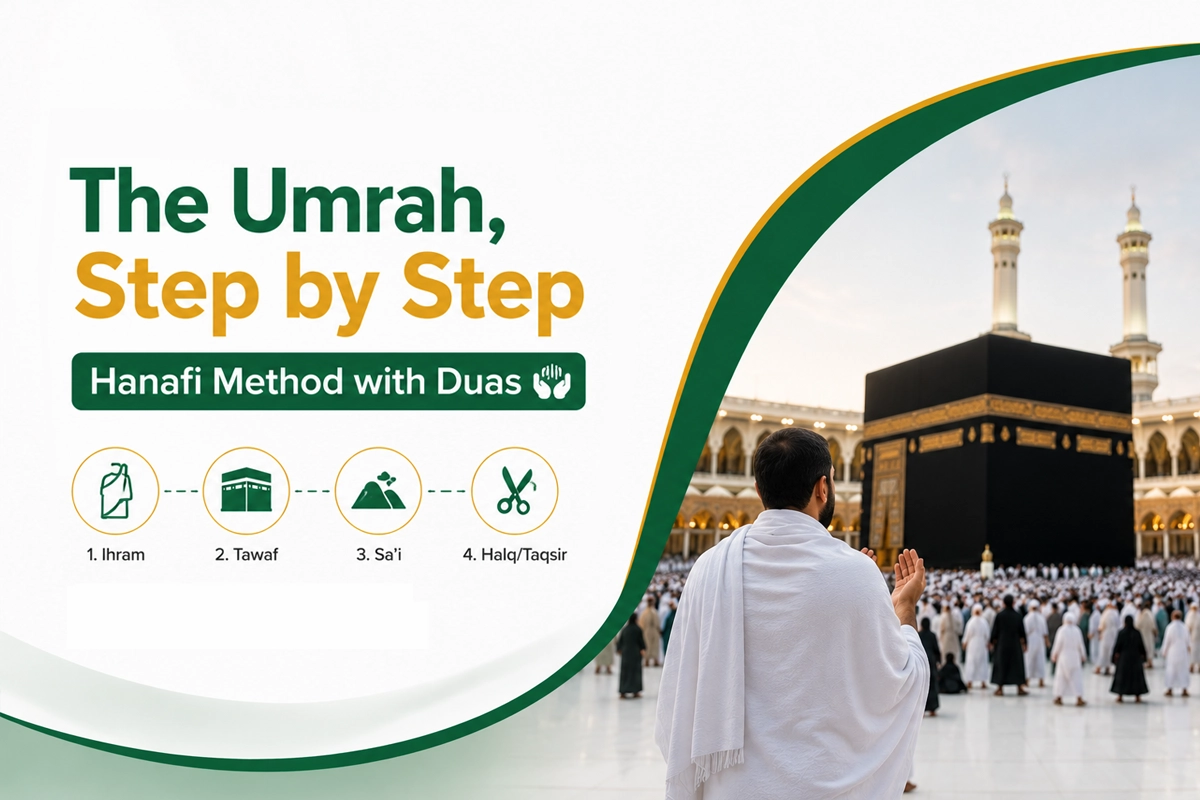
The Umrah, Step by Step — The Authenticated Ḥanafī Method with Every Duʿā
Quick reference · Ḥanafī method
ʿUmrah at a glance
New to ʿUmrah? Read the full step-by-step method below. Just need a refresher? It's all here.
🔔 Practical must-dos before you travel — verify on Nusuk
- Umrah visa or eVisa (via Nusuk) · passport valid 6+ months.
- The meningitis ACWY vaccine is mandatory; take it in good time.
- Install Nusuk for permits and the timed Rawḍah slot in Madīnah.
- Stay near the Ḥaram and pre-book your transport.
The rites, in order
- Iḥrām at the mīqāt — ghusl, sheets, two rakʿah, intention + Talbiyah ×3.
- Ṭawāf ×7 — istilām, Kaʿbah on your left; men do raml in the first three rounds.
- Two rakʿah at Maqām Ibrāhīm, then drink Zamzam.
- Saʿī ×7 — start Ṣafā, end Marwah.
- Ḥalq / Qaṣr — shave or trim (at least a quarter of the head). Complete.
Key duʿās
- Talbiyah (iḥrām → ṭawāf): “Labbayk Allāhumma labbayk…”
- First sight: Allāhu akbar ×3 · Lā ilāha illallāh ×3.
- Yamānī corner → Stone: “Rabbanā ātinā fid-dunyā ḥasanah…”
- Beginning saʿī: “Abda'u bimā bada'a Allāhu bih.”
Ḥanafī cautions
- In iḥrām, don't touch the perfumed stones — greet by gesture (dam risk).
- Circle around the Ḥaṭīm, never through it.
- Raml is the first three rounds only; women never do it.
- A few snipped strands is not enough — cut a full quarter of the head.
Avoid these
- Pushing through the crowd to kiss the Black Stone.
- Turning your chest or back to the Kaʿbah for photos mid-round.
- Praying the two rakʿah of ṭawāf at sunrise, zenith or sunset.
- Women jogging between the green lights — the jog is for men only.
Short answer
ʿUmrah is four acts within one sacred state: you enter iḥrām at the mīqāt with the intention and the Talbiyah; make ṭawāf (seven rounds of the Kaʿbah); pray two rakʿah at Maqām Ibrāhīm and drink Zamzam; perform saʿī (seven lengths between Ṣafā and Marwah); then men shave or trim and women trim a fingertip's length, and the iḥrām is released. This guide gives the authenticated Ḥanafī method step by step, with every duʿā in Arabic, transliteration and translation.
Key takeaways
- ✓ʿUmrah is four rites in one sacred state: iḥrām, ṭawāf (7), two rakʿah + Zamzam, saʿī (7), then ḥalq/qaṣr.
- ✓Enter iḥrām BEFORE the mīqāt — on a Jeddah flight, make the intention and Talbiyah early, before the announcement.
- ✓In iḥrām, do not touch the perfumed stones (Black Stone, Rukn Yamānī, Multazam) — greet by gesture, or risk a dam.
- ✓The Ḥaṭīm is part of the Kaʿbah — always circle around it; a round through it does not count.
- ✓Men do raml (brisk steps) only in the first three rounds, and jog between the green lights in saʿī; women do neither.
- ✓For a Ḥanafī, a few snipped strands at Marwah do NOT release iḥrām — at least a quarter of the head must be cut; shaving is best for men.
- ✓The seven round-duʿās are a scholars' compilation, not a fixed sunnah — recite them with the heart present, in any language.
- ✓Madīnah is not a rite of ʿUmrah but is deeply loved — present the salām to the Prophet ﷺ, Abū Bakr and ʿUmar; book the Rawḍah on Nusuk.
Quick facts
- School
- Ḥanafī
- Core rites
- Iḥrām, ṭawāf, saʿī, ḥalq
- Ṭawāf
- 7 rounds
- Saʿī
- 7 lengths
- Iḥrām from
- The mīqāt
- Rites take
- ~2–4 hours
- Duʿās included
- Every step
- Also covers
- Madīnah salām
The whole of ʿUmrah is four acts wrapped inside one sacred state. You enter iḥrām with an intention and the talbiyah; you circle the House of Allah seven times (ṭawāf); you pray two rakʿah and drink Zamzam; you walk the seven lengths of saʿī between Ṣafā and Marwah; then the head is shaved or the hair trimmed (ḥalq / qaṣr) and the iḥrām is released. Nothing below adds to those acts — it simply walks you through them exactly as the Ḥanafī manuals record, with the duʿā for each moment placed where you will need it. Read as you go, do as you read.
On this page
Part I — Before iḥrām: the preparation
1. Groom yourself
Before entering iḥrām, tidy the hair of the head, trim the moustache, remove the hair of the underarms and below the navel, and clip the nails. Once the iḥrām begins, none of this will be permitted until the ʿUmrah is complete. Ghunyat al-Nāsik
2. Ghusl with the intention of iḥrām
Perform a full bath (ghusl) with the intention of iḥrām — this is the sunnah even for a woman in her period. If a bath is not possible, wuḍū suffices. Use unscented soap; perfume on the body before the intention is permitted for men, but nothing scented may touch the iḥrām sheets themselves. Ghunyat al-Nāsik
3. Put on the two sheets
Men now remove all stitched clothing and wear two plain white sheets — one tied around the waist (izār), the other draped over the upper body (ridāʾ). Take off shoes and socks and wear open sandals that leave the raised middle bone of each foot uncovered. Ghunyat al-Nāsik
4. Pray two rakʿah nafl of iḥrām
Cover the head and pray two rakʿah nafl with the intention of iḥrām. It is preferred to recite Sūrah al-Kāfirūn in the first rakʿah and Sūrah al-Ikhlāṣ in the second. Ḥayāt
5. Flying to Jeddah? Do this on the plane
When travelling by air it is more prudent to prepare fully before the flight: complete everything above — the ghusl, the sheets, the nafl — at home or at the airport, and leave only the intention and the talbiyah. Then, once the aircraft is airborne and well before the mīqāt is announced, make the intention and recite the talbiyah. From that moment you are in iḥrām.
Part II — Niyyah & Talbiyah: the iḥrām begins
6. Make the intention of ʿUmrah
Men now uncover the head. Turn the heart to Allah and make the intention. The intention is valid in any language; the manuals record it in these words: Ghunyat al-Nāsik
Niyyah of ʿUmrah
اَللّٰهُمَّ إِنِّيْ أُرِيْدُ الْعُمْرَةَ فَيَسِّرْهَا لِيْ وَتَقَبَّلْهَا مِنِّيْ
Allāhumma innī urīdul-ʿumrata fa-yassirhā lī wa taqabbalhā minnī.
O Allah, I intend the ʿUmrah — so make it easy for me, and accept it from me.
7. Recite the Talbiyah three times
The moment the intention is made, say the talbiyah three times. Men raise the voice; women say it softly. With the intention and the first talbiyah together, the iḥrām — and all its restrictions — takes effect. Ghunyat al-Nāsik
The Talbiyah
لَبَّيْكَ اللّٰهُمَّ لَبَّيْكَ، لَبَّيْكَ لَا شَرِيْكَ لَكَ لَبَّيْكَ، إِنَّ الْحَمْدَ وَالنِّعْمَةَ لَكَ وَالْمُلْكَ، لَا شَرِيْكَ لَكَ
Labbayk Allāhumma labbayk. Labbayka lā sharīka laka labbayk. Innal-ḥamda wan-niʿmata laka wal-mulk. Lā sharīka lak.
Here I am, O Allah, here I am. Here I am — You have no partner — here I am. Truly all praise, all favour and all sovereignty are Yours. You have no partner.
8. Send ṣalawāt, then ask
After the talbiyah, recite durūd sharīf upon the Messenger of Allah ﷺ and then ask Allah for His pleasure and for Paradise, and seek His refuge from His displeasure and the Fire. The booklet
Duʿā after the Talbiyah
اَللّٰهُمَّ إِنِّيْ أَسْأَلُكَ رِضَاكَ وَالْجَنَّةَ، وَأَعُوْذُ بِكَ مِنْ سَخَطِكَ وَالنَّارِ
Allāhumma innī as'aluka riḍāka wal-jannah, wa aʿūdhu bika min sakhaṭika wan-nār.
O Allah, I ask You for Your pleasure and for Paradise, and I seek refuge in You from Your displeasure and from the Fire.
9. The restrictions of iḥrām now apply
From the moment of the intention and talbiyah until the hair is cut at the end of ʿUmrah, the following apply. Learn them now; nearly every penalty pilgrims incur comes from forgetting one of these. Ghunyat al-Nāsik
- Cutting or plucking any hair; clipping nails
- Perfume in any form — on body, clothing or food; scented soaps and wipes included
- Marital intimacy, its preliminaries, and contracting marriage
- Hunting land animals, or even pointing one out to a hunter
- Sin, quarrelling and harsh words (fusūq wa jidāl) — guard the tongue above all
- No stitched garment worn as clothing — no shirt, trousers or underwear
- Nothing may cover the head or the face
- Footwear must leave the raised middle bone of the foot bare
- Nothing may rest upon the face — no niqāb touching the skin, no gloves; ordinary modest dress with head covered remains obligatory
Part III — Makkah al-Mukarramah & the first sight
10. Keep the talbiyah alive on the road
When the blessed journey toward the Ḥaram begins, recite the talbiyah again and again along the way, and enter Makkah al-Mukarramah reciting it with longing and love. Ḥayāt · Ghunyah
11. Enter al-Masjid al-Ḥarām
Enter with complete reverence, right foot first, saying: Ghunyat al-Nāsik
On entering the Sacred Mosque
بِسْمِ اللهِ وَالصَّلَاةُ وَالسَّلَامُ عَلٰى رَسُوْلِ اللهِ، رَبِّ اغْفِرْ لِيْ ذُنُوْبِيْ وَافْتَحْ لِيْ أَبْوَابَ رَحْمَتِكَ
Bismillāhi waṣ-ṣalātu was-salāmu ʿalā rasūlillāh. Rabbi-ghfir lī dhunūbī waftaḥ lī abwāba raḥmatik.
In the name of Allah; blessings and peace upon the Messenger of Allah. My Lord, forgive me my sins and open for me the doors of Your mercy.
Also make the intention of nafl iʿtikāf for your time inside the mosque — worship upon worship at no extra cost — and move forward without inconveniencing anyone.
12. The first sight of the Kaʿbah
The moment your eyes fall on the House of Allah, step out of the walkway and stand to one side. This is a special hour of acceptance — the manuals record that duʿā at the first sight of the Kaʿbah is answered. Say each of these three times, then raise both hands, send durūd upon the Prophet ﷺ, and ask Allah to your heart's fill — for yourself, your family, and every Muslim. Ghunyat al-Nāsik
At the first sight — say each three times
اَللهُ أَكْبَرُ ۞ لَا إِلٰهَ إِلَّا اللهُ
Allāhu akbar (three times) · Lā ilāha illallāh (three times)
Part IV — Ṭawāf of ʿUmrah: seven rounds of the House
13. Prepare: wuḍū and iḍṭibāʿ
Wuḍū is a condition of ṭawāf — confirm it now. Then men perform iḍṭibāʿ: pass the upper sheet under the right armpit and drape both ends over the left shoulder, leaving the right shoulder bare. It stays this way for the whole ṭawāf. The talbiyah stops when the ṭawāf begins. Ghunyat al-Nāsik
14. Stand at the line and make the niyyah
Come to the side of the Kaʿbah where al-Ḥajar al-Aswad (the Black Stone) is set and stand so that the whole Stone is to your right — the brown-black strip on the marble marks the alignment. Then, without raising the hands, make the intention: Ḥayāt
Niyyah of ṭawāf
اَللّٰهُمَّ إِنِّيْ أُرِيْدُ طَوَافَ بَيْتِكَ الْحَرَامِ فَيَسِّرْهُ لِيْ وَتَقَبَّلْهُ مِنِّيْ
Allāhumma innī urīdu ṭawāfa baytikal-ḥarāmi fa-yassirhu lī wa taqabbalhu minnī.
O Allah, I intend the ṭawāf of Your Sacred House — so make it easy for me, and accept it from me.
15. Face the Stone, raise the hands
Now slide a little to your right so that you stand squarely facing the Ḥajar al-Aswad. Raise both hands to the ears with the palms facing the Stone, say the words below, then lower the hands. Ḥayāt
Facing the Black Stone
بِسْمِ اللهِ، اَللهُ أَكْبَرُ، وَلِلّٰهِ الْحَمْدُ، وَالصَّلَاةُ وَالسَّلَامُ عَلٰى رَسُوْلِ اللهِ
Bismillāhi, Allāhu akbar, wa lillāhil-ḥamd, waṣ-ṣalātu was-salāmu ʿalā rasūlillāh.
In the name of Allah; Allah is the Greatest; all praise belongs to Allah; blessings and peace upon the Messenger of Allah.
16. Istilām — greet the Stone
Perform istilām: if you can reach the Stone without harming anyone, place both palms on it and kiss it. In today's crowds, the sunnah is fully carried by the gesture: raise the palms toward the Stone as before, say the same words, and kiss both palms. Ghunyat al-Nāsik
17. Begin — the House on your left
Turn to your right and begin the ṭawāf, moving anticlockwise with the Kaʿbah on your left. Two rules govern every step: Taʾkīd
- Apart from the moments of istilām, it is not permissible during ṭawāf to turn your chest or your back toward the Kaʿbah. Take special care when the crowd swirls, and when tempted to photograph.
- The Ḥaṭīm — the low semicircular wall — is part of the House itself. Every round must pass around it, never through it, or that round does not count.
18. Raml — the first three rounds
In the first three rounds only, men walk with raml: chest out, shoulders moving with a soldier's bearing, steps short and quick. In the remaining four rounds walk normally. Women never perform raml. Ḥayāt
19. What to recite while circling
Ṭawāf is itself an act of worship, and filling it with dhikr and duʿā multiplies the reward. Reciting the third kalimah in ṭawāf is established from ḥadīth: The booklet
Dhikr of ṭawāf — the third kalimah
سُبْحَانَ اللهِ وَالْحَمْدُ لِلّٰهِ وَلَا إِلٰهَ إِلَّا اللهُ وَاللهُ أَكْبَرُ
Subḥānallāhi wal-ḥamdu lillāhi wa lā ilāha illallāhu wallāhu akbar.
Glory be to Allah; all praise is for Allah; there is no god but Allah; Allah is the Greatest.
Beyond this, ask for whatever you wish in any language — the real duʿā, the manuals insist, is the one made with presence of heart. The famous seven round-duʿās are given at the end of this guide, with an honest note on their status.
20. The Rukn Yamānī
When you reach the Rukn Yamānī — the corner before the Black Stone — touch it with both hands or with the right hand if it is easy, and move on making duʿā until you arrive before the Ḥajar al-Aswad. The Rukn Yamānī is not kissed, and if it cannot be reached, simply pass by — there is no gesture toward it from afar. Ḥayāt
21. Between the Yamānī corner and the Stone
Along this final stretch of every round, recite the transmitted duʿā: Thābit min al-ḥadīth
Between Rukn Yamānī and al-Ḥajar al-Aswad
رَبَّنَا آتِنَا فِي الدُّنْيَا حَسَنَةً وَّفِي الْآخِرَةِ حَسَنَةً وَّقِنَا عَذَابَ النَّارِ، وَأَدْخِلْنَا الْجَنَّةَ مَعَ الْأَبْرَارِ، يَا عَزِيْزُ يَا غَفَّارُ يَا رَبَّ الْعٰلَمِيْنَ
Rabbanā ātinā fid-dunyā ḥasanah, wa fil-ākhirati ḥasanah, wa qinā ʿadhāban-nār; wa adkhilnal-jannata maʿal-abrār, yā ʿAzīzu yā Ghaffāru yā Rabbal-ʿālamīn.
Our Lord, grant us good in this world and good in the Hereafter, and shield us from the punishment of the Fire; and admit us into Paradise with the righteous — O Mighty One, O Ever-Forgiving, O Lord of the worlds.
22. Seven rounds, then the eighth istilām
Each time you arrive back at the Black Stone, one round is complete: greet the Stone with istilām or its gesture and begin the next. When the seventh round ends, perform the istilām or gesture an eighth time — with it, the ṭawāf is complete. Ḥayāt
Part V — After the ṭawāf: prayer, Multazam, Zamzam
23. Cover both shoulders again
The iḍṭibāʿ was only for the ṭawāf. Now bring the sheet back over both shoulders — the two rakʿah that follow must be prayed with both shoulders covered. Ghunyat al-Nāsik
24. Two rakʿah at Maqām Ibrāhīm
Behind Maqām Ibrāhīm — or anywhere in the mosque if it is crowded — pray the two rakʿah wājib of ṭawāf, head uncovered as you remain in iḥrām. It is sunnah to recite Sūrah al-Kāfirūn in the first rakʿah and Sūrah al-Ikhlāṣ in the second. Then ask Allah earnestly. Ḥayāt
25. Al-Multazam — the door of weeping
Come to al-Multazam, the stretch of wall between the Black Stone and the door of the Kaʿbah. The way of the pious is to cling to it and beg Allah with tears and utter humility — this is a place where duʿā is poured out. Ḥayāt
26. Drink Zamzam to your fill
Now drink Zamzam — the adab is to face the Kaʿbah, say بِسْمِ الله, drink in three breaths to your fill, and praise Allah. Zamzam is for whatever it is drunk for — so drink it with this duʿā: Muʿallim al-Ḥujjāj
On drinking Zamzam
اَللّٰهُمَّ إِنِّيْ أَسْأَلُكَ عِلْمًا نَافِعًا وَرِزْقًا وَاسِعًا وَشِفَاءً مِنْ كُلِّ دَاءٍ
Allāhumma innī as'aluka ʿilman nāfiʿan, wa rizqan wāsiʿan, wa shifā'an min kulli dā'.
O Allah, I ask You for knowledge that benefits, provision that is vast, and cure from every disease.
Part VI — Saʿī: seven lengths between Ṣafā and Marwah
27. The ninth istilām, then out to Ṣafā
To begin the saʿī, return toward the Black Stone and perform the istilām or its gesture a ninth time, then set out for Mount Ṣafā. Being in wuḍū for the saʿī is sunnah. Ḥayāt
28. On Ṣafā: face the House and intend
Climb Ṣafā until the Kaʿbah is before you, face it, praise Allah and send durūd, then make the intention and raise the hands and ask long — this standing-place of duʿā is beloved. Ḥayāt
Niyyah of saʿī, on Ṣafā
اَللّٰهُمَّ إِنِّيْ أُرِيْدُ السَّعْيَ بَيْنَ الصَّفَا وَالْمَرْوَةِ فَيَسِّرْهُ لِيْ وَتَقَبَّلْهُ مِنِّيْ
Allāhumma innī urīdus-saʿya baynaṣ-Ṣafā wal-Marwati fa-yassirhu lī wa taqabbalhu minnī.
O Allah, I intend the saʿī between Ṣafā and Marwah — so make it easy for me, and accept it from me.
29. Walk to Marwah — jog between the green lights
Descend from Ṣafā and walk toward Marwah. When you reach the stretch marked by the green pillars of light, men run lightly; women do not run, in any length. Along the way, and especially between the lights, recite: Muʿallim al-Ḥujjāj
Between the green lights
رَبِّ اغْفِرْ وَارْحَمْ، أَنْتَ الْأَعَزُّ الْأَكْرَمُ
Rabbi-ghfir warḥam, antal-aʿazzul-akram.
My Lord, forgive and have mercy — You are the Most Mighty, the Most Generous.
30. Count the lengths — seven, ending at Marwah
Reaching Marwah, turn toward the qiblah and make duʿā — that is one length. The second ends back on Ṣafā, the third on Marwah, and so on: the seventh length finishes on Marwah. In every length the men jog between the green lights and the women walk. ʿUmdat al-Manāsik
31. Two rakʿah of gratitude
After the saʿī — provided it is not a makrūh time — pray two nafl of shukrānah (gratitude) inside the Ḥaram. Ḥayāt · Ghunyah
Part VII — Ḥalq or qaṣr, and the iḥrām is released
32. Shave, or trim properly
Men now have the whole head shaved — the greater reward — or the hair of the whole head trimmed. Women gather all their hair and cut slightly more than one finger-joint's length from the ends of all of it; a woman never shaves. Make certain, at the very least, that the hair of a full quarter of the head has been cut. Ghunyat al-Nāsik
33. Your ʿUmrah is complete
With the ḥalq or qaṣr, the ʿUmrah is complete and every restriction of iḥrām is lifted. Change into your clothes and live as normal. Then thank Allah with heart and soul that He granted you the felicity of ʿUmrah — value the remaining moments of this journey and of this life, and spend them seeking the pleasure of your Lord.
The seven round-duʿās of ṭawāf
First round
سُبْحَانَ اللهِ وَالْحَمْدُ لِلّٰهِ وَلَا إِلٰهَ إِلَّا اللهُ وَاللهُ أَكْبَرُ، وَلَا حَوْلَ وَلَا قُوَّةَ إِلَّا بِاللهِ الْعَلِيِّ الْعَظِيْمِ، وَالصَّلَاةُ وَالسَّلَامُ عَلٰى رَسُوْلِ اللهِ صَلَّى اللهُ عَلَيْهِ وَسَلَّمَ، اَللّٰهُمَّ إِيْمَانًا بِكَ وَتَصْدِيْقًا بِكَلِمَاتِكَ وَوَفَاءً بِعَهْدِكَ وَاتِّبَاعًا لِسُنَّةِ نَبِيِّكَ وَحَبِيْبِكَ مُحَمَّدٍ صَلَّى اللهُ عَلَيْهِ وَسَلَّمَ، اَللّٰهُمَّ إِنِّيْ أَسْأَلُكَ الْعَفْوَ وَالْعَافِيَةَ وَالْمُعَافَاةَ الدَّائِمَةَ فِي الدِّيْنِ وَالدُّنْيَا وَالْآخِرَةِ، وَالْفَوْزَ بِالْجَنَّةِ وَالنَّجَاةَ مِنَ النَّارِ
Glory be to Allah; all praise is for Allah; there is no god but Allah; Allah is the Greatest. There is no power to turn from sin and no strength to do good except with Allah, the Most High, the Most Great. Blessings and peace be upon the Messenger of Allah ﷺ. O Allah — believing in You, affirming Your words as true, fulfilling Your covenant, and following the sunnah of Your Prophet and beloved Muḥammad ﷺ, I perform this ṭawāf. O Allah, I ask You for pardon, for wellbeing, and for lasting protection in religion, in this world and in the Hereafter — and for the triumph of Paradise and safety from the Fire.
Second round
اَللّٰهُمَّ إِنَّ هٰذَا الْبَيْتَ بَيْتُكَ، وَالْحَرَمَ حَرَمُكَ، وَالْأَمْنَ أَمْنُكَ، وَالْعَبْدَ عَبْدُكَ، وَأَنَا عَبْدُكَ وَابْنُ عَبْدِكَ، وَهٰذَا مَقَامُ الْعَائِذِ بِكَ مِنَ النَّارِ، فَحَرِّمْ لُحُوْمَنَا وَبَشَرَتَنَا عَلَى النَّارِ، اَللّٰهُمَّ حَبِّبْ إِلَيْنَا الْإِيْمَانَ وَزَيِّنْهُ فِيْ قُلُوْبِنَا، وَكَرِّهْ إِلَيْنَا الْكُفْرَ وَالْفُسُوْقَ وَالْعِصْيَانَ، وَاجْعَلْنَا مِنَ الرَّاشِدِيْنَ، اَللّٰهُمَّ قِنِيْ عَذَابَكَ يَوْمَ تَبْعَثُ عِبَادَكَ، اَللّٰهُمَّ ارْزُقْنِيَ الْجَنَّةَ بِغَيْرِ حِسَابٍ
O Allah, this House is Your House, this Sanctuary is Your Sanctuary, its security is Your security, and every slave here is Your slave — and I am Your slave, son of Your slave, and this is the station of one who takes refuge in You from the Fire: so make our flesh and our skin forbidden to the Fire. O Allah, make faith beloved to us and adorn it in our hearts; make disbelief, wickedness and disobedience hateful to us, and place us among the rightly guided. O Allah, protect me from Your punishment on the Day You raise Your slaves. O Allah, grant me Paradise without reckoning.
Third round
اَللّٰهُمَّ إِنِّيْ أَعُوْذُ بِكَ مِنَ الشَّكِّ وَالشِّرْكِ وَالشِّقَاقِ وَالنِّفَاقِ وَسُوْءِ الْأَخْلَاقِ وَسُوْءِ الْمَنْظَرِ وَالْمُنْقَلَبِ فِي الْمَالِ وَالْأَهْلِ وَالْوَلَدِ، اَللّٰهُمَّ إِنِّيْ أَسْأَلُكَ رِضَاكَ وَالْجَنَّةَ، وَأَعُوْذُ بِكَ مِنْ سَخَطِكَ وَالنَّارِ
O Allah, I seek refuge in You from doubt, from associating partners with You, from discord and hypocrisy, from evil character, and from an evil turn of fortune in wealth, family and children. O Allah, I ask You for Your pleasure and for Paradise, and I seek refuge in You from Your displeasure and from the Fire.
Fourth round
اَللّٰهُمَّ اجْعَلْهُ حَجًّا مَّبْرُوْرًا، وَسَعْيًا مَّشْكُوْرًا، وَذَنْبًا مَّغْفُوْرًا، وَعَمَلًا صَالِحًا مَّقْبُوْلًا، وَتِجَارَةً لَّنْ تَبُوْرَ، يَا عَالِمَ مَا فِي الصُّدُوْرِ، أَخْرِجْنِيْ يَا اَللهُ مِنَ الظُّلُمَاتِ إِلَى النُّوْرِ، اَللّٰهُمَّ إِنِّيْ أَسْأَلُكَ مُوْجِبَاتِ رَحْمَتِكَ، وَعَزَائِمَ مَغْفِرَتِكَ، وَالسَّلَامَةَ مِنْ كُلِّ إِثْمٍ، وَالْغَنِيْمَةَ مِنْ كُلِّ بِرٍّ، وَالْفَوْزَ بِالْجَنَّةِ، وَالنَّجَاةَ مِنَ النَّارِ، رَبِّ قَنِّعْنِيْ بِمَا رَزَقْتَنِيْ، وَبَارِكْ لِيْ فِيْمَا أَعْطَيْتَنِيْ، وَاخْلُفْ عَلٰى كُلِّ غَائِبَةٍ لِّيْ مِنْكَ بِخَيْرٍ
O Allah, make this a pilgrimage accepted, an effort appreciated, a sin forgiven, a righteous deed received, and a trade that never perishes. O Knower of all that is within hearts — bring me out, O Allah, from the darknesses into the light. O Allah, I ask You for all that draws Your mercy, all that makes Your forgiveness certain, safety from every sin, a share of every good, the triumph of Paradise and safety from the Fire. My Lord, make me content with what You have provided me; bless me in all You have granted me; and guard with good from You everything of mine that is beyond my sight.
Fifth round
اَللّٰهُمَّ أَظِلَّنِيْ تَحْتَ ظِلِّ عَرْشِكَ يَوْمَ لَا ظِلَّ إِلَّا ظِلُّ عَرْشِكَ، وَلَا بَاقِيَ إِلَّا وَجْهُكَ، وَاسْقِنِيْ مِنْ حَوْضِ نَبِيِّكَ سَيِّدِنَا مُحَمَّدٍ صَلَّى اللهُ عَلَيْهِ وَسَلَّمَ شَرْبَةً هَنِيْئَةً مَّرِيْئَةً لَّا نَظْمَأُ بَعْدَهَا أَبَدًا، اَللّٰهُمَّ إِنِّيْ أَسْأَلُكَ مِنْ خَيْرِ مَا سَأَلَكَ مِنْهُ نَبِيُّكَ سَيِّدُنَا مُحَمَّدٌ صَلَّى اللهُ عَلَيْهِ وَسَلَّمَ، وَأَعُوْذُ بِكَ مِنْ شَرِّ مَا اسْتَعَاذَكَ مِنْهُ نَبِيُّكَ سَيِّدُنَا مُحَمَّدٌ صَلَّى اللهُ عَلَيْهِ وَسَلَّمَ، اَللّٰهُمَّ إِنِّيْ أَسْأَلُكَ الْجَنَّةَ وَنَعِيْمَهَا وَمَا يُقَرِّبُنِيْ إِلَيْهَا مِنْ قَوْلٍ أَوْ فِعْلٍ أَوْ عَمَلٍ، وَأَعُوْذُ بِكَ مِنَ النَّارِ وَمَا يُقَرِّبُنِيْ إِلَيْهَا مِنْ قَوْلٍ أَوْ فِعْلٍ أَوْ عَمَلٍ
O Allah, shade me beneath the shade of Your Throne on the Day when there is no shade but the shade of Your Throne, and nothing remains but Your Countenance; and give me to drink from the Fountain of Your Prophet, our master Muḥammad ﷺ, a drink pleasant and satisfying, after which we shall never thirst again. O Allah, I ask You for the best of all that Your Prophet ﷺ asked of You, and I take refuge in You from the worst of all from which he sought Your refuge. O Allah, I ask You for Paradise and its bliss, and for every word, act or deed that brings me near to it; and I take refuge in You from the Fire, and from every word, act or deed that brings me near to it.
Sixth round
اَللّٰهُمَّ إِنَّ لَكَ عَلَيَّ حُقُوْقًا كَثِيْرَةً فِيْمَا بَيْنِيْ وَبَيْنَكَ، وَحُقُوْقًا كَثِيْرَةً فِيْمَا بَيْنِيْ وَبَيْنَ خَلْقِكَ، اَللّٰهُمَّ مَا كَانَ لَكَ مِنْهَا فَاغْفِرْهُ لِيْ، وَمَا كَانَ لِخَلْقِكَ فَتَحَمَّلْهُ عَنِّيْ، وَأَغْنِنِيْ بِحَلَالِكَ عَنْ حَرَامِكَ، وَبِطَاعَتِكَ عَنْ مَعْصِيَتِكَ، وَبِفَضْلِكَ عَنْ مَّنْ سِوَاكَ، يَا وَاسِعَ الْمَغْفِرَةِ، اَللّٰهُمَّ إِنَّ بَيْتَكَ عَظِيْمٌ، وَوَجْهَكَ كَرِيْمٌ، وَأَنْتَ يَا اَللهُ حَلِيْمٌ كَرِيْمٌ عَظِيْمٌ، تُحِبُّ الْعَفْوَ فَاعْفُ عَنِّيْ
O Allah, You have many rights over me in what lies between me and You, and there are many rights upon me in what lies between me and Your creation. O Allah, whatever of them is owed to You — forgive it for me; and whatever is owed to Your creation — take charge of it on my behalf. Suffice me with Your ḥalāl against Your ḥarām, with obedience to You against disobedience, and with Your grace against all besides You, O Vast in forgiveness. O Allah, Your House is mighty, Your Countenance is noble, and You, O Allah, are Forbearing, Generous, Great — You love to pardon, so pardon me.
Seventh round
اَللّٰهُمَّ إِنِّيْ أَسْأَلُكَ إِيْمَانًا كَامِلًا، وَيَقِيْنًا صَادِقًا، وَرِزْقًا وَاسِعًا، وَقَلْبًا خَاشِعًا، وَلِسَانًا ذَاكِرًا، وَرِزْقًا حَلَالًا طَيِّبًا، وَتَوْبَةً نَّصُوْحًا، وَتَوْبَةً قَبْلَ الْمَوْتِ، وَرَاحَةً عِنْدَ الْمَوْتِ، وَمَغْفِرَةً وَرَحْمَةً بَعْدَ الْمَوْتِ، وَالْعَفْوَ عِنْدَ الْحِسَابِ، وَالْفَوْزَ بِالْجَنَّةِ، وَالنَّجَاةَ مِنَ النَّارِ، بِرَحْمَتِكَ يَا عَزِيْزُ يَا غَفَّارُ، رَبِّ زِدْنِيْ عِلْمًا وَأَلْحِقْنِيْ بِالصَّالِحِيْنَ
O Allah, I ask You for complete faith, true certainty, vast provision, a humble heart, a tongue engaged in Your remembrance, sustenance pure and ḥalāl, sincere repentance — repentance before death, ease at death, forgiveness and mercy after death, pardon at the reckoning, the triumph of Paradise and safety from the Fire — by Your mercy, O Mighty One, O Ever-Forgiving. My Lord, increase me in knowledge and join me with the righteous.
At the end of every round, close the duʿā when you reach the Rukn Yamānī, and recite رَبَّنَا آتِنَا فِي الدُّنْيَا حَسَنَةً… along the stretch to the Black Stone, as given in step 21.
Madīnah — presenting the salām, step by step
Visiting Madīnah is not a rite of ʿUmrah, but it is deeply beloved, and the manuals give it the same careful, step-by-step treatment.
M1. The intention for the journey
When you set out for Madīnah al-Munawwarah, make this intention: "O Allah, I travel to Madīnah to visit the blessed resting place of the Master of both worlds ﷺ; O Allah, accept it from me." On the road, keep the sunnahs of travel and recite durūd sharīf in great abundance — this is the journey of durūd. ʿUmdat al-Manāsik
M2. Prepare, then walk to the Mosque
At your lodging, set down your things and perform ghusl — or at least wuḍū. Wear your best clothes, apply perfume (you are no longer in iḥrām), and walk toward al-Masjid al-Nabawī reciting durūd with reverence and love.
M3. Enter — Bāb Jibrīl if you can
Enter through Bāb Jibrīl or Bāb al-Salām — otherwise any door — right foot first, with the intention of nafl iʿtikāf, saying: The booklet
On entering al-Masjid al-Nabawī
اَللّٰهُمَّ صَلِّ عَلٰى مُحَمَّدٍ وَّعَلٰى آلِ مُحَمَّدٍ وَّصَحْبِهِ وَسَلِّمْ، اَللّٰهُمَّ اغْفِرْ لِيْ ذُنُوْبِيْ وَافْتَحْ لِيْ أَبْوَابَ رَحْمَتِكَ
Allāhumma ṣalli ʿalā Muḥammadin wa ʿalā āli Muḥammadin wa ṣaḥbihī wa sallim. Allāhumma-ghfir lī dhunūbī waftaḥ lī abwāba raḥmatik.
O Allah, send blessings upon Muḥammad, upon the family of Muḥammad and his Companions, and peace. O Allah, forgive me my sins and open for me the doors of Your mercy.
M4. Two rakʿah of greeting
If it is not a makrūh time, pray two rakʿah taḥiyyat al-masjid — in Riyāḍ al-Jannah beside the Prophet's miḥrāb ﷺ if you can reach it, otherwise anywhere in the mosque. Then praise Allah, make duʿā, and renew your tawbah. Ḥayāt
M5. Stand before the Sacred Chamber
With the utmost humility, stillness and respect, come before the golden grills of the blessed resting place. Stand facing the first opening, about four paces back, with the gaze lowered — the manners here are the worship. Then, in a moderate voice, present the salām: Ḥayāt
The salām upon the Prophet ﷺ
اَلسَّلَامُ عَلَيْكَ أَيُّهَا النَّبِيُّ وَرَحْمَةُ اللهِ وَبَرَكَاتُهُ
As-salāmu ʿalayka ayyuhan-Nabiyyu wa raḥmatullāhi wa barakātuh.
Peace be upon you, O Prophet, and the mercy of Allah and His blessings.
Then say
اَلصَّلَاةُ وَالسَّلَامُ عَلَيْكَ يَا رَسُوْلَ اللهِ ۔ اَلصَّلَاةُ وَالسَّلَامُ عَلَيْكَ يَا نَبِيَّ اللهِ ۔ اَلصَّلَاةُ وَالسَّلَامُ عَلَيْكَ يَا حَبِيْبَ اللهِ
Aṣ-ṣalātu was-salāmu ʿalayka yā Rasūlallāh. Aṣ-ṣalātu was-salāmu ʿalayka yā Nabiyyallāh. Aṣ-ṣalātu was-salāmu ʿalayka yā Ḥabīballāh.
Blessings and peace be upon you, O Messenger of Allah. Blessings and peace be upon you, O Prophet of Allah. Blessings and peace be upon you, O Beloved of Allah.
M6. Ask for his intercession
Then request the Prophet's ﷺ intercession, saying three times أَسْأَلُكَ الشَّفَاعَةَ يَا رَسُوْلَ اللهِ — "I ask you for intercession, O Messenger of Allah" — and make duʿā to Allah through his blessed means (wasīlah), asking especially for a good end (ḥusn al-khātimah), for Allah's pleasure, and for forgiveness. Ghunyat al-Nāsik
M7. Convey the salāms entrusted to you
Whoever asked you to convey their salām — a parent, a relative, a friend — present it now, saying the person's name in place of fulān ibn fulān: The booklet
Conveying another's salām
اَلسَّلَامُ عَلَيْكَ يَا رَسُوْلَ اللهِ مِنْ فُلَانِ بْنِ فُلَانٍ
As-salāmu ʿalayka yā Rasūlallāh min fulān ibn fulān.
Peace be upon you, O Messenger of Allah, from [name, son/daughter of so-and-so].
M8. Salām to Abū Bakr al-Ṣiddīq (raḍiyallāhu ʿanhu)
Move a little to your right, before the second opening, and present the salām to Sayyidunā Abū Bakr al-Ṣiddīq: The booklet
اَلسَّلَامُ عَلَيْكَ يَا خَلِيْفَةَ رَسُوْلِ اللهِ، جَزَاكَ اللهُ عَنْ أُمَّةِ مُحَمَّدٍ خَيْرًا
As-salāmu ʿalayka yā khalīfata Rasūlillāh, jazākallāhu ʿan ummati Muḥammadin khayrā.
Peace be upon you, O Caliph of the Messenger of Allah — may Allah reward you with good on behalf of the Ummah of Muḥammad ﷺ.
M9. Salām to ʿUmar al-Fārūq (raḍiyallāhu ʿanhu)
Move a little further right, before the third opening, and present the salām to Sayyidunā ʿUmar al-Fārūq: The booklet
اَلسَّلَامُ عَلَيْكَ يَا أَمِيْرَ الْمُؤْمِنِيْنَ عُمَرَ الْفَارُوْقِ، جَزَاكَ اللهُ عَنْ أُمَّةِ مُحَمَّدٍ خَيْرًا
As-salāmu ʿalayka yā Amīral-Mu'minīna ʿUmaral-Fārūq, jazākallāhu ʿan ummati Muḥammadin khayrā.
Peace be upon you, O Commander of the Faithful, ʿUmar al-Fārūq — may Allah reward you with good on behalf of the Ummah of Muḥammad ﷺ.
M10. Then both together
Step back slightly to the left, so you stand between the two, and say: The booklet
اَلسَّلَامُ عَلَيْكُمَا يَا وَزِيْرَيْ رَسُوْلِ اللهِ، جَزَاكُمَا اللهُ أَحْسَنَ الْجَزَاءِ
As-salāmu ʿalaykumā yā wazīray Rasūlillāh, jazākumallāhu aḥsanal-jazā'.
Peace be upon you both, O two ministers of the Messenger of Allah — may Allah grant you both the finest of rewards.
Then return once more before the first opening, present durūd and salām to the Beloved ﷺ with love and longing, and ask Allah — for yourself, your family, your parents and all whom you carry in your heart.
M11. Weep and ask, facing the qiblah
Afterwards move to a spot in the mosque where, facing the qiblah, your back is not toward the Sacred Chamber ﷺ — and there pour your heart out to Allah in duʿā. This is the complete manner of presenting the salām.
M12. The forty prayers — a clarification
Men should try to pray with the congregation in al-Masjid al-Nabawī, and many strive for forty prayers there. Know its true status: the forty are not obligatory and not binding; it is merely commendable (mustaḥabb). Do not shorten your stay in Makkah, or burden the sick, for the sake of a number. The booklet
M13. Qubāʾ, al-Baqīʿ, and the farewell
- Masjid Qubāʾ: on a Saturday — otherwise whenever the chance comes — pray two rakʿah nafl there, outside the makrūh times.
- Jannat al-Baqīʿ: visit from time to time; send reward (īṣāl-e-thawāb) and duʿā of forgiveness for those who rest there, and through their means ask for yourself.
- The farewell: when leaving Madīnah, present the salām at the Sacred Chamber once more in the manner above, let the tears of parting fall, and return with the yearning of being brought back again.
Mistakes that cost pilgrims dearly
- Touching the perfumed stones in iḥrām. The Ḥajar al-Aswad, Rukn Yamānī and Multazam usually carry fresh perfume — greet from a step away while in iḥrām, or risk a dam.
- Chest or back toward the Kaʿbah mid-round — usually while taking photos. Outside the istilām it is not permissible; the affected portion of the round must be redone.
- Cutting through the Ḥaṭīm. It is part of the House — a round through it does not count.
- Raml in all seven rounds. It belongs to the first three only; women never do it.
- Gesturing to the Rukn Yamānī from afar. It is touched when easy; otherwise simply pass by.
- The few-strands haircut at Marwah. For a Ḥanafī it does not release the iḥrām — at least a quarter of the head must be trimmed, and shaving is best for men.
- Women jogging between the green lights. The jog is for men only, in ṭawāf's raml and in saʿī alike.
- Praying the two rakʿah of ṭawāf at sunrise, zenith or sunset. Wait out the makrūh window, then pray them.
- Pushing through the crowd to kiss the Stone. Harming a Muslim to reach a sunnah inverts the reward — the gesture carries the sunnah in full.
Sources & method
This guide follows the Ḥanafī school. Its sequence, wordings and warnings are drawn from the classical Ḥanafī manuals of pilgrimage rites, each instruction carrying a citation. The same tags appear throughout this page:
- غنية الناسك — Ghunyat al-Nāsik fī Bughyat al-Manāsik, the classical Ḥanafī reference of pilgrimage rites.
- معلم الحجاج — Muʿallim al-Ḥujjāj, the standard Urdu manual carried by generations of pilgrims.
- عمدة المناسك and حيات — ʿUmdat al-Manāsik and Ḥayāt, as cited in the booklet.
- Aḥkām-e-Ḥajj of Muftī Muḥammad Shafīʿ ʿUthmānī and the rulings of Muftī Muḥammad Taqī ʿUthmānī (Dārul ʿUlūm Karāchī) — with which this method accords.
اَللّٰهُمَّ تَقَبَّلْ مِنَّا إِنَّكَ أَنْتَ السَّمِيْعُ الْعَلِيْمُ
O Allah, accept from us — truly You are the All-Hearing, the All-Knowing.
When you are ready to plan the practical side of the journey, we can help you find a stay near the Ḥaram, pre-book a private car for your airport transfer and the Makkah–Madīnah leg, or answer any question — see our Umrah hub.
Step by step
- 1
Enter iḥrām at the mīqāt
Groom, do ghusl, wear the iḥrām (men: two white sheets; women: modest dress), pray two rakʿah, then make the intention of ʿUmrah and recite the Talbiyah three times before crossing the mīqāt.
- 2
Enter the Ḥaram and greet the House
Enter right foot first with the du'a, and at the first sight of the Kaʿbah — an hour of acceptance — glorify Allah and make du'a. Men then do iḍṭibāʿ (right shoulder bare) and the Talbiyah stops.
- 3
Perform ṭawāf — seven rounds
Begin at the Black Stone with istilām (or its gesture), Kaʿbah on your left, anticlockwise; men do raml in the first three rounds; circle around the Ḥaṭīm; recite the du'a between the Yamānī corner and the Stone. Greet the Stone an eighth time to finish.
- 4
Two rakʿah and Zamzam
Cover both shoulders, pray the two wājib rakʿah at Maqām Ibrāhīm (or anywhere if crowded, avoiding makrūh times), make du'a at the Multazam, then drink Zamzam to your fill with its du'a.
- 5
Perform saʿī — seven lengths
After a ninth istilām, begin at Ṣafā facing the Kaʿbah with the intention; walk to Marwah (one length), jogging between the green lights (men only); seven lengths end at Marwah. Pray two nafl of gratitude.
- 6
Ḥalq or qaṣr — release the iḥrām
Men shave the whole head (best) or trim it all; women trim a fingertip-plus length. At least a quarter of the head must be cut — a few strands is NOT enough. The iḥrām is now released and ʿUmrah is complete.
- 7
Visit Madīnah (optional, beloved)
Present the salām to the Prophet ﷺ at the first opening, then to Abū Bakr and ʿUmar; ask for his intercession and make du'a facing the qiblah; pray in Riyāḍ al-Jannah (Nusuk permit) and visit Qubāʾ and al-Baqīʿ.
Frequently asked questions
Planning a Saudi trip?
Pre-book a private car, find a stay, or ask us anything on WhatsApp.
Last updated: 21 July 2026·Sources reviewed by the Wadana Go editorial team.