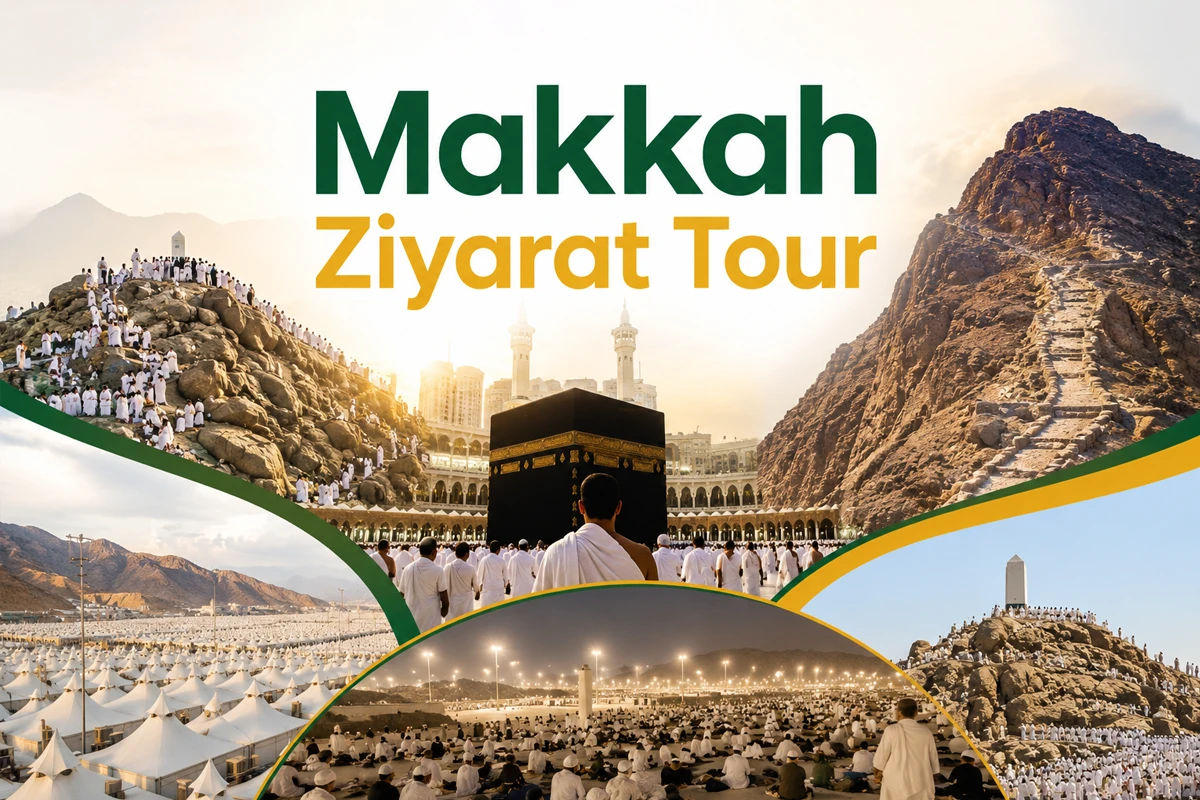
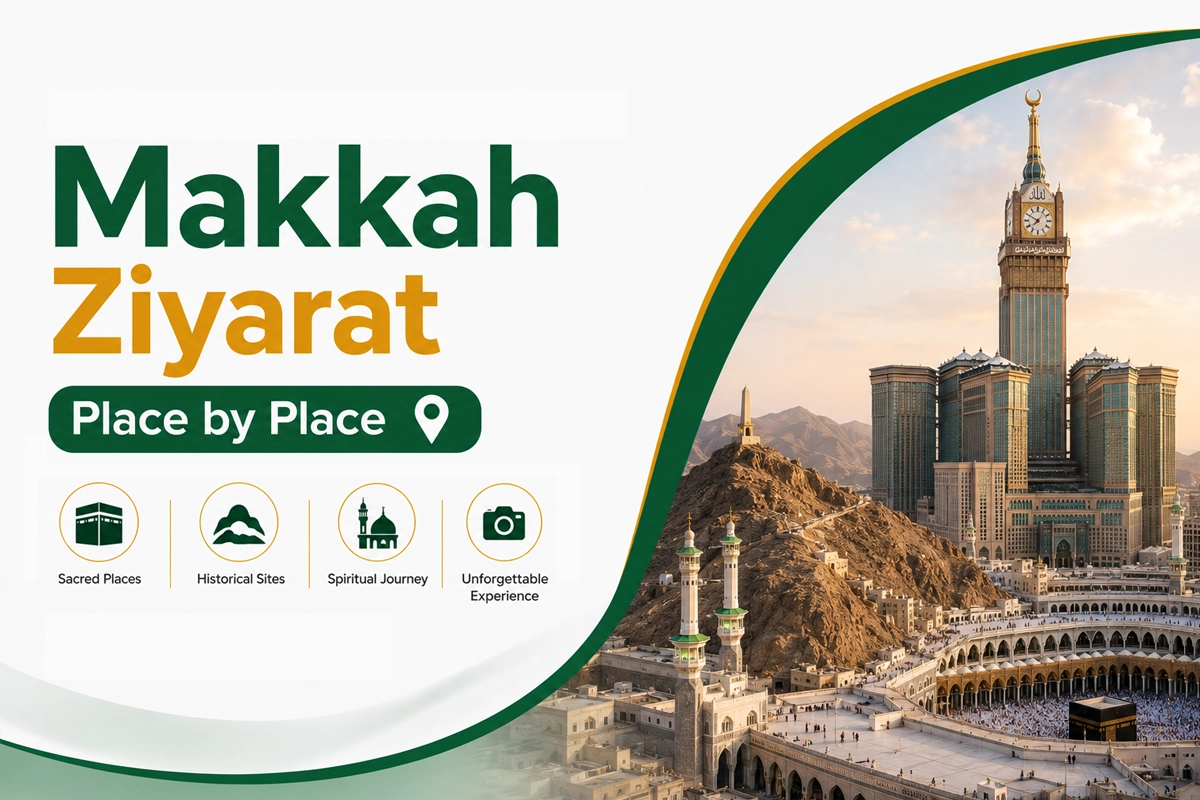
Makkah Ziyārat, Place by Place — the Authenticated Guide to Every Site
Quick reference · Ḥanafī method
Makkah ziyārat at a glance
First visit? Read the site-by-site guide below. Been before? The essentials are here.
🔔 Good to know
- The Ḥaram is the ziyārat — one prayer inside outweighs a hundred thousand elsewhere; keep every farḍ there.
- Jannat al-Muʿallā admits men only; women give the salām from the boundary, losing nothing.
- The Ḥirāʾ & Thawr climbs are not worship — visit for reflection; the museum tells the story at ground level.
- Stay near the Ḥaram and pre-book your ziyārat transport.
The Ḥaram's stations
- The Kaʿbah · the Black Stone (kissed) · the Ḥijr (part of the House).
- Maqām Ibrāhīm · the Multazam & Mīzāb · the Yamānī corner (touched).
- Zamzam — drink facing the qiblah, and drink it for a need.
The three marks
- ✦ Established — rests on a ṣaḥīḥ/ḥasan text; do what it establishes.
- ◈ Historical — real Sīrah ground; visit for reflection, no rite attaches.
- ⚠ Not established — a claim the muḥaddithīn could not verify; named honestly.
Two circuits
- On foot — the seven stations, Bayt Khadījah & Dār al-Arqam, the birthplace, Masjid al-Jinn/al-Rāyah, al-Muʿallā.
- By car — Ḥirāʾ & Thawr, ʿArafāt/Muzdalifah, Minā, and the mīqāt mosques (Tanʿīm, Jiʿrānah, Ḥudaybiyah).
Never do this
- Ask the buried for needs — duʿā is to Allah, for them.
- Kiss or wipe walls, glass, pillars — only the Black Stone and Yamānī corner are touched.
- Take pebbles, soil, Mīzāb drips or Kiswah threads as blessing.
- Tour the sites but pray your farḍ at the hotel.
Short answer
In Makkah the destination is the Ḥaram itself — one prayer inside outweighs a hundred thousand elsewhere, so keep every farḍ there. During ṭawāf you pass its seven stations: the Kaʿbah, the Black Stone (the one thing the sunnah kisses), the Ḥijr (part of the House), Maqām Ibrāhīm, the Multazam and Mīzāb, the Yamānī corner (touched), and Zamzam. Beyond the Ḥaram, a person already in Makkah may visit Sīrah sites for reflection — Ghār Ḥirāʾ, Jabal Thawr, Jannat al-Muʿallā, the mīqāt mosques (Tanʿīm, Jiʿrānah, Ḥudaybiyah) and the rite-lands — each marked Established or Historical, always with duʿā to Allah alone and never a rite invented for a spot.
Key takeaways
- ✓The Ḥaram IS the ziyārat — one prayer inside outweighs a hundred thousand elsewhere; never trade a farḍ there for a site tour.
- ✓The sunnah touches only two points of the House: it kisses the Black Stone and touches the Yamānī corner — nothing else is kissed, wiped or circled.
- ✓The Ḥijr Ismāʿīl is part of the Kaʿbah — every ṭawāf passes outside it, and two rakʿah inside it (when the crowd allows) are prayer within the House.
- ✓Drink Zamzam facing the qiblah, standing, in three breaths — and drink it FOR a need; 'the water of Zamzam is for whatever it is drunk for'.
- ✓Ghār Ḥirāʾ and Jabal Thawr are visited for reflection — the climb is not worship, and he ﷺ never returned to the cave after prophethood.
- ✓Jannat al-Muʿallā (where Khadījah رضي الله عنها rests) admits men only; women give the same salām from the boundary, losing nothing.
- ✓Never ask the buried for needs, never take pebbles/soil/Mīzāb drips/Kiswah threads as blessing, and never invent prayers or counts at a spot.
- ✓Sites marked ✦ rest on a ṣaḥīḥ/ḥasan text; ◈ are historical (reflection only); ⚠ flags popular claims the muḥaddithīn could not verify.
Quick facts
- Sites
- 30+
- The destination
- The Ḥaram
- Best prayer
- The Ḥaram (100,000×)
- Sunnah touches
- Black Stone · Yamānī
- Zamzam
- For whatever it's drunk for
- Muʿallā
- Men only
- Nearest mīqāt
- Tanʿīm
- School
- Ḥanafī
How to read this guide
Makkah needs no reason beyond itself: the traveller's destination is the Ḥaram, and one prayer inside it outweighs a hundred thousand elsewhere. Everything else in this guide — the caves, the cemetery, the little mosques on the city's old edges — is what a person already in Makkah may visit for remembrance, walking the Sīrah on its own ground. He ﷺ loved this city with a lover's grief; standing at its edge as he was driven out, he said:
His ﷺ words to Makkah itself
مَا أَطْيَبَكِ مِنْ بَلَدٍ وَأَحَبَّكِ إِلَيَّ، وَلَوْلَا أَنَّ قَوْمِيْ أَخْرَجُوْنِيْ مِنْكِ مَا سَكَنْتُ غَيْرَكِ
Mā aṭyabaki min baladin wa aḥabbaki ilayy, wa lawlā anna qawmī akhrajūnī minki mā sakantu ghayrak.
What a good land you are, and how beloved to me! Had my own people not driven me from you, I would never have lived anywhere else.
Jāmiʿ al-Tirmidhī — ḥasan ṣaḥīḥAnd it is a sanctuary before it is a city: on the day of the Conquest he ﷺ proclaimed, إِنَّ هٰذَا الْبَلَدَ حَرَّمَهُ اللهُ يَوْمَ خَلَقَ السَّمٰوَاتِ وَالْأَرْضَ — “Allah made this city sacred the day He created the heavens and the earth” (al-Bukhārī & Muslim): its thorn is not cut, its game not startled, and — the manuals add from al-Ḥajj 22:25 — wrongdoing inside it weighs as nowhere else. The visitor's first ziyārat of Makkah is therefore his own conduct in it.
✦ Established — the place or its virtue rests on a ṣaḥīḥ or ḥasan text, quoted at the site with its source; what the sunnah establishes there, you do.
◈ Historical — genuinely part of the Sīrah; visited for reflection (ʿibrah), with no special act, prayer or reward attaching to the spot itself.
⚠ Not established — a popular claim the muḥaddithīn could not verify, named honestly so that love is never built on invention.
On this page
- I — The adab of Makkah, before you go
- II — Within the Ḥaram: the House & its stations
- III — Ḥirāʾ & Thawr: revelation and refuge
- IV — Muʿallā & the vanished hills
- V — The memory-sites of the old city
- VI — The mīqāt & treaty mosques
- VII — The rite-lands, outside the rites
- VIII — Modern visits worth an hour
- Two ziyārat circuits
- Mistakes & innovations to avoid
- Sources & method
Part I — The adab of Makkah, before you go anywhere
1 · Guard the heart the Ḥaram guards
Rafīq-e-Ḥajj opens Makkah with a warning before a welcome: in the city where reward is multiplied, the intention to sin is itself taken to account — وَمَنْ يُّرِدْ فِيْهِ بِإِلْحَادٍ بِظُلْمٍ نُّذِقْهُ مِنْ عَذَابٍ أَلِيْمٍ (al-Ḥajj 22:25). So the visitor lowers his gaze in the crowds, holds his tongue in the queues, harms no one for a better spot, and treats every hour here as weighed on a heavier scale — in both directions. Rafīq-e-Ḥajj
2 · The one duʿā for its graveyard
Makkah's ziyārat includes one great cemetery, and the sunnah gives it the same single greeting taught for every graveyard:
Entering Jannat al-Muʿallā — or any graveyard — say
اَلسَّلَامُ عَلَيْكُمْ أَهْلَ الدِّيَارِ مِنَ الْمُؤْمِنِيْنَ وَالْمُسْلِمِيْنَ، وَإِنَّا إِنْ شَاءَ اللهُ بِكُمْ لَاحِقُوْنَ، أَسْأَلُ اللهَ لَنَا وَلَكُمُ الْعَافِيَةَ
As-salāmu ʿalaykum ahlad-diyāri minal-mu'minīna wal-muslimīn, wa innā in shā'allāhu bikum lāḥiqūn, as'alullāha lanā wa lakumul-ʿāfiyah.
Peace be upon you, people of these dwellings, believers and Muslims. We too, if Allah wills, shall join you. I ask Allah for wellbeing — for us and for you.
Ṣaḥīḥ Muslim3 · For women
4 · Carry the boundaries with you
Part II — Within the Ḥaram: the House and its stations
You will meet these seven during every ṭawāf; here are their stories, so that the circling is done with open eyes. Their rites — the istilām, the two rakʿah, the duʿās — are set out step by step in the ʿUmrah guide; nothing there is repeated here.
5 · The Kaʿbah ✦ Established
The first house set down for mankind (Āl ʿImrān 3:96): raised on old foundations by Ibrāhīm and Ismāʿīl عليهما السلام while they prayed رَبَّنَا تَقَبَّلْ مِنَّا (al-Baqarah 2:127); rebuilt by Quraysh in the Prophet's ﷺ youth — when their funds of pure wealth ran short, they left out part of the original building, and his ﷺ own hands placed the Black Stone that ended their quarrel; rebuilt again by Ibn al-Zubayr on Ibrāhīm's full lines, then returned by al-Ḥajjāj to the Quraysh plan that stands today. He ﷺ told ʿĀʾishah he would have restored Ibrāhīm's building “were your people not so new to Islam” (al-Bukhārī & Muslim) — leaving the ummah a masterclass in weighing benefit against fitnah. What you do: ṭawāf and duʿā at sight of it — and know, each round, that part of what you circle around is actually walked through: see the Ḥijr below. Ṣaḥīḥ al-Bukhārī · Akhbār Makkah
6 · Al-Ḥajar al-Aswad — the Black Stone ✦ Established
Its origin, in his ﷺ words
نَزَلَ الْحَجَرُ الْأَسْوَدُ مِنَ الْجَنَّةِ وَهُوَ أَشَدُّ بَيَاضًا مِنَ اللَّبَنِ، فَسَوَّدَتْهُ خَطَايَا بَنِيْ آدَمَ
Nazalal-ḥajarul-aswadu minal-jannati wa huwa ashaddu bayāḍan minal-laban, fa-sawwadat-hu khaṭāyā banī Ādam.
The Black Stone came down from Paradise whiter than milk, and the sins of the children of Ādam blackened it.
Jāmiʿ al-Tirmidhī — ṣaḥīḥSet in its silver casing at the eastern corner, it is where every ṭawāf begins and the one object the sunnah itself kisses. The balance of that kiss was fixed forever by ʿUmar رضي الله عنه, spoken while kissing it: “I know well you are a stone that neither harms nor benefits; had I not seen the Messenger of Allah ﷺ kiss you, I would not have kissed you” (al-Bukhārī) — pure following, zero superstition. What you do: istilām each round as the ʿUmrah guide teaches — and never a push or an elbow to reach it; the gesture from afar carries the full sunnah. Ṣaḥīḥ al-Bukhārī
7 · Ḥijr Ismāʿīl (al-Ḥaṭīm) ✦ Established
The low semicircular wall on the Kaʿbah's north side embraces ground that is the Kaʿbah — the part Quraysh's honest money could not cover. That is why every ṭawāf must pass outside it, and why prayer inside it is prayer within the House itself:
His ﷺ answer when ʿĀʾishah wished to pray inside the Kaʿbah
صَلِّيْ فِي الْحِجْرِ فَإِنَّمَا هُوَ قِطْعَةٌ مِنَ الْبَيْتِ
Ṣallī fil-Ḥijri fa-innamā huwa qiṭʿatun minal-bayt.
Pray in the Ḥijr, for it is a piece of the House.
Jāmiʿ al-Tirmidhī · al-Nasāʾī — ṣaḥīḥWhat you do: when the crowd allows — never during your own ṭawāf — two rakʿah of nafl inside it, outside the makrūh times, with duʿā under the golden Mīzāb; entering it is entering the Kaʿbah, and it costs no permit. By tradition carried in the histories, Ismāʿīl عليه السلام and his mother Hājar rest beneath this ground — reported by the topographers, treated with reverence, and left without any rite, exactly as the manuals leave it. Akhbār Makkah
8 · Maqām Ibrāhīm ✦ Established
The golden lattice holds the very stone Ibrāhīm عليه السلام stood upon as the walls rose — the prints of two feet pressed into rock that softened for its builder. Allah commanded its station in the Qurʾān: وَاتَّخِذُوْا مِنْ مَّقَامِ إِبْرٰهِيْمَ مُصَلًّى — “take the standing-place of Ibrāhīm as a place of prayer” (al-Baqarah 2:125) — and the two rakʿah after every ṭawāf answer that verse, prayed behind it where possible, anywhere in the masjid where not. What you do: those two rakʿah are the whole rite; the glass is not wiped, kissed or circled — the stone obeyed its Lord by serving a builder, and is honoured by the same obedience. al-Baqarah 2:125 · Ṣaḥīḥ Muslim
9 · The Multazam and the Mīzāb ✦ / ◈
Al-Multazam ✦ — the two metres of wall between the Black Stone and the door — is “the place of clinging”: chest and cheek pressed to the House, arms spread above the head, duʿā poured out. Ibn ʿAbbās رضي الله عنهما did exactly this and named it, and the ummah's practice has never lapsed; the manuals endorse it wholeheartedly while noting its narrations are practice-based rather than a fixed farḍ text. In iḥrām, beware its perfume — cling on the return visits, not mid-ʿUmrah. Al-Mīzāb al-Raḥmah ◈ — the golden spout casting rainwater from the Kaʿbah's roof into the Ḥijr — marks a blessed spot for duʿā beneath it inside the Ḥijr; the water itself carries no ruling, and bottling its drips as medicine is the invention the warning of step 4 was written for. Rafīq-e-Ḥajj · Akhbār Makkah
10 · Al-Rukn al-Yamānī ✦ Established
The corner before the Stone, aligned toward Yemen — the only other point of the House the sunnah touches: he ﷺ touched it in every round when he could, and between it and the Stone the transmitted رَبَّنَا آتِنَا فِي الدُّنْيَا حَسَنَةً closes each circuit. Two angels stand at it saying āmīn, the narrations of the salaf relate. What you do: exactly what the ʿUmrah guide teaches — touch when easy, pass by when not, and never gesture to it from afar; that gesture belongs to the Stone alone. Ṣaḥīḥ al-Bukhārī · Sunan Abī Dāwūd
11 · Zamzam ✦ Established
When Hājar ran her seven desperate lengths between the two hills, the answer broke from the ground at her infant's feet — Jibrīl struck the earth and Zamzam has not stopped since (the long ḥadīth of Ibn ʿAbbās, al-Bukhārī). From this well the Prophet's ﷺ chest was washed before the Night Journey; of its water he ﷺ said إِنَّهَا مُبَارَكَةٌ، إِنَّهَا طَعَامُ طُعْمٍ — “it is blessed; it is a food that satisfies” (Muslim) — and:
The promise of Zamzam
مَاءُ زَمْزَمَ لِمَا شُرِبَ لَهُ
Mā'u Zamzama limā shuriba lah.
The water of Zamzam is for whatever it is drunk for.
Sunan Ibn Mājah — ḥasanWhat you do: drink your fill facing the qiblah, standing, in three breaths, with bismillāh before and ḥamd after — and drink it for something: name your need, worldly or eternal, as the ḥadīth invites; the manuals record the salaf drinking it for knowledge, for cure, for a good end. The taps and dispensers throughout both Ḥarams are all true Zamzam. Rafīq-e-Ḥajj · Ṣaḥīḥ Muslim
Part III — Ḥirāʾ and Thawr: revelation and refuge
12 · Jabal al-Nūr and Ghār Ḥirāʾ ✦ Event ◈ Climb
Some four kilometres north-east of the Ḥaram rises the Mountain of Light, and near its summit the cave — barely four people's shelter — where he ﷺ withdrew each Ramaḍān to worship in the way of Ibrāhīm, until the night the angel seized him and the first words of the final revelation entered the world:
The first words ever revealed of the Qurʾān — here
اِقْرَأْ بِاسْمِ رَبِّكَ الَّذِيْ خَلَقَ خَلَقَ الْإِنْسَانَ مِنْ عَلَقٍ اِقْرَأْ وَرَبُّكَ الْأَكْرَمُ الَّذِيْ عَلَّمَ بِالْقَلَمِ عَلَّمَ الْإِنْسَانَ مَا لَمْ يَعْلَمْ
Iqra' bismi rabbikal-ladhī khalaq · khalaqal-insāna min ʿalaq · iqra' wa rabbukal-akram · alladhī ʿallama bil-qalam · ʿallamal-insāna mā lam yaʿlam.
Read, in the name of your Lord who created — created man from a clinging clot. Read, and your Lord is the Most Generous — who taught by the pen, taught man what he did not know.
Sūrat al-ʿAlaq 96:1–5 · the event in Ṣaḥīḥ al-BukhārīHe came down trembling to Khadījah's zammilūnī — “cover me” — and her immortal reassurance that Allah would never disgrace one who carried burdens for others opened the first chapter of the Sīrah. The status, honestly: the event is the most established thing in Islam's history; the climb is not worship — he ﷺ never returned to the cave after prophethood, no prayer or count belongs to it, and the manuals warn against pressing the elderly up its steep hour of steps. What you do: visit for ʿibrah. The mountain's base is now the Hira Cultural District — Revelation Exhibition, Museum of the Holy Qurʾān, a marked path to the summit — open through the day into the night (exhibitions ticketed, roughly SR 40–60); the climb itself is free, steep, and best at dawn with solid shoes and water. Those who cannot climb lose nothing: the museum tells the story at ground level, and Sūrat al-ʿAlaq is recited anywhere. Ṣaḥīḥ al-Bukhārī · verified at writing
13 · Jabal Thawr ✦ Established
South of the city, higher and harder than Ḥirāʾ, stands the mountain of the Hijrah's first three nights. Here the Prophet ﷺ and Abū Bakr lay hidden while Quraysh's trackers stood close enough that “had one of them looked at his feet, he would have seen us” — and here were spoken the words the Qurʾān made eternal:
Inside this cave, to his companion
لَا تَحْزَنْ إِنَّ اللهَ مَعَنَا
Lā taḥzan innallāha maʿanā.
Do not grieve — surely Allah is with us.
al-Tawbah 9:40 · Ṣaḥīḥ al-BukhārīAbū Bakr's family threaded the three days together — ʿAbdullāh carrying the city's news by night, Asmāʾ the food that earned her the title Dhāt al-Niṭāqayn, ʿĀmir's flock erasing the footprints — until the two rode out for Madīnah with history on their saddle. What you do: reflection; the climb is longer and rougher than Ḥirāʾ's and carries the same rule — the cave has no rite, the popular spider-and-dove embellishments have no established chain, and the ṣaḥīḥ account needs no decoration. Most visitors read 9:40 at the mountain's foot and let the summit belong to the young. Ṣaḥīḥ al-Bukhārī · Rafīq-e-Ḥajj
Part IV — Jannat al-Muʿallā and the vanished hills
14 · Jannat al-Muʿallā ✦ Established
A kilometre and a half north of the Ḥaram, in the fold of al-Ḥajūn, lies Makkah's ancient cemetery — the Quraysh burial ground that Islam inherited and honoured. Here rests Sayyidah Khadījah رضي الله عنها, the first believer, buried by the Prophet's ﷺ own descent into her grave in the Year of Sorrow; his sons Qāsim — and ʿAbdullāh by the reports — who died in her lap; his grandfather ʿAbd al-Muṭṭalib, who had named him; and his uncle Abū Ṭālib, the shield of the daʿwah's hardest decade. What you do: the graveyard salām of step 2, duʿā and istighfār for its people, and at Khadījah's unmarked earth the gratitude of every believer whose dīn her wealth and steadfastness sheltered. The domes that once crowded the ground were levelled in 1344 AH; the graves lie plain under stones, largely unidentifiable — so most give the salām to the ground as a whole. Open through the day, free, men enter, women greet from the boundary; no photography. One honesty note: tour lists often place his ﷺ mother Āminah here, but the ṣaḥīḥ account (Muslim) puts her grave at al-Abwāʾ on the Madīnah road, where he ﷺ wept at it — this guide follows the ḥadīth. Ṣaḥīḥ Muslim · Akhbār Makkah · verified at writing
15 · Jabal Abū Qubays ⚠ Claims not established
The hill that rose immediately east of the House — first of mountains, say the old tales; the pulpit from which, popular books add, the split moon was witnessed. The splitting of the moon itself is Qurʾān and ṣaḥīḥ ḥadīth (al-Qamar 54:1; al-Bukhārī); the Abū Qubays specifications are later tradition without a standing chain — and the point is now doubly moot, for the hill has vanished beneath the palace and the Ḥaram's expansions. It is kept in this guide for one reason: so that when a guide gestures at the ridge with confident stories, you know exactly which part is revelation and which is folklore. What you do: nothing — there is nowhere to go; the ṣaḥīḥ miracle is honoured by reciting Sūrat al-Qamar, from anywhere. Akhbār Makkah — with its discussions
16 · Al-Muḥaṣṣab (al-Abṭaḥ) ✦ Established
The open gravel plain toward Minā where he ﷺ camped on leaving Ḥajj, praying Ẓuhr to ʿIshāʾ and resting before the farewell ṭawāf (al-Bukhārī) — and where, years earlier, Quraysh had signed their boycott against Banū Hāshim, so that his camping there was itself a quiet triumph. Was the halt a sunnah of the Ḥajj or a travel convenience? ʿĀʾishah said convenience, Ibn ʿUmar practised it as sunnah — the books of fiqh carry both, and the manuals leave it as the gentlest of differences. What you do: today the plain lies under the ring roads and towers of al-ʿAzīziyyah's edge; there is nothing to visit — but when your Ḥajj bus crosses it, you now know whose camp you are crossing. Ṣaḥīḥ al-Bukhārī · the topographic histories
Part V — The memory-sites of the old city
Old Makkah — the shiʿbs and lanes of the Sīrah — lies almost entirely beneath the modern Ḥaram district. These sites are visited with the eyes and the heart more than the feet; each is a page of the Sīrah pinned to a location, and the manuals include them so that the city is read, not merely lodged in.
17 · The birthplace — Maktabat Makkah ◈ Historical
In Shiʿb Banī Hāshim, east of the Ḥaram by the Ṣafā side, the plain white building of the Makkah Library stands on the spot long identified as the house of his ﷺ birth in the Year of the Elephant — the house of ʿAbdullāh and Āminah, later held by ʿAqīl's line, marked by a mosque in the Abbasid centuries and by the library since 1370 AH. The status, plainly: the identification is the considered tradition of Makkah's historians (al-Azraqī onward) — solid as history, carrying no rite whatsoever: no prayer at it, no fixed day, no celebration attaches to the spot, and the building itself is generally closed to entry — the visit is a look from the plaza and the remembrance that here the mercy to the worlds entered the world. Gratitude is expressed the way the sunnah expresses it: durūd, and his ﷺ own Monday fast, kept anywhere on earth. Akhbār Makkah · Rafīq-e-Ḥajj
18 · Bayt Khadījah ◈ Historical
Steps from Marwah, in the old goldsmiths' lane, stood the house of Khadījah رضي الله عنها — his ﷺ home for the twenty-five years of their marriage, the birthplace of all their children including Fāṭimah, the room of the earliest revelations after Ḥirāʾ, and the address of the first Muslim household on earth. He never took another wife while she lived, and never stopped honouring her after she died. The site, excavated during the Ḥaram works and documented, now lies preserved beneath the paving of the expanded masjid near the Marwah gates. What you do: nothing can be entered; but a pilgrim finishing saʿī at Marwah stands a minute's walk from where the Prophet ﷺ lived longest — and the manuals suggest exactly that pause: durūd for him, raḍiyallāhu ʿanhā for her, and the thought that revelation's first roof was a family home. Akhbār Makkah
19 · Dār al-Arqam ◈ Historical
At the foot of Ṣafā stood the house of al-Arqam ibn Abī al-Arqam رضي الله عنه — a teenager's home turned first school of Islam: here the weak and the young learned the new Qurʾān behind a bolted door through the hardest years, and here, by the famous accounts, ʿUmar رضي الله عنه pronounced his shahādah and the muslims walked out to pray at the Kaʿbah openly for the first time. The site was absorbed into the Ṣafā side of the masjid in the expansions. What you do: as you stand on Ṣafā beginning a saʿī, you stand practically upon it — the manuals love the symmetry: the hill of Hājar's duʿā and the house of the first madrasah, one footprint apart. Reflection only; the classroom's syllabus — Qurʾān learned and lived quietly under pressure — is the ziyārat. Akhbār Makkah · Rafīq-e-Ḥajj
20 · Masjid al-Jinn ✦ Established
On the Muʿallā road, a small modern mosque marks where, by the transmitted accounts, the Prophet ﷺ drew a line for Ibn Masʿūd and went forward alone to meet the delegation of the jinn — the night a company of them heard the Qurʾān and carried it back as warners to their kind, as Sūrat al-Jinn and al-Aḥqāf 46:29 record and Ṣaḥīḥ Muslim details in the ḥadīth of the night of the jinn. What you do: two rakʿah of taḥiyyah if you pass at an open hour, and the correction of a whole genre of superstition: the unseen creation heard the same Qurʾān you carry, and believed — nothing at this mosque is feared, petitioned, or warded off. The event is ṣaḥīḥ; the exact spot is the city's continuous tradition. Ṣaḥīḥ Muslim · Sūrat al-Jinn 72
21 · Masjid al-Rāyah ◈ Historical
Nearby on the same road, an old mosque — rebuilt across the centuries — keeps the memory of the banner of the Conquest: the spot where, by the historians' transmission, the Prophet's ﷺ standard was planted as Makkah opened before him in Ramaḍān 8 AH, the day he entered with his head lowered to the saddle in gratitude, and told the city that had tortured his companions: “Go — you are free.” What you do: prayer if open, and the Conquest's lesson taken neat: absolute power meeting absolute mercy. History carries the spot; no text assigns it a virtue, and none is invented here. Akhbār Makkah
Part VI — The mīqāt and treaty mosques
22 · Masjid ʿĀʾishah — al-Tanʿīm ✦ Established
Six kilometres up the Madīnah road, at the Ḥaram's nearest boundary, stands the great white mosque of Tanʿīm — born of one night in the Farewell Ḥajj: ʿĀʾishah رضي الله عنها, kept from her ʿUmrah by her cycle, wept, and the Prophet ﷺ sent her out with her brother ʿAbd al-Raḥmān to this very edge of the sanctuary to tie a fresh iḥrām and return with her ʿUmrah complete (al-Bukhārī & Muslim). Ever since, it is the mīqāt of those already inside Makkah who intend another ʿUmrah. What you do: if a second ʿUmrah is intended, everything the ʿUmrah guide teaches happens here — ghusl facilities and iḥrām shops stand ready. And the honesty: the spot itself carries no extra virtue over any other Ḥill boundary; it is simply the nearest. The Ḥanafīs permit repeated ʿUmrahs and count them blessed — but racking numbers while trampling rest, crowds and khushūʿ inverts the purpose; quality before count, say the muftīs. Ṣaḥīḥ al-Bukhārī & Muslim · Fatāwā ʿUthmānī
23 · Masjid al-Jiʿrānah ✦ Established
Some twenty-four kilometres north-east, where the Prophet ﷺ camped dividing the spoils of Ḥunayn — and answered the Anṣār's hurt hearts with the speech that made them weep into their beards: “Are you not content that the people leave with sheep and camels, while you return with the Messenger of Allah?” From this camp he ﷺ entered iḥrām and performed his ʿUmrah of Jiʿrānah (al-Bukhārī & Muslim) — which is why the fuqahāʾ count it the most virtuous of the Ḥill mīqāts for the ʿUmrah of one already in Makkah, for the sunnah touched it directly. What you do: tie an ʿUmrah iḥrām here when time and transport allow the longer run; otherwise visit for the story — the mosque and its well stand in open country, a favourite of those who want their ʿUmrah to begin where his ﷺ did. Ṣaḥīḥ al-Bukhārī & Muslim · Rafīq-e-Ḥajj
24 · Al-Ḥudaybiyah — Masjid al-Shumaysī ✦ Established
Twenty-two kilometres out on the old Jeddah road lies the ground of the treaty the Qurʾān named “a manifest victory” while the Companions still thought it a defeat. Here the fourteen hundred camped in iḥrām, barred from the House; here, under the tree, they gave the Bayʿat al-Riḍwān — لَقَدْ رَضِيَ اللهُ عَنِ الْمُؤْمِنِيْنَ إِذْ يُبَايِعُوْنَكَ تَحْتَ الشَّجَرَةِ (al-Fatḥ 48:18) — and here the harsh-looking clauses of the truce opened the two years in which more entered Islam than in all the years before. Part of the camp lay outside the Ḥaram boundary — which is precisely why the site teaches the Ḥaram's edges: the ruins of the old mosque stand beside the newer one, with the boundary markers near. What you do: reflection, and the manuals' lesson read on location: what looks like loss under obedience is victory being written. It is also a Ḥill point — an ʿUmrah iḥrām may be tied here too. al-Fatḥ 48 · Ṣaḥīḥ al-Bukhārī
Part VII — The rite-lands, outside the rites
Minā, ʿArafāt and Muzdalifah belong to the Ḥajj guide during the five days; outside them, they are open valleys a ziyārat tour crosses in an afternoon. Knowing their marked places turns that drive into a rehearsal — invaluable for anyone whose Ḥajj lies ahead.
25 · Minā — Masjid al-Khayf ✦ / discussed
The great mosque under Minā's southern slope stands where the Prophet ﷺ prayed and delivered khuṭbah during the days of Minā — his encampment there is ṣaḥīḥ and the mosque marks it. The famous narration that “seventy prophets prayed in Masjid al-Khayf” stands in al-Ṭabarānī with a grading the scholars dispute — ḥasan to some, weak to others — and this guide reports exactly that, as the manuals do, while the mosque's real rank rests on the undisputed: he ﷺ prayed here. What you do: prayer inside when open outside the Ḥajj days; during Ḥajj it is the neighbourhood mosque of your Minā nights. Ṣaḥīḥ Muslim · al-Ṭabarānī — with its discussion
26 · Minā — Masjid al-Bayʿah ✦ Established
Behind Jamrat al-ʿAqabah, in a fold of the hillside, stands a small open-air mosque of Abbasid stone — built 144 AH by order of al-Manṣūr — marking the ravine of the two Pledges of ʿAqabah: the nights, before the Hijrah, when the men and women of Yathrib clasped his ﷺ hand in secret and bought the Hereafter with their protection. Islam's move from persecuted daʿwah to a city with a Prophet was signed here, in the dark, at Ḥajj season. Almost no pilgrim knows it exists — it may be the most under-visited established site in either sanctuary. What you do: reflection at the enclosure (the old structure is protected); the pledge's text — hearing and obeying, in hardship and ease, and speaking truth without fearing blame — is renewed silently by every visitor who reads it there. Ṣaḥīḥ al-Bukhārī · Akhbār Makkah
27 · ʿArafāt — Masjid Namirah ✦ Established
The vast mosque on ʿArafāt's western edge covers where he ﷺ camped at Namirah on the morning of ʿArafah, preached the Farewell Sermon to a hundred and forty thousand — the rights of women, the sanctity of blood and wealth, the end of usury and vendetta, “I leave among you the Book of Allah” — and prayed Ẓuhr and ʿAṣr joined (Muslim, from Jābir). One architectural fact carries a ruling: the mosque's front section stands in Wādī ʿUranah, outside ʿArafāt — boundary lines run through the building, and a Ḥajj-day worshipper must stand behind them for the wuqūf. What you do outside Ḥajj: the tour stop where the Farewell Sermon should be read aloud in full — ten minutes that summarise the dīn. Ṣaḥīḥ Muslim · Rafīq-e-Ḥajj
28 · ʿArafāt — Jabal al-Raḥmah ◈ Historical
The granite hill in the plain's north-east, crowned by a white pillar, is by long tradition linked to Ādam's عليه السلام repentance — a tradition, not a text — and it is not where standing earns anything special: عَرَفَةُ كُلُّهَا مَوْقِفٌ, “all of ʿArafah is standing-ground” (Muslim). The Prophet ﷺ stood at its foot, by the rocks — see the next site — not on its summit. What you do: climb for the view if you wish on a ziyārat day; on the Ḥajj day itself the manuals advise against the crush entirely. The pillar is a marker: it is not touched, wiped, circled, or written upon — the graffiti and cloth-tying that plague it are the very inventions step 4 forbids. Ṣaḥīḥ Muslim · Aḥkām-e-Ḥajj
29 · ʿArafāt — the Ṣakharāt, his ﷺ wuqūf ✦ Established
Jābir's رضي الله عنه precise camera of the Farewell Ḥajj records it: he ﷺ rode until he came to the rocks at the foot of Jabal al-Raḥmah, made the belly of al-Qaṣwāʾ face them, took the pedestrians' path before him and the qiblah before his face, and stood — hands raised — until the sun set (Ṣaḥīḥ Muslim). Those low rocks, long marked at the hill's base, are the noblest square metres of the plain. What you do: on a ziyārat visit, stand there once with raised hands and rehearse the duʿā you intend for your own ʿArafah; on the day itself, reach it only if the crowd is merciful — the standing is equally valid in your tent, and he ﷺ said so in the same breath. Ṣaḥīḥ Muslim
30 · Muzdalifah — al-Mashʿar al-Ḥarām and Wādī Muḥassar ✦ Established
Mid-plain in Muzdalifah stands the mosque of al-Mashʿar al-Ḥarām, the “Sacred Landmark” named in the Qurʾān's own Ḥajj instructions — فَاذْكُرُوا اللهَ عِنْدَ الْمَشْعَرِ الْحَرَامِ (al-Baqarah 2:198) — marking where he ﷺ made the dawn wuqūf of the 10th. And on Muzdalifah's Minā edge runs Wādī Muḥassar, where the army of the elephant was destroyed (Sūrat al-Fīl): the sunnah crossing it is a quickened pace — the one stretch of the Ḥajj roads where the Prophet ﷺ hurried, teaching that the sites of punishment are not lingered in. What you do outside Ḥajj: a drive-through with the map finally making sense; on the night itself, both points return as rites in the Ḥajj guide. al-Baqarah 2:198 · Ṣaḥīḥ Muslim
Part VIII — Modern visits worth an hour
31 · The Kiswah complex, the Two Ḥarams exhibition, the Clock Tower museum ◈ Historical
Three visits that deepen the Ḥaram without leaving the modern city: the Kiswah complex at Umm al-Jūd, where the Kaʿbah's black silk is woven and its calligraphy embroidered in gold — group visits watch the looms that dress the House each year; beside it the Exhibition of the Architecture of the Two Holy Mosques, holding relics of the old Ḥarams — carved doors, ancient pillars, the historic Zamzam winch, Ottoman and Saudi stages side by side; and the Clock Tower museum in the Abraj al-Bait summit, its balconies giving the one lawful bird's-eye of the Ḥaram (ticketed). The Hira Cultural District of site 12 completes the set. What you do: ordinary museum manners; these carry history and craft, not rulings — and they answer, better than words, the child's question of how the House is clothed and who has served it. Verified at writing
Two circuits that cover it all
Makkah's ziyārat splits cleanly into a walking circuit around the Ḥaram and a vehicle circuit of the outer sites. Keep every farḍ in the Ḥaram — no site outweighs a hundred-thousand-fold prayer — and take the drives in the cool halves of the day.
- The seven stations read during any unhurried ṭawāf and its aftermath — sites 5–11
- Bayt Khadījah and Dār al-Arqam, remembered from Marwah and Ṣafā at the end of a saʿī — sites 18–19
- The birthplace library viewed from the eastern plaza — site 17
- North on the Muʿallā road: Masjid al-Jinn, Masjid al-Rāyah, and Jannat al-Muʿallā after Fajr or ʿAṣr — sites 20, 21, 14
- Ḥirāʾ district first — museum for all, summit for the strong — site 12
- Jabal Thawr viewpoint on the southern side — site 13
- ʿArafāt: Namirah, the Ṣakharāt, the hill — sites 27–29 — then Muzdalifah and Muḥassar — site 30
- Minā: al-Khayf and the hidden Masjid al-Bayʿah — sites 25–26
- Separate short runs as ʿUmrah intentions allow: Tanʿīm (nearest), Jiʿrānah (most virtuous of the Ḥill), Ḥudaybiyah (the treaty ground) — sites 22–24
Mistakes & innovations to avoid
- Asking the buried at Muʿallā for needs. Khadījah رضي الله عنها is greeted, prayed for, and thanked in the heart — never petitioned. Needs go to Allah alone, here as everywhere.
- Turning the climbs into worship. Ḥirāʾ and Thawr carry no prayer, no count, no reward for ascent; pressing the elderly and unwell up them buys hardship, not ḥasanāt. He ﷺ never climbed to the cave again after prophethood.
- Writing, tying and scratching. Names on the cave walls, cloth on the Jabal al-Raḥmah pillar, threads at fences — the mountains are not petition boards, and defacing them wrongs the sanctuary itself.
- Collecting blessings by the pocket. Pebbles from ʿArafāt, stones from Ḥirāʾ, soil from Muʿallā, bottled drips from the Mīzāb, threads worked loose from the Kiswah — none carries a ruling, and several involve theft or damage. Barakah is in obedience, not gravel.
- Wiping and kissing what the sunnah never touched. The Maqām's glass, the Kaʿbah's walls and door, the Multazam treated as a relic to scrape — the sunnah's two touches are the Black Stone and the Yamānī corner; everything else is honoured with the eyes.
- Elbowing to the Stone. Harming Muslims to reach a sunnah inverts it; the gesture from afar carries the kiss in full, by his ﷺ own practice on camelback.
- Treating Tanʿīm as a production line. The spot has no virtue of its own — it is simply the nearest boundary. Repeated ʿUmrahs are valid and blessed in the Ḥanafī school; racked-up counts on trampled crowds and vanished khushūʿ are neither.
- Celebration rites at the birthplace. The site is honest history and nothing more; gatherings, fixed prayers, or festival acts at the library door attach worship to a place the sharīʿah left plain. His ﷺ birth is honoured his way: the Monday fast and the durūd.
- Believing the folklore layer. The spider and dove at Thawr, the moon watched from Abū Qubays, ʿArafah's hill as the site of Ādam's forgiveness — beloved tales, unestablished chains. The ṣaḥīḥ Sīrah is grander than its embroidery.
- Touring the sites and hoteling the prayers. Whoever drives every kilometre of this guide but prays his farḍ at the lobby has inverted Makkah: one prayer in the Ḥaram outweighs the whole itinerary a hundred thousand times.
Sources & method
This guide keeps the manuals' balance: full reverence for the Mother of Cities, and strict honesty about what the texts establish at each of its stones. Its material is drawn from:
- رفیق حج — Rafīq-e-Ḥajj of Muftī Muḥammad Rafīʿ ʿUthmānī رحمه الله (English: Companion of Hajj) — the frame of adab, the Ḥaram's stations, Zamzam, and the warnings against invented practices.
- Aḥkām-e-Ḥajj of Muftī Muḥammad Shafīʿ ʿUthmānī — the rulings: what the sunnah touches and kisses, what is reflection only, and the treatment of graded narrations.
- أخبار مكة — Akhbār Makkah of Imām al-Azraqī (3rd century AH), the mother reference of Makkah's topography — the buildings of the Kaʿbah, the houses of the Sīrah, the hills and lanes — on which the later histories rest.
- The ḥadīth collections — al-Bukhārī, Muslim, al-Tirmidhī, Abū Dāwūd, al-Nasāʾī, Ibn Mājah, al-Ṭabarānī — every virtue above is tagged, and every disputed grading flagged where quoted.
- Fatāwā ʿUthmānī of Muftī Muḥammad Taqī ʿUthmānī — the contemporary questions: repeated ʿUmrahs, conduct at sites, and the line between ziyārat and invention.
رَبَّنَا تَقَبَّلْ مِنَّا، إِنَّكَ أَنْتَ السَّمِيْعُ الْعَلِيْمُ
Our Lord, accept from us — truly You are the All-Hearing, the All-Knowing. (The duʿā of Ibrāhīm and Ismāʿīl as they raised this very House.)
When you are ready to plan the visit, we can help you find a stay near the Ḥaram, pre-book a private car for the ziyārat run and your transfers, or answer any question — see our Umrah & Ḥajj hub.
Step by step
- 1
Guard your conduct — the first ziyārat
Makkah is a sanctuary before it is a city, and wrongdoing in it weighs as nowhere else. Lower the gaze, hold the tongue, harm no one for a better spot — your conduct is your first ziyārat.
- 2
The Ḥaram's seven stations
As you make ṭawāf, read the Kaʿbah, the Black Stone, the Ḥijr, Maqām Ibrāhīm, the Multazam & Mīzāb, the Yamānī corner and Zamzam — the rites themselves are in the ʿUmrah guide; here are their stories.
- 3
Drink Zamzam for a need
Facing the qiblah, standing, in three breaths, bismillāh before and ḥamd after — and name your need, worldly or eternal. All the taps in both Ḥarams are true Zamzam.
- 4
Ḥirāʾ and Thawr — for reflection
Visit the Mountain of Light (first revelation) and Jabal Thawr (the Hijrah cave, 'do not grieve, Allah is with us') for ʿibrah. The climbs are not worship; the museums tell the story at ground level.
- 5
Jannat al-Muʿallā
Men enter Makkah's ancient cemetery with the graveyard salām and make du'a for Khadījah and the Companions who rest there; women give the same salām from the boundary. No petitioning the buried.
- 6
The mīqāt & treaty mosques
For a second ʿUmrah, tie iḥrām at Tanʿīm (nearest) or Jiʿrānah (where the Prophet ﷺ tied his); visit al-Ḥudaybiyah for the treaty that the Qurʾān called a manifest victory.
- 7
The rite-lands, rehearsed
Outside the five Ḥajj days, drive ʿArafāt (Namirah, the Ṣakharāt, the hill), Muzdalifah and Minā (al-Khayf, the hidden Masjid al-Bayʿah) — a rehearsal that makes the map make sense before your Ḥajj.
Frequently asked questions
Planning a Saudi trip?
Pre-book a private car, find a stay, or ask us anything on WhatsApp.
Last updated: 21 July 2026·Sources reviewed by the Wadana Go editorial team.