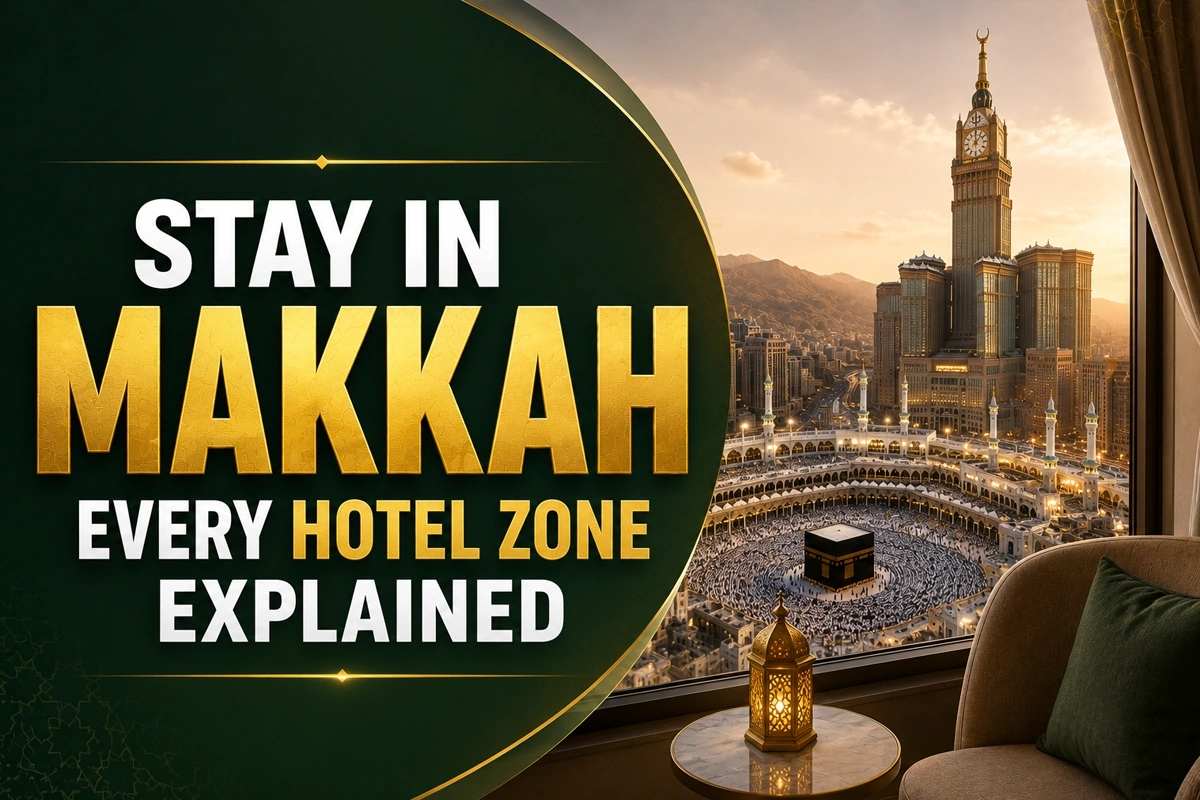
Where to Stay in Makkah: Best Hotel Areas Near Masjid al-Haram Explained
Short answer
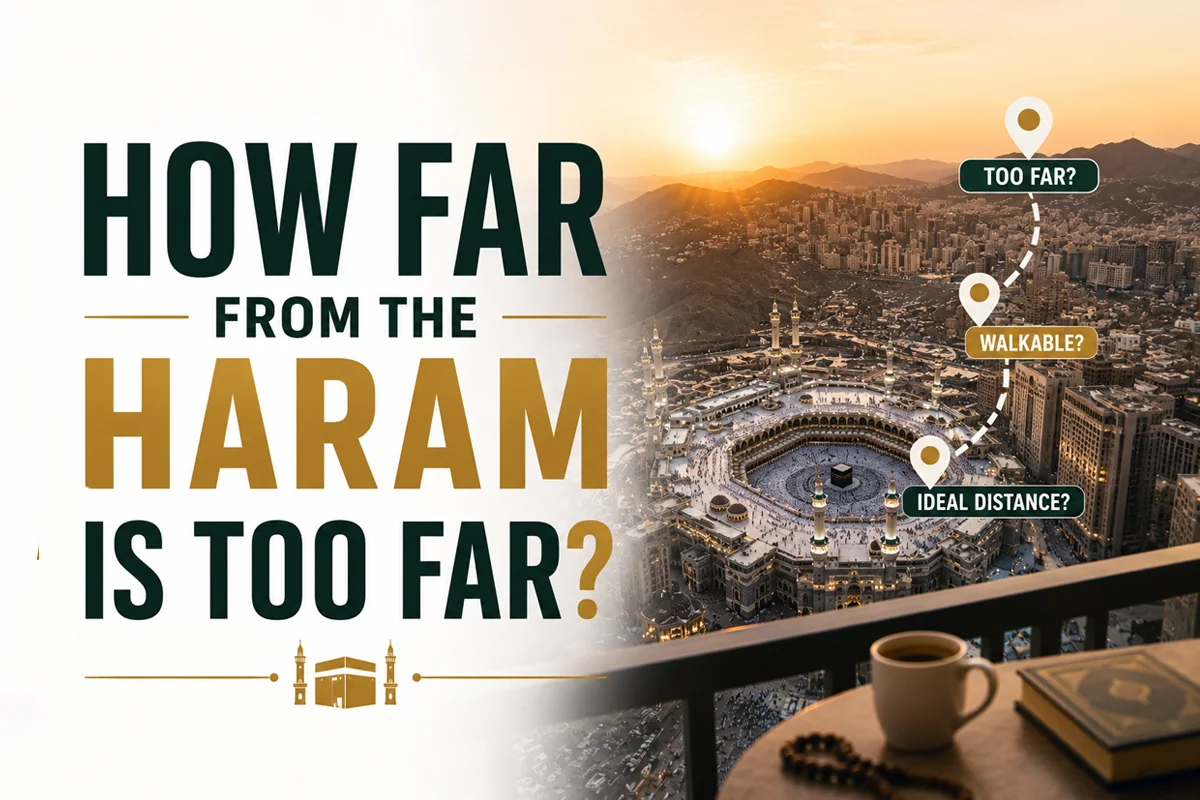
Makkah has five hotel areas, and the right one depends on who you're travelling with. Haram-front, the Abraj Al Bait towers, sits under 200 metres from the mosque: a 2-5 minute walk and the most expensive place in the city. Jabal Omar is 5-10 minutes away on covered walkways and has the most modern rooms. Ajyad, 5-15 minutes south, has the widest choice of 3 and 4 star hotels and suits most first-time travellers. Misfalah, along Ibrahim Al Khalil Road, is 10-15 minutes on foot and noticeably cheaper. Aziziyah and Al Shisha are 3-5 km out and aren't walkable, but they have the biggest apartments at the lowest prices. Pay for proximity if you're travelling with elderly parents or young children. If everyone in your group walks comfortably, Ajyad or Misfalah will serve you better.
Key takeaways
- ✓Makkah's hotels sit in five rings around Masjid al-Haram: Haram-front (under 200 m), Jabal Omar (5-10 min), Ajyad (5-15 min), Misfalah (10-15 min), and Aziziyah and Al Shisha (3-5 km, not walkable).
- ✓The walking time on a listing isn't the walk you'll take. Add the lift in a tall tower, the distance to a gate that's actually open, and the crowd on the way back after prayer.
- ✓Ajyad is the right answer for most first-timers. Moving one ring out from the mosque often halves the room rate and costs you a handful of minutes.
- ✓Pay the Haram-front premium when it buys something specific: elderly parents, a wheelchair, children under five, a two or three night trip, or Ramadan.
- ✓Aziziyah is only cheap once you've solved the transport, because every prayer turns into a 10-20 minute road journey each way.
- ✓Book six to nine months ahead for Ramadan, the last ten nights and Hajj season, and read the street address rather than the district name on any listing.
Quick facts
- Hotel areas
- Haram-front, Jabal Omar, Ajyad, Misfalah, Aziziyah and Al Shisha
- Closest ring
- Haram-front, under roughly 200 m from Masjid al-Haram
- Best value for most people
- Ajyad, a 5-15 minute walk
- Cheapest
- Aziziyah and Al Shisha, 3-5 km out, not walkable
- Typical price gap
- Haram-front usually runs 3-5 times an equivalent Ajyad room
- Trips to the mosque
- Around 25-30 over a five-night stay
- Book ahead
- 6-9 months for Ramadan, the last ten nights and Hajj
- Airport
- King Abdulaziz International, Jeddah, about 90 minutes by road
- Entry
- Makkah is open to Muslim travellers only
Ask ten people planning their first Umrah what's worrying them and nine will say the same thing: which hotel to book. Hardly anyone asks the question that actually decides how the trip goes, which is which part of Makkah they'll be waking up in.
It sounds like the same question. It isn't.
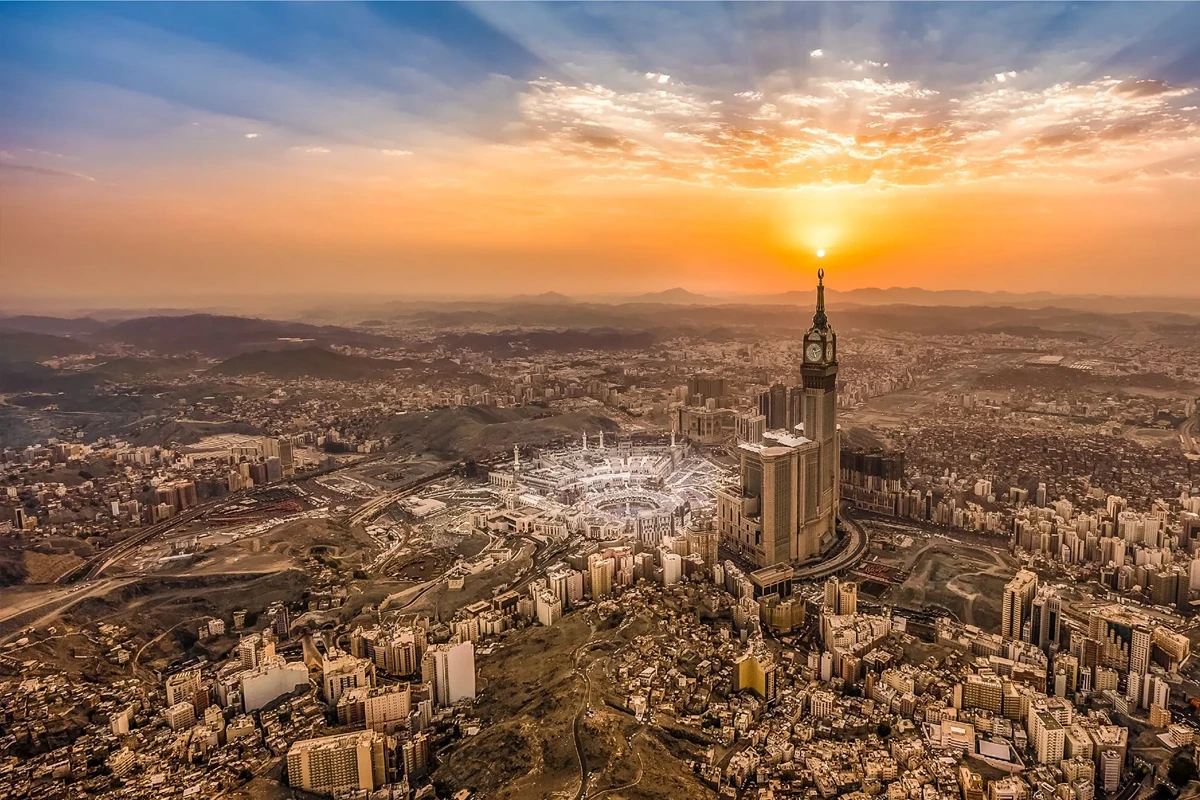
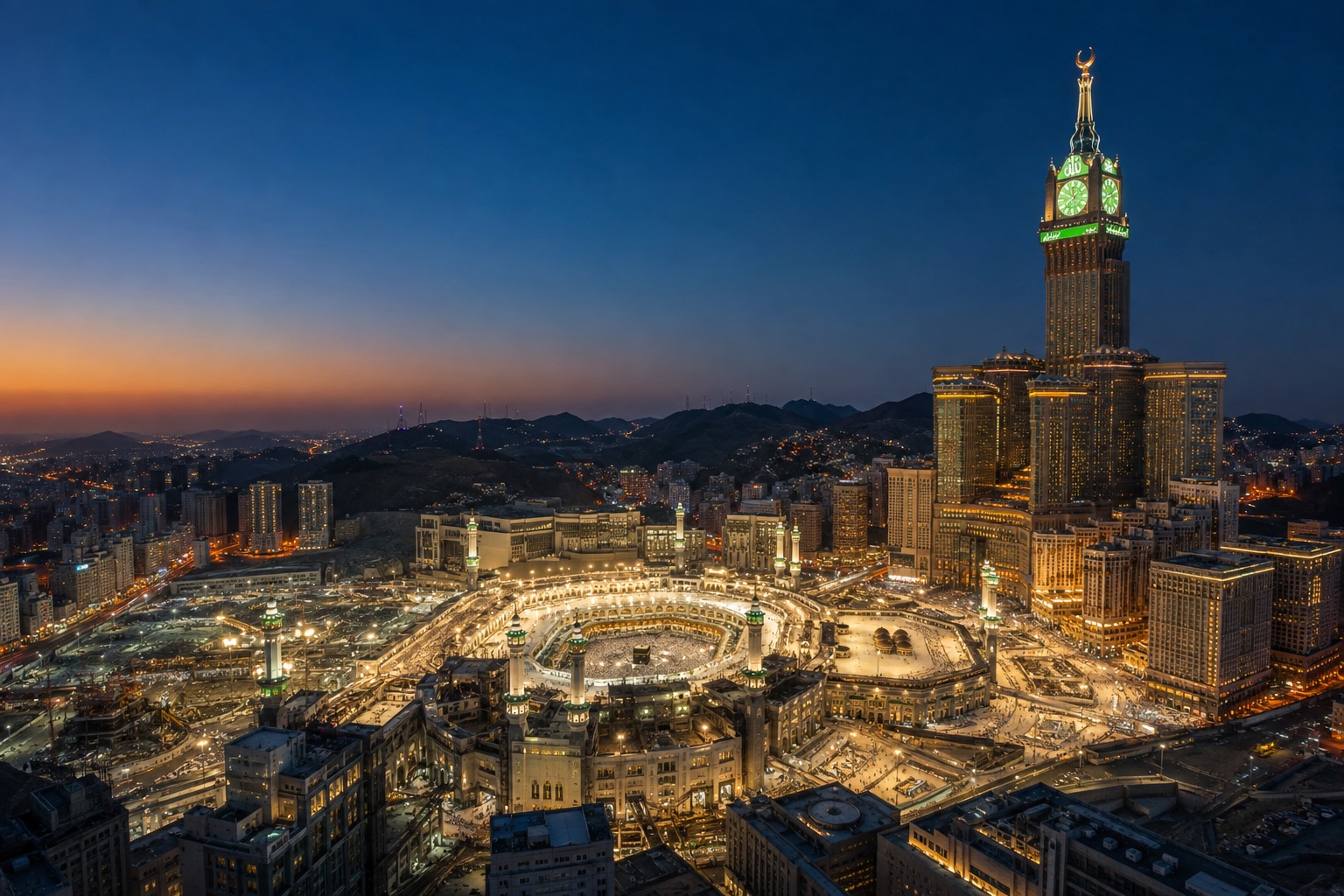
Makkah is a small city built around one point. Masjid al-Haram sits at the bottom of a bowl and the hotels climb the sides of it in rings. Step one ring outward and the nightly rate can drop by half. Step one ring inward and a hard walk turns into an easy one, which if you're travelling with a parent whose knees have opinions is basically the whole trip.
So that's what this is about. Not which hotel does the better breakfast. Which area gives you the trip you actually came for.
There are five hotel areas worth knowing about. Haram-front, the Abraj Al Bait towers right beside the mosque, under about 200 metres and priced like it. Jabal Omar, newer towers about 5-10 minutes away on purpose-built walkways. Ajyad, just south of the complex, where most first-timers end up: 5-15 minutes on foot and by far the widest choice of 3 and 4 star hotels. Misfalah, along Ibrahim Al Khalil Road, a few minutes further for noticeably less money. And Aziziyah and Al Shisha, 3-5 km out, which aren't walkable at all. Those last two are the budget and long-stay option, and every prayer turns into a shuttle or a car ride.
If what you want is the reference version, every zone with walking times, price bands and a decision matrix, that's our where to stay in Makkah guide. This is the opinionated version: what the areas are actually like, and the mistakes we watch people make every season.
Why the distance question swallows everything else
In most cities your hotel is where you sleep and the day happens somewhere else. Makkah works the other way round. The mosque isn't a sight you visit once, it's the reason you're there, and you'll go back to it five times a day. More, if you're making tawaf outside prayer hours.
Over five nights that's twenty-five or thirty trips between your room and the Haram.
Multiply anything by thirty and small stops being small. A hotel eight minutes further out doesn't cost you eight minutes. It costs you around four hours of walking across the stay, most of it in heat, some of it in crowds, all of it on the same legs you're asking to stand through long prayers. That's why the towers nearest the mosque charge what they charge. You're not paying for the marble in the lobby, you're paying for minutes, and for the energy those minutes would have eaten.
But the flip side is the bit people forget when they're stretching the budget for a Haram-front room: those minutes aren't worth the same to everyone. A fit couple in their thirties on a four-night trip will absorb a twelve-minute walk and never think about it. A family with a grandmother, a pushchair and a bag of Zamzam will feel every metre. The right answer isn't the closest hotel. It's the closest hotel your particular group actually needs, which is usually further out than people assume.
What "5 minutes from the Haram" leaves out
Every listing in this city quotes a walking time and almost none of them are lying. They're just measuring something you won't experience. Four things sit between the number on the page and your actual walk.
Which gate you end up at
Masjid al-Haram is enormous and it has a lot of gates. "Five minutes to the Haram" usually means five minutes to the nearest point on the outer boundary. Not five minutes to a door, and definitely not five minutes to somewhere inside where you can pray. Arrive at the perimeter on the wrong side during a busy period and you can add another ten or fifteen minutes walking round the complex looking for an entrance that's open and not already full.
Broadly, hotels on the southern side are nearest to Bab al-Umrah and the Ajyad approaches, while King Abdulaziz Gate and the newer expansion entrances serve the north and west. I'd treat any specific gate as a hint rather than a promise, though. Numbering changes, one-way systems appear, entrances close for construction or crowd control, and in Ramadan all of that happens at once. Ask at your hotel desk when you arrive.
The lift counts as walking
Hotels here are tall. A room on the 38th floor of a full tower isn't a 38-floor journey, it's a queue in a corridor and then a lift that stops nine times on the way down. People who stay in the big towers regularly budget ten to fifteen minutes just to get from the room to the street at peak times, and they leave for prayer far earlier than the maths suggests.
This is the single most common reason a "two-minute" hotel doesn't feel like one. If that bothers you, ask for a lower floor. You lose the view and you get the minutes back.
The walk back is the real walk
Going to the mosque is usually fine. It's coming back you want to plan for, because tens of thousands of people leave at the same moment and the streets move at the speed of the slowest person in them. A pleasant eight-minute route at two in the afternoon can take twenty-five after Isha in a busy month, and the tunnels and bridges around the complex sometimes run one-way to manage the flow.
Who's walking with you
Then the honest one. Walking times published anywhere, this site included, assume an adult with nothing to carry moving at a steady pace. Add a wheelchair, a pram, a child who needs carrying by day three, or a father who can manage fifteen minutes but not thirty, and your practical radius shrinks fast. If someone in your group is in that category, pick the area for them rather than for the average of everybody.
Entry to Makkah is restricted to Muslims. That applies to every hotel in every area on this page, whatever your nationality and however the booking was made. Non-Muslim travellers in a wider group usually base themselves in Jeddah or Taif and meet everyone afterwards.
The five areas side by side
Before going through them one at a time, here's the shape of the thing. Walking times assume an adult at a normal pace outside the peak crowd. Prices are relative rather than absolute, because Makkah rates move more violently than almost any hotel market anywhere and the same room can triple between a quiet week in autumn and the last ten nights of Ramadan.
| Area | Distance | Typical walk | Hotel standard | Price | Best for |
|---|---|---|---|---|---|
| Haram-front (Abraj Al Bait / Clock Tower) | Under ~200 m | 2-5 min | 4-5 star, big towers | Highest, often 3-5x an Ajyad room | Elderly parents, very young kids, praying all five in the mosque |
| Jabal Omar | ~400-800 m | 5-10 min | Modern 4-5 star | High | A newer room and a good walk, without Haram-front rates |
| Ajyad | ~400 m-1 km | 5-15 min | Lots of 3-4 star, a few 5 | Mid, and the best value in the city | Most first-time travellers and families watching the budget |
| Misfalah / Ibrahim Al Khalil Road | ~800 m-1.5 km | 10-15 min | Mostly 3-4 star | Lower | Longer stays and anyone happy to walk |
| Aziziyah & Al Shisha | ~3-5 km | Not walkable, 10-20 min by road | Hotels and big apartments | Lowest | Groups, long stays, budget-first trips |
Two things in that table are worth pausing on. The price gap between Ajyad and Haram-front is much bigger than the walking gap, so you're paying steeply for the last few hundred metres. And Aziziyah isn't just "further away". It's a different kind of stay, because the walk vanishes completely and gets replaced by a logistics problem you have to solve five times a day.
1. Haram-front: the towers at the mosque
This is the ring of hotels standing right against Masjid al-Haram, mostly the Abraj Al Bait complex under the clock tower and the properties built into the King Abdulaziz Endowment. You walk out of the door and you're basically there.
What it's actually like
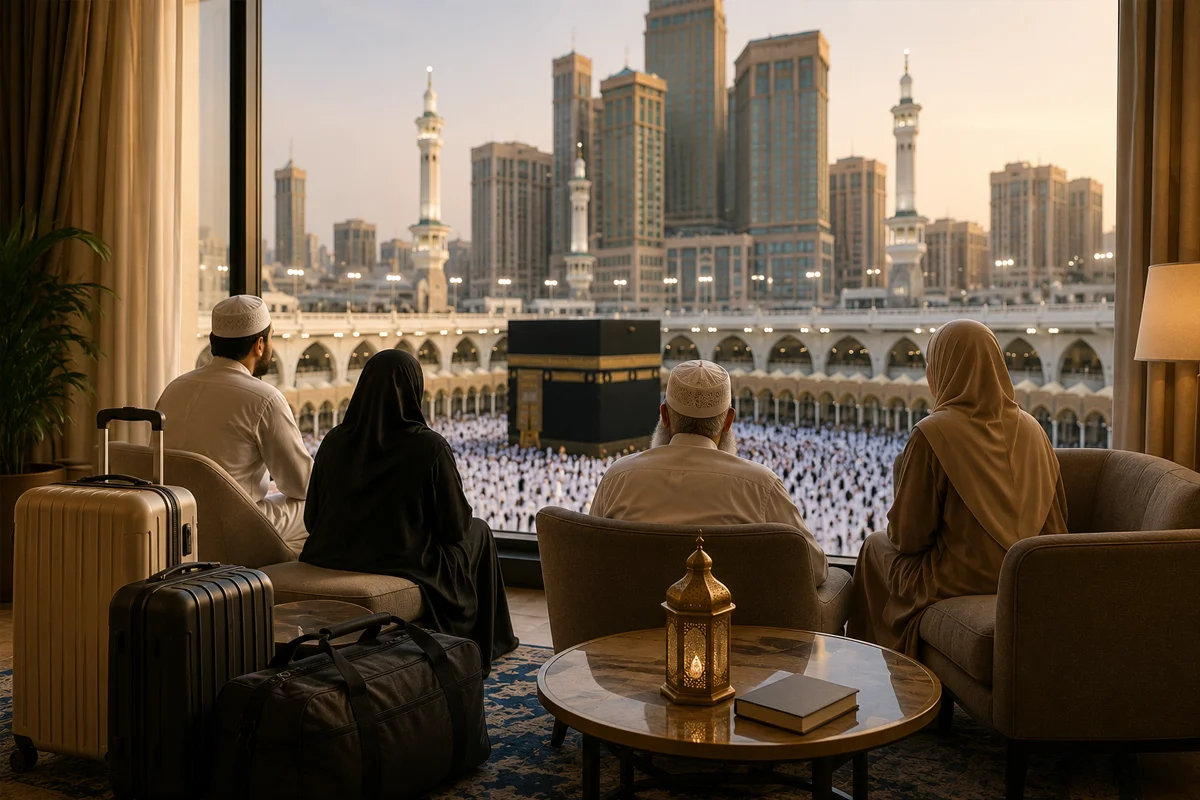
Staying here compresses the whole trip. You stop planning around prayer, you just go, and if you've forgotten something you go back for it. A lot of these hotels have their own prayer halls looking onto the mosque, which turns out to matter on the nights the Haram itself fills up. The complex has a mall, a food court and enough shops that some guests barely step outside it except to pray, which is either wonderfully convenient or a slightly airless way to spend five days depending on the kind of person you are.
What nobody puts in the brochure is the density. The lobbies are busy at every hour, the lifts are the bottleneck of the entire experience, and the background noise is roughly that of a small airport. If you're picturing a serene retreat with a view of the Kaaba, adjust the picture. It's extraordinary. It is not quiet.
How long the walk really takes
Two to five minutes from the tower door to a gate, plus your lift time, plus whatever the crowd is doing. In a quiet month you can leave the room six minutes before iqamah and make it comfortably. In the last ten nights of Ramadan people staying here still leave forty-five minutes early, because by then the bottleneck has moved inside the mosque rather than outside it.
Where the money goes
Three things, in this order. The minutes. The certainty that the walk will never be the reason you missed a prayer in the mosque. And the view.
The view is the most expensive of the three and the least necessary. A confirmed Kaaba-view room routinely costs two to three times a comparable room without one in the same building, and the wording is careful: "Haram view", "partial view" and "city view" can all be sold off the same corridor. If the view is the point, get the exact category confirmed in writing before you pay. If it isn't, the identical hotel at the identical distance is dramatically cheaper on the other side of the building.
- The shortest and most reliable walk in the city.
- Hotel prayer halls to fall back on when the mosque fills.
- Shops, food and pharmacies without going outside.
- Far and away the easiest option for wheelchair users and elderly pilgrims.
- Kaaba and Haram views, if that's what you came for.
- The highest rates in Makkah and the steepest Ramadan jump.
- Lift queues that can cancel out the distance advantage.
- Crowded, noisy public areas at almost all hours.
- Food inside the complex is convenient rather than cheap.
- View categories are easy to misread and expensive to get wrong.
Who I'd send here
Anyone travelling with a parent who tires quickly, a wheelchair user, or children under about five. Anyone on a two or three night trip where every hour counts. Anyone whose stated goal is to pray all five daily prayers inside the Haram. And anyone for whom the Kaaba view is a once-in-a-lifetime thing worth paying for.
Who I wouldn't
Healthy travellers on a longer stay. Across seven nights the gap between here and Ajyad is often the entire cost of everything else you'd want to do, and I've never met anyone who regretted spending that on a Ziyarat day or an extra night in Madinah instead.
2. Jabal Omar: the modern middle
Jabal Omar is the big redevelopment on the hillside west of the mosque, a cluster of newer towers linked to the Haram by walkways built for that exact journey. It's the newest of the close-in areas and, room for room, usually the smartest product in the city.
What you get
Calmer than Haram-front, with more space and better-finished rooms for the money. The walk is engineered rather than improvised: covered stretches, escalators, bridges. In a Saudi summer that matters more than the extra few hundred metres. Several of the towers have their own shops and restaurants too, so you're not living off the Abraj Al Bait food court.
The bit nobody mentions
It's a hillside. Getting from some towers onto the walkway network involves lifts, escalators and a decent amount of indoor walking before you've even reached the outside air. Ask your hotel directly how its guests get to the Haram, because the answer varies a lot between buildings in the same development.
Realistically: five to ten minutes on the published routes, eight to fifteen once you count the indoor navigation and the crowd on the way home. Comfortable in every month except the peak of Ramadan, when the routes get managed and can run one-way.
Who it suits
People who want a properly modern hotel and will pay above Ajyad but not Haram-front. Couples. Families with school-age kids who can walk. Anyone who'd rather have a shaded, covered route than raw proximity, which in August is a more sensible preference than it sounds.
Jabal Omar is a development, not a building, and the gap between its nearest and furthest towers is real. Two hotels both described as "Jabal Omar" can be five or six minutes and a full price tier apart. Check the tower, not the district name.
3. Ajyad: where most people should probably stay
Ajyad runs south of the Haram complex and holds the densest concentration of three and four star hotels in the city. If you've been to Makkah on a package tour there's a fair chance you stayed here without ever learning the name of the area.
Why it's the default answer
It's ordinary, in the best way. Streets of hotels with small restaurants and shops underneath, laundries, phone shops, places selling dates and prayer mats. It feels like a city rather than a complex. And everything costs less: food, water, a taxi, a SIM card, all noticeably cheaper a few streets back from the mosque than inside the towers.
The money argument is simple. Give up a handful of minutes, halve the accommodation bill. For most trips that's not a close call.
The catch
Ajyad is wide. Its northern edge, closest to the mosque, is nearly Haram-front in both convenience and price. Go south or east and the streets climb, and you can end up with a fifteen-minute walk that has a gradient in it on the way home, which matters a great deal more after Isha than it does on paper.
This is the area where reading the actual street address instead of the district label pays for itself.
- The widest choice of hotels at every price point in Makkah.
- Normal neighbourhood prices for food, laundry and everything else.
- Still an easy walk for most people, in most months.
- Family rooms and triples without suite money.
- Quality varies enormously between hotels with the same star rating.
- Uphill returns from parts of the district after night prayers.
- Older buildings and small lifts at the cheaper end.
- "Ajyad" on a listing can mean four minutes or eighteen.
4. Misfalah and Ibrahim Al Khalil Road
South-west of the mosque, along and around the Ibrahim Al Khalil road toward Bab al-Umrah. This is where the price curve flattens out. Ten to fifteen minutes on foot, mostly on wide, flat, well-lit road with plenty of other people walking the same direction.
What it's like
Busy, practical, cheaper. There's a strong South and South-East Asian character to a lot of it, and with that comes some of the best-value eating anywhere in the city. A meal here costs a fraction of the same plate inside the towers. Supermarkets, luggage shops, pharmacies, all easy to find. It's the natural home of the longer stay, the place where you start feeling like a resident instead of a guest.
The walk
Ten to fifteen minutes to the nearest gates in normal conditions. It scales badly with crowds, though, because that same road carries an enormous number of people after prayer. In Ramadan, plan on double.
Plenty of people staying here walk in for Fajr, Maghrib and Isha and pray the middle two at a local mosque nearby. That isn't a compromise so much as a rhythm, and regular visitors adopt it deliberately.
Who it suits
Stays of a week or more. Anyone who walks comfortably and would rather spend the difference on food, Ziyarat or their Madinah leg. Younger groups. And repeat visitors, who tend to drift outward from the Haram with each trip as the novelty of the view wears off and the value of the money reasserts itself.
5. Aziziyah and Al Shisha: cheap, spacious, and not walkable
Three to five kilometres out. These are not a walking option and shouldn't be treated as one. What they offer instead is space and price: hotels and furnished apartments that are markedly cheaper and often much bigger, which is why families and organised groups fill them.
What it's like
A normal Saudi residential district. Supermarkets, bakeries, family restaurants, laundries, apartments with kitchens and separate bedrooms. For a family of six on a ten-night stay the difference between here and Ajyad isn't a few hundred riyals, it can be the difference between the trip happening and not happening.
The catch, said plainly
Every trip to the mosque becomes a road journey of ten to twenty minutes each way, and a good deal more when traffic near the Haram is being managed. Five prayers a day is up to ten road journeys.
Groups solve this with a hotel shuttle or a car booked for the week. Individuals often solve it by praying most prayers locally and going into the Haram once or twice a day. Both are fine. What doesn't work is booking Aziziyah while quietly imagining you'll pray every prayer in the mosque. That's a ten-hour-a-day commute and nobody keeps it up past day two.
Who it suits
Big families and groups. Ten nights or more. Anyone for whom the budget is the constraint that actually binds. Anyone who'd honestly rather have an apartment with a kitchen than a hotel room. If you book out here, sort the transport before you fly rather than haggling at the kerb five times a day. A pre-booked car in Makkah is calmer and usually cheaper than the alternative, particularly with luggage or elderly travellers.
Now match it to your trip
Everything above is neutral. The recommendation only appears once you say who's going and for how long. Here's how we'd advise the cases we see most.
A couple on a first Umrah, four or five nights
Ajyad, or Jabal Omar if the budget stretches. You'll walk without thinking about it, you'll want to be in the mosque a lot, and a short trip does reward being close. Haram-front is a reach most couples don't need.
Travelling with elderly parents
Haram-front, and don't talk yourself out of it. This is the one case where the premium is straightforwardly worth paying. Ask for a lower floor to cut the lift time, check there's step-free access from the lobby to the street, and find out whether the hotel has its own prayer hall. If Haram-front genuinely isn't affordable, the northern edge of Ajyad is the next best thing. It's also worth reading our notes on wheelchair access at the Haram before you travel.
A family with young children
Close in for a short trip, further out for a long one. Three nights with a toddler: pay for the proximity, because you'll be going back to the room mid-day whether you planned to or not. Ten nights with three kids: an apartment in Aziziyah with a kitchen and separate bedrooms will keep everyone sane, and the shuttle is the price of that. Our family stays and furnished apartments pages are filtered for this.
A group of friends, or a big extended family
Misfalah or Aziziyah. Groups have the two things that make distance cheap: legs, and the ability to split a car. Book the bigger, cheaper rooms further out and put the saving into a vehicle rather than square metres you'll barely see.
Ten nights or more
Misfalah. The daily walk turns into routine inside two days, the food is better and cheaper, and over ten nights the saving against a close-in hotel is substantial. Long stays change your prayer rhythm anyway. You stop trying to make every prayer in the Haram and start choosing which ones matter most to you.
Ramadan, and especially the last ten nights
As close as you can afford, booked as early as you can manage. This is the one period where the usual value logic falls apart. Crowds are extreme, the mosque fills long before prayer, the streets are managed and every walk takes longer than its published time. Book six to nine months out and treat proximity as the priority rather than the luxury.
One night, fixed departure
Haram-front or Jabal Omar. Minutes are the only currency you have. Spend the money.
What Ramadan does to all of it
Worth saying separately, because Ramadan isn't a busier version of the normal city. It's a different city that happens to share a street plan.
- Rates. Prices climb sharply in every area and the last ten nights are the peak of the peak. Multiples of the off-season rate are normal, and the closer you are to the mosque the steeper the curve.
- Availability. The first rooms to disappear are the close-in ones at moderate prices, which are of course exactly the rooms everybody wants. What's left late is either very expensive or a long way out.
- Walking times. Assume everything doubles, and that some routes go one-way or close entirely for crowd control.
- Capacity. The mosque itself fills well before prayer. A hotel prayer hall facing the Haram stops being a nice extra and becomes the reason you get to pray in congregation with a view of the mosque at all.
- Getting around. Road access near the Haram is restricted at peak times, which hits Aziziyah stays hardest. If you're out there and coming in, build in far more time than feels reasonable.
If Ramadan is the plan, read our notes on Umrah in Ramadan alongside this. The accommodation decision and the crowd reality are really the same subject.
Five mistakes we see every season
Buying the view instead of the walk
A Kaaba-view room is a real experience and for a milestone trip it's defensible. But a lot of people spend their entire proximity budget on the window and then find they look out of it for ten minutes a day. If the goal is time inside the mosque, buy the distance.
Believing the district name
"Ajyad", "Jabal Omar", even "Haram area" are broad labels. Within each one the nearest and furthest properties can be five to ten minutes and a whole price tier apart. Find the street. Look at where it sits relative to the mosque. Read recent guest comments about the walk specifically, not the hotel in general.
Only planning the outbound trip
People picture the walk to the mosque and never once think about the walk back, which is the harder one: crowded, later, and after an hour on your feet. Judge every hotel on the return after Isha.
Booking Aziziyah with Haram-front intentions
Covered above, but it's the most common source of disappointment so it's worth repeating. If you book three to five kilometres out, plan the transport at the same time as the room. The stay is only cheap once the ten daily journeys are solved.
Leaving it late and paying twice
Makkah rewards booking early more than almost any market. Six to nine months for Ramadan, the last ten nights and Hajj season. Three to four months for other busy periods. A few weeks is fine for a quiet week in a shoulder month. Late bookers routinely end up paying Haram-front money for an Ajyad walk.
Hotel or apartment?
This only really comes up once you're looking outside the close-in towers, but for bigger groups it changes the maths completely.
Hotels win on service, on lifts, on being close in (the inner rings are almost entirely hotels) and on simplicity. You arrive, you drop the bag, somebody else handles the rest. Apartments win on space, on cost per person, and on the kitchen, which for a family on a ten-night stay isn't a luxury. It's a daily saving and a way to eat around prayer times instead of around a buffet schedule.
Rough rule: four people or fewer, a week or less, close in, book a hotel. Five or more, longer than a week, happy to be further out, look properly at furnished apartments before you book rooms at all.
What the money actually buys
Any specific figure printed today will be wrong by next season, so there's not much point quoting one. What stays roughly stable is the relationship between the areas, and that's the more useful thing to carry into a booking.
| Area | Relative cost of a comparable room | What the extra buys | In Ramadan |
|---|---|---|---|
| Haram-front | Highest, commonly 3-5x Ajyad | The shortest walk in the city, hotel prayer halls, view categories | Steepest rise, sells out first |
| Jabal Omar | Around 2-3x Ajyad | Newer rooms, covered walkways, calmer public areas | Sharp rise |
| Ajyad | Baseline | Choice, normal neighbourhood prices, walkability | Significant rise, mid-range rooms go first |
| Misfalah | Around 0.6-0.8x Ajyad | More space, or a better room for the same money | Moderate rise |
| Aziziyah & Al Shisha | Around 0.3-0.5x Ajyad | Apartments, kitchens, room for a large family | Mildest rise, but add the transport |
One line to hold on to. The money you save moving one ring outward is real. So is the transport cost of moving two rings outward. Aziziyah is much cheaper than Ajyad on the room and closer to it on the total once you've paid for ten car journeys a day. Do that sum with your own group size before you decide.
Getting there, and getting to Madinah
Most international travellers land at King Abdulaziz International in Jeddah and continue to Makkah by road, about an hour and a half depending on traffic and the checks on the way in. If you're arriving late at night, travelling with elderly parents, or staying somewhere a taxi driver will struggle to find, a pre-arranged transfer takes out the one part of the journey that most often goes wrong. Our Jeddah airport to Makkah transfers page has the options and current prices, and we've compared taxi, train and private car separately if you want the reasoning.
From Makkah most trips go on to Madinah, either on the Haramain high-speed train or by car. That comparison is in Makkah to Madinah: best ways to travel, and if Madinah is next you'll want where to stay in Madinah. The same logic applies there in a gentler form, since the hotel rings around Masjid an-Nabawi sit closer together and the walk is easier almost everywhere. One thing does differ, though: in Madinah the side of the mosque you stay on matters as much as the metres, because the women’s prayer access and the gate your group will actually use are not evenly spread around the complex.
And if you've got a spare day, Makkah's Ziyarat sites are worth planning into the trip properly rather than squeezing in. A car for the afternoon beats assembling the route out of taxis.
So, where should you book?
Haram-front if you're travelling with someone whose walking is limited, if the trip is very short, or if praying all five daily prayers inside the mosque is the whole point. The crowds and the lift times come with it.
Jabal Omar if you want a modern room and a well-built, shaded walk, and you'd rather have that five minutes further out than an older room at the mosque.
Ajyad if you're a first-timer with no particular constraint. It's the right answer more often than anything else, and what it frees up tends to improve the trip more than the extra six minutes would have.
Misfalah if you're staying a week or more, you walk fine, and you'd rather spend the difference on food, transport or Madinah.
Aziziyah or Al Shisha if you're a large group or a family on a long stay and the budget is the thing that binds. Book the car at the same time as the room.
Whichever ring you land in: book earlier than feels necessary, read the street address rather than the district label, and get the room category and family configuration confirmed in writing. Then let the trip be about the mosque rather than the logistics.
Ready to look? Browse Makkah hotels by district with live prices and real availability, filter for family stays or budget stays, pre-book a car from Jeddah airport, and use the full where to stay in Makkah zone guide when you're ready to narrow it down to a shortlist.
Step by step
- 1
Start with your group, not the map
Work out who walks the least and how long you're staying. Those two answers narrow five areas down to one or two before you've looked at a single hotel.
- 2
Pick the ring first
Choose Haram-front, Jabal Omar, Ajyad, Misfalah or Aziziyah before you start comparing properties. A tower at the mosque and an apartment three kilometres out aren't the same trip.
- 3
Read the street, not the district
Ajyad and Jabal Omar each span several minutes of walking and a full price tier. Find the actual address and see where it sits relative to the mosque.
- 4
Judge it on the walk back
Look for recent guest comments about the return after Isha, and add lift time if it's a tall tower.
- 5
Get the room category in writing
Haram view, partial view and city view get sold off the same corridor. Confirm the view, the beds and the family configuration before you pay.
- 6
Sort the transport at the same time
If you're booking outside walking distance, arrange the airport transfer and a car in Makkah now rather than haggling at the kerb five times a day.
- 7
Book earlier than feels necessary
Close-in rooms at moderate prices go first. For Ramadan and the last ten nights, six to nine months ahead is normal rather than cautious.
Frequently asked questions
Planning a Saudi trip?
Pre-book a private car, find a stay, or ask us anything on WhatsApp.
Last updated: 22 August 2026·Sources reviewed by the Wadana Go editorial team.