Cave Hira (Ghar Hira): Where the First Revelation Came
Short answer
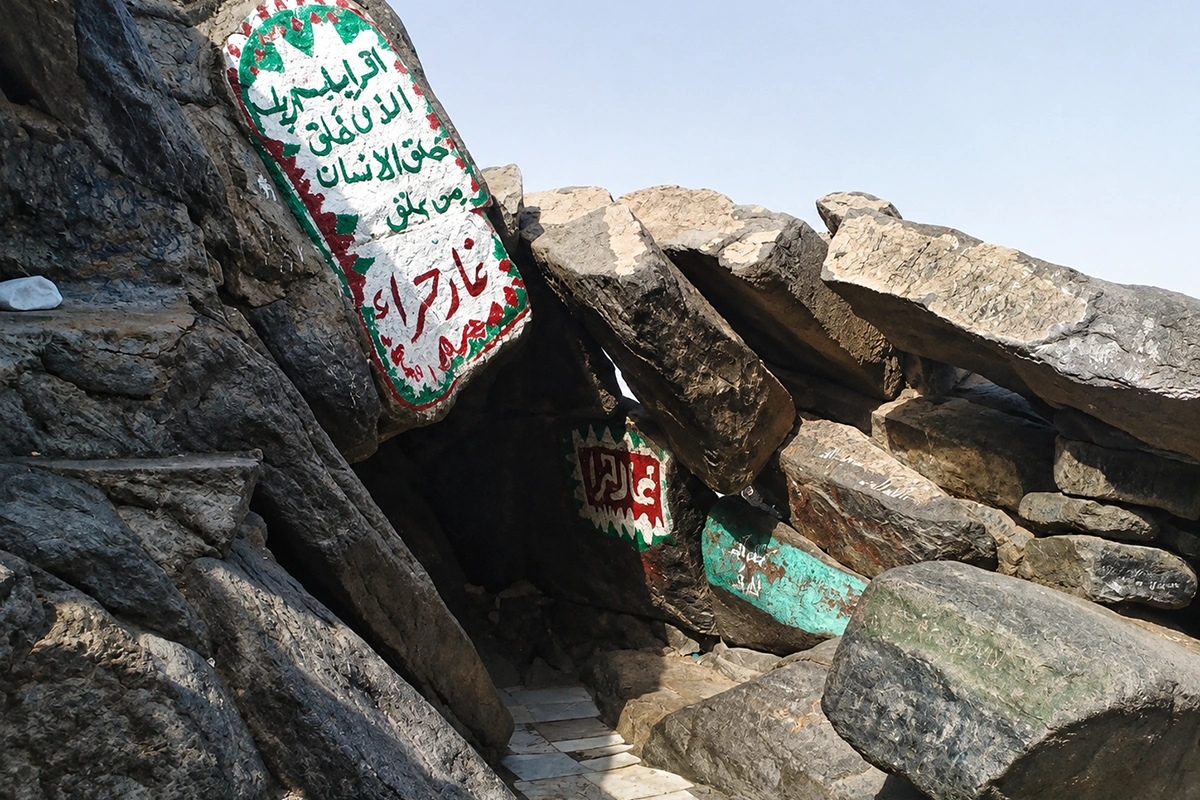
Ghar Hira is a small cave near the summit of Jabal al-Noor in Makkah, roughly 3.5 metres long and holding about five people. Sahih al-Bukhari records that the Prophet Muhammad withdrew there to worship before prophethood, and that the first verses of Surah al-Alaq were revealed to him in it. Climbing to the cave is not part of Hajj or Umrah.
Key takeaways
- ✓Ghar Hira is near the summit of Jabal al-Noor, about 3.5 m long and holding roughly five people.
- ✓The entrance faces north and the inside of the cave faces towards the Kaaba.
- ✓Sahih al-Bukhari records the Prophet's seclusion there and the revelation of Surah al-Alaq 96:1-5.
- ✓The sources do not record him returning to the cave to worship after prophethood began.
- ✓The Saudi Standing Committee called climbing to the cave an innovation; Ibn 'Uthaymeen said climbing only to look should not be rebuked.
- ✓The climb takes most people 45 minutes to 1.5 hours, and there is no vehicle or wheelchair access.
- ✓The Hira Cultural District at the base tells the same story indoors for anyone who cannot climb.
Quick facts
- City
- Makkah
- Where
- Near the summit of Jabal al-Noor, about 4 km from the Haram
- Size
- About 3.5 m long, 2 m high, 1.3 m at its widest
- Capacity
- Roughly five people at a time
- Orientation
- Entrance faces north; the interior faces the Kaaba
- Part of Umrah
- No
- Can a car reach it
- No; a car reaches the base, the rest is on foot
- Climb time
- 45 minutes to 1.5 hours, as reported by visitors
- Best time
- Before sunrise or late afternoon
- If you cannot climb
- Hira Cultural District at the base, indoors and level
A crack in the rock, and how small it really is
People expect something larger. The Cave of Hira is a narrow opening near the summit of Jabal al-Noor, and it holds about five people at a time.
The figures usually given for it are roughly three and a half metres long, about two metres high, and a little over a metre wide at the widest point. The entrance faces north. The inside of the cave faces towards the Kaaba.
That last detail catches most visitors off guard. A man sitting inside is looking, without any wall or window in between, straight down the four kilometres of valley towards the House.
What the Prophet did there before prophethood
Aisha's account, at the very start of Sahih al-Bukhari, describes what came first. Revelation began with true dreams. Then the Prophet was given a love of solitude, and he would withdraw to the cave of Hira and worship there for several nights at a stretch before going back to Khadijah for more food, and then returning again.
Two things are worth noticing in that account. This went on for a period, not a single night. And he did it before he was a prophet, before any command to do so had come.
What happened in the cave
The angel came to him there and said: Read.
He answered that he did not read. The angel took hold of him and pressed him until he could bear no more, then released him and said again: Read. The same answer, the same pressing, a third time. Then came the words of Surah al-Alaq: read in the name of your Lord who created, created man from a clinging clot.
He came down the mountain with his heart pounding and went to Khadijah, asking to be covered until the fear left him. She took him to her cousin Waraqah ibn Nawfal, an old man who had studied the earlier scriptures. Waraqah told him that what had come to him was the same that came to Musa, and that his people would drive him out.
All of this is in Bukhari, in the opening chapter on the beginning of revelation. It is as strong as evidence gets.
What the sources do not record
Here is a point that changes how many pilgrims think about the cave.
The early sources do not record the Prophet returning to Ghar Hira to worship after the revelation began. He lived in Makkah for another thirteen years. He passed the mountain constantly. The seclusion in the cave belongs to the period before prophethood, and it does not appear afterwards.
The Standing Committee for Issuing Fatwas made the same observation about the generations that followed: fourteen centuries have passed, and none of the caliphs who succeeded the Prophet are known to have climbed up to it. On that basis they called climbing to the cave an innovation, and warned that treating a place as sacred in itself is a step towards shirk.
Shaykh Ibn 'Uthaymeen added a distinction worth keeping in mind. If someone climbs simply to look at the place, without seeking nearness to Allah through the climb itself, he said that person should not be rebuked.
So: a real place, named in the most authentic sources, with no prescribed act of worship attached to it. Both halves of that are true, and pilgrims are owed both.
What it is like at the cave today
You reach a small clearing near the top, and the entrance is below and to the side, down a short scramble over rock.
Expect a queue. Because only a handful of people fit inside, visitors go in and out in small groups, and at busy times you may wait longer at the top than you spent climbing. The space is dark, hot and tight. Anyone who is uneasy in confined spaces should be honest with themselves about that before starting up the mountain.
Some visitors reach the summit, look at the entrance, and choose not to go in. That is a perfectly reasonable visit.
Getting to the cave
There is one way up and it is on foot. No road reaches the cave, no vehicle goes past the base of the mountain, and there is no lift or accessible route.
A car takes you to the Hira Cultural District at the foot of Jabal al-Noor. From there the path begins. Most people report the climb taking between three quarters of an hour and an hour and a half, on uneven stone steps and rocky ground with almost no shade.
Practical advice from pilgrims who have done it: start before sunrise or go late in the afternoon, carry more water than you think you need, wear proper shoes, and do not attempt it on the same day as a long tawaf and sa'i.
Because taxis at the trailhead are unpredictable, especially at dawn, most visitors arrange a private car for Makkah Ziyarat that waits while they climb.
If you cannot climb
Many pilgrims cannot, and the trip is still worth making.
The Hira Cultural District at the base tells the story of the revelation through the Revelation Exhibition and the Holy Qur'an Museum. It is indoors, level and air-conditioned. The district and the path are open around the clock; the museums and exhibitions run Saturday to Wednesday from 7:30am to 11:30pm, Thursday from 7:30am to 1:00am, and Friday from 3:30pm to 1:00am. Those hours have changed before, so check on the day.
Elderly parents, wheelchair users and families with young children can spend a good hour or two there while others in the group climb.
Where it fits in a Makkah ziyarat round
Ghar Hira is one stop on a route that usually takes a half day.
| Cave Hira | Where the first revelation came. Steep climb, on foot. |
| Cave Thawr | Where the Prophet and Abu Bakr hid during the Hijrah. A harder climb again. |
| Masjid Aisha (Taneem) | The miqat used for a second Umrah from inside Makkah. |
| Jannat al-Mu'alla | Makkah's historic cemetery. |
Our Makkah Ziyarat guide puts these in a workable order for one morning, and the Makkah Ziyarat tour covers the standard route with a driver who knows where to park at each stop.
If you are still planning the trip as a whole, our first-time Umrah guide covers the rites in order, and a private ziyarat car is the part of the day that saves you the most time.
Accuracy note
The Prophet's seclusion at Hira, the coming of the angel, the first verses of Surah al-Alaq, and his return to Khadijah and then to Waraqah ibn Nawfal are all recorded in Sahih al-Bukhari in the chapter on the beginning of revelation, narrated by Aisha. This is established evidence.
The cave's dimensions, its northward-facing entrance and the interior facing the Kaaba come from Saudipedia. Opening hours and facilities at the base come from the Hira Cultural District's own material.
Climb times are what visitors report and vary with fitness and heat; they are not an official figure. We have deliberately not given a step count for the path, because the numbers repeated online do not trace back to a source we can verify. The ruling on climbing is quoted from the Standing Committee for Issuing Fatwas and from Shaykh Ibn 'Uthaymeen. Verified August 2026.
Frequently asked questions
Planning a Saudi trip?
Pre-book a private car, find a stay, or ask us anything on WhatsApp.
Last updated: 26 August 2026·Sources reviewed by the Wadana Go editorial team.