Jabal al-Noor: The Mountain of Light and How to Visit It
Short answer
Jabal al-Noor, the Mountain of Light, stands 642 metres above sea level and about four kilometres north-east of the Grand Mosque in Makkah. The Cave of Hira sits at its summit, where the first verses of the Qur'an were revealed. Climbing it is not part of Hajj or Umrah, and Saudi scholars discourage climbing as an act of worship.
Key takeaways
- ✓Jabal al-Noor is 642 metres above sea level, roughly four kilometres north-east of Masjid al-Haram.
- ✓The Cave of Hira sits at the summit; the Prophet's seclusion there is recorded in Sahih al-Bukhari.
- ✓Climbing is not part of Hajj or Umrah, and the Saudi Standing Committee called the climb an innovation.
- ✓Ibn 'Uthaymeen said a person who climbs only to look, not to seek nearness to Allah, should not be rebuked.
- ✓The Hira Cultural District at the base covers 67,000 square metres and has hosted over four million visitors.
- ✓The climb takes most people 45 minutes to an hour and a half, on uneven steps with almost no shade.
- ✓A car reaches the base only. There is no vehicle or wheelchair access to the cave.
Quick facts
- City
- Makkah
- Height
- 642 m above sea level
- Distance from the Haram
- About 4 km north-east
- At the summit
- Ghar Hira, the Cave of Hira
- Can a car reach it
- To the base only; the climb is on foot
- Climb time
- Around 45 minutes to 1.5 hours, as reported by visitors
- Part of Umrah
- No
- At the base
- Hira Cultural District, open 24 hours
- Best time to climb
- Before sunrise or late afternoon
- Wheelchair access
- District yes; the mountain path no
A mountain you can see from the road
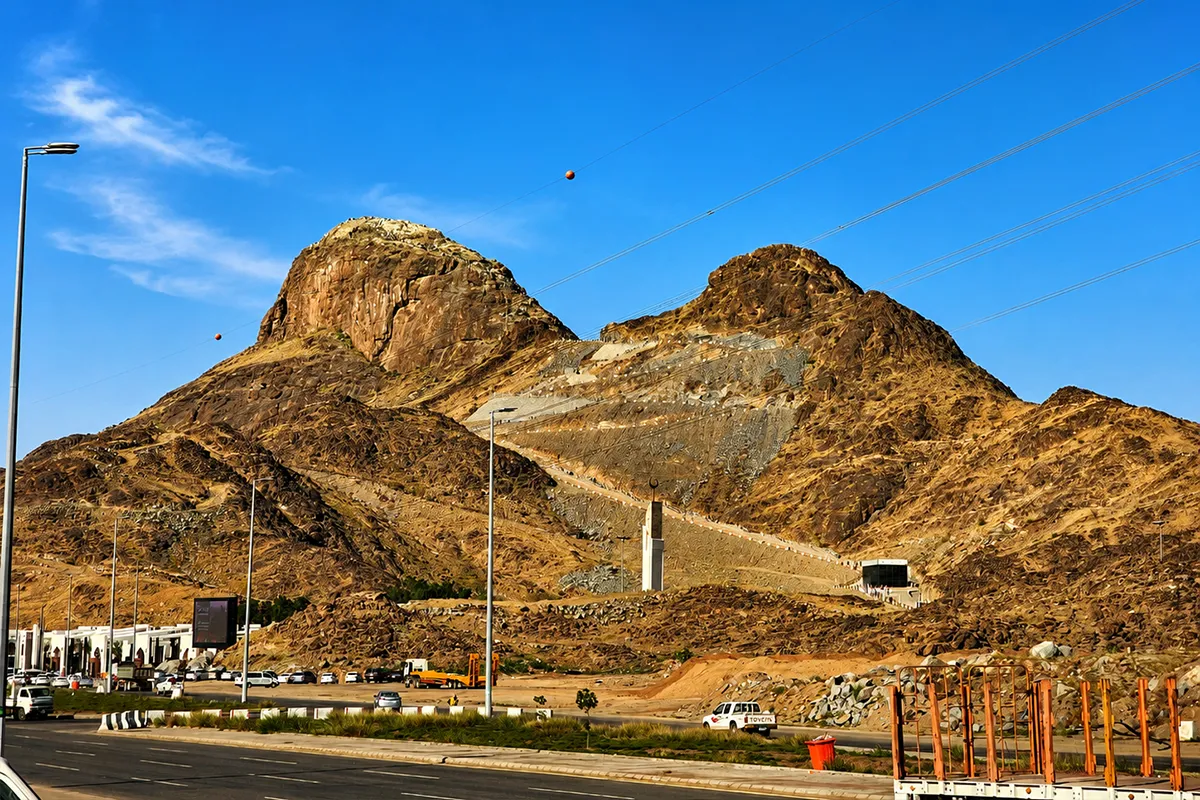
Jabal al-Noor stands about four kilometres north-east of the Grand Mosque, and it is easy to pick out. The summit has an odd shape, a lump that Saudipedia describes as looking like a camel's hump. Once someone points it out to you, you will spot it every time you drive that stretch of road.
The mountain rises to 642 metres above sea level and covers around 5,250 square metres. The lower slopes are gentle. From about 380 metres up, the climb turns steep, eases again near 500 metres, then rises sharply to the top.
At the summit is a small opening in the rock. That opening is Ghar Hira, the Cave of Hira, and it is the reason anyone climbs at all. We cover the cave itself, and what happened there, in our article on Cave Hira.
The name, and where it comes from
Almost everyone today calls the mountain Jabal al-Noor, the Mountain of Light. In the early sources the place is usually named after the cave rather than the mountain: Hira. If you read older Seerah material and cannot find "Jabal al-Noor" in it, that is why. The name is a later popular one and nothing in Islamic law hangs on it.
Why pilgrims know this mountain
Before prophethood, the Prophet Muhammad used to withdraw to the cave at the top of this mountain and stay there for several nights at a time, worshipping alone, before returning to his family for more provisions. Aisha's account of this is recorded in Sahih al-Bukhari at the very opening of the collection.
It was there that the angel came to him with the command to read, and the first verses of Surah al-Alaq were revealed. He came down the mountain shaking and went to Khadijah.
So this is not a place of legend or loose attribution. The mountain and the cave are named in the most authentic sources Muslims have. That is worth saying, because plenty of sites sold to pilgrims as ziyarat rest on far thinner ground.
Is climbing it part of Hajj or Umrah?
No, and it is worth being clear about this before you decide whether to spend half a morning on it.
Climbing to the cave is not one of the rites of Hajj or Umrah, and no reward for the climb is established in authentic evidence. The Standing Committee for Issuing Fatwas in Saudi Arabia went further and called the climb an innovation, pointing out that fourteen centuries have passed and none of the caliphs who succeeded the Prophet are known to have done it. Their concern was that treating the spot as a place of worship opens a door towards shirk.
Shaykh Ibn 'Uthaymeen drew a distinction that many pilgrims find useful. If a person climbs simply to look at the place, without seeking nearness to Allah by the act of climbing, he said such a person should not be rebuked.
Weigh that honestly. Go to see where something happened, if you wish, and do not go expecting a reward that has not been promised.
The Hira Cultural District at the base
The bottom of the mountain looks nothing like it did ten years ago. The Hira Cultural District now covers about 67,000 square metres at the foot of Jabal al-Noor and has received more than four million visitors from 132 countries.
What is there:
- The Revelation Exhibition, which walks through the story of the Qur'an's revelation using displays and augmented reality.
- The Holy Qur'an Museum.
- A visitor centre, shops and cafes.
- A special exhibitions hall with changing displays.
- The prepared path that begins the climb to the cave.
The district itself and the path to the cave are open around the clock. The museums and exhibitions keep their own hours: Saturday to Wednesday from 7:30am to 11:30pm, Thursday from 7:30am to 1:00am, and Friday from 3:30pm to 1:00am. Hours have changed more than once as visitor numbers grew, so check before you set out.
Many pilgrims who decide not to climb still come here. The exhibition gives you the history without the mountain, and it is comfortable, indoors and air-conditioned. You can book it as a visit to the Hira Cultural District, or pair it with the Museum of the Prophet's Biography on the same afternoon.
What the climb is actually like
Be realistic about this one. It is a genuine hill walk in a hot country, not a viewpoint you stroll up to.
The route is a mix of stone steps and rocky path. It is uneven in places, and there is very little shade on the way up. Visitors commonly report the climb taking somewhere between three quarters of an hour and an hour and a half, depending on fitness and how often you stop. Coming back down is quicker but harder on the knees.
At the top, the cave is small and there is often a queue to get inside. It holds about five people at a time.
Who should think twice: anyone with a heart or breathing condition, anyone unsteady on their feet, wheelchair users, and parents carrying small children. There is no vehicle access and no lift. If you are already tired from tawaf and sa'i, this is not the day.
If you do go, go before sunrise or in the late afternoon, carry more water than you think you need, and wear real shoes rather than sandals.
Getting there
A car can take you to the base of the mountain and no further. Everything above that point is on foot.
From most hotels in the central Makkah area the drive is short, since the mountain is only around four kilometres from the Haram, though traffic in the surrounding streets can be slow at prayer times. Public buses do not run to the trailhead, and taxi availability on the way back down is unpredictable, particularly at odd hours.
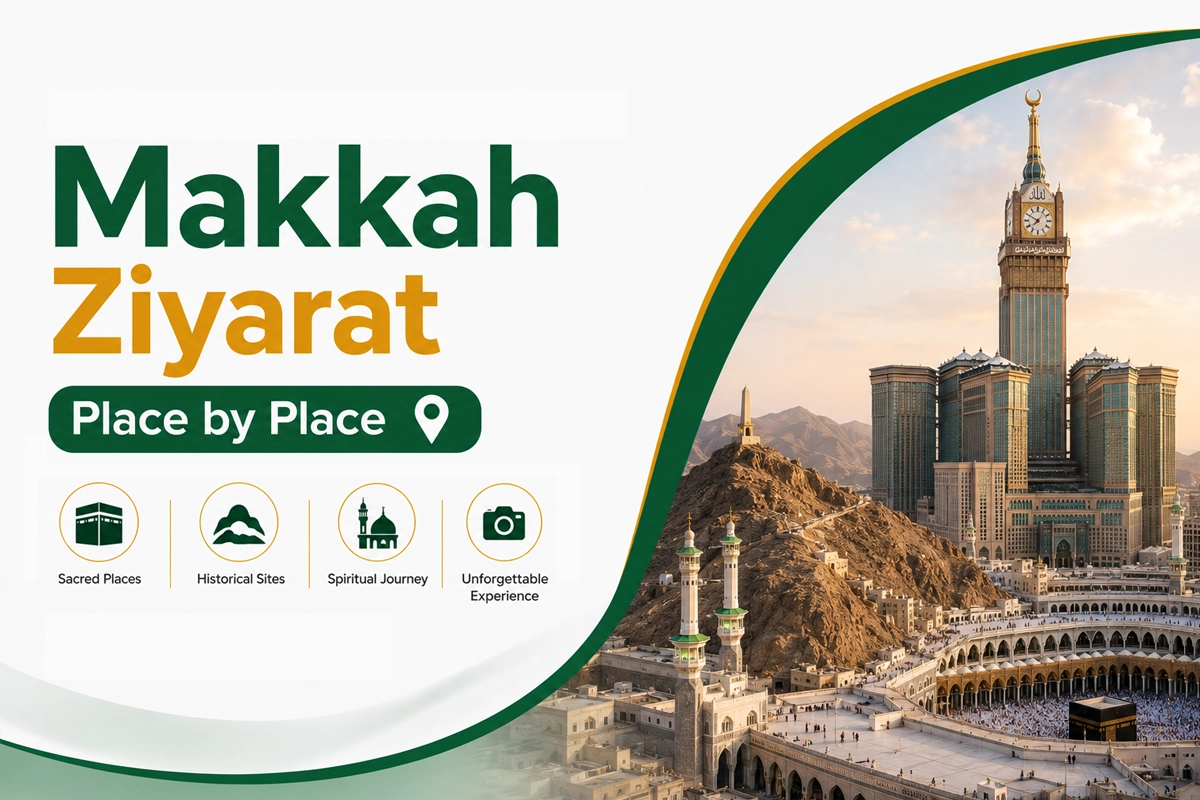
This is where a driver who waits makes the difference. A Makkah Ziyarat private car stays with you while you climb, so you are not standing at the roadside afterwards trying to find a ride with tired legs. Most pilgrims combine it with the other Makkah sites in one round; our Makkah Ziyarat tour covers the usual route.
What else is on the same round
Jabal al-Noor is normally visited alongside the other Makkah sites rather than on its own.
| Jabal Thawr | The cave of the Hijrah, south of Makkah. An even harder climb. |
| Masjid Aisha (Taneem) | The nearest miqat for a second Umrah from inside Makkah. |
| Jannat al-Mu'alla | The historic cemetery of Makkah. |
| Masjid al-Jinn | In the Mu'alla area, close to the cemetery. |
Our Makkah Ziyarat guide sets out the full route and a sensible order for a half-day. For the city as a whole, see the Makkah destination page.
Planning the visit
Give it half a day if you intend to climb, including the drive each way and time at the exhibition. Two hours is enough if you are only visiting the district at the base.
Fit it around your Umrah, not the other way round. Our Umrah itinerary guide shows where a ziyarat morning fits in a three, five or seven-day trip, and a private car with a driver who knows the sites saves you the part of the day that usually goes wrong.
Accuracy note
The Prophet's seclusion in the cave of Hira and the first revelation are recorded in Sahih al-Bukhari, narrated by Aisha. Those are established facts, not traditional attribution.
The mountain's height of 642 metres, its area of about 5,250 square metres, the four-kilometre distance north-east of the Grand Mosque, and the description of the summit come from Saudipedia. District size, visitor numbers and opening hours come from the Hira Cultural District's own material.
Climb times are what visitors report, not an official figure, and they vary a great deal with fitness and heat. We have not given a step count, because the numbers in circulation do not come from a source we can stand behind. The ruling on climbing is quoted from the Standing Committee for Issuing Fatwas and from Shaykh Ibn 'Uthaymeen. Verified August 2026; check current opening hours before you travel.
Frequently asked questions
Planning a Saudi trip?
Pre-book a private car, find a stay, or ask us anything on WhatsApp.
Last updated: 26 August 2026·Sources reviewed by the Wadana Go editorial team.