The Holy Kaaba: What It Is, and What It Is Not
Short answer
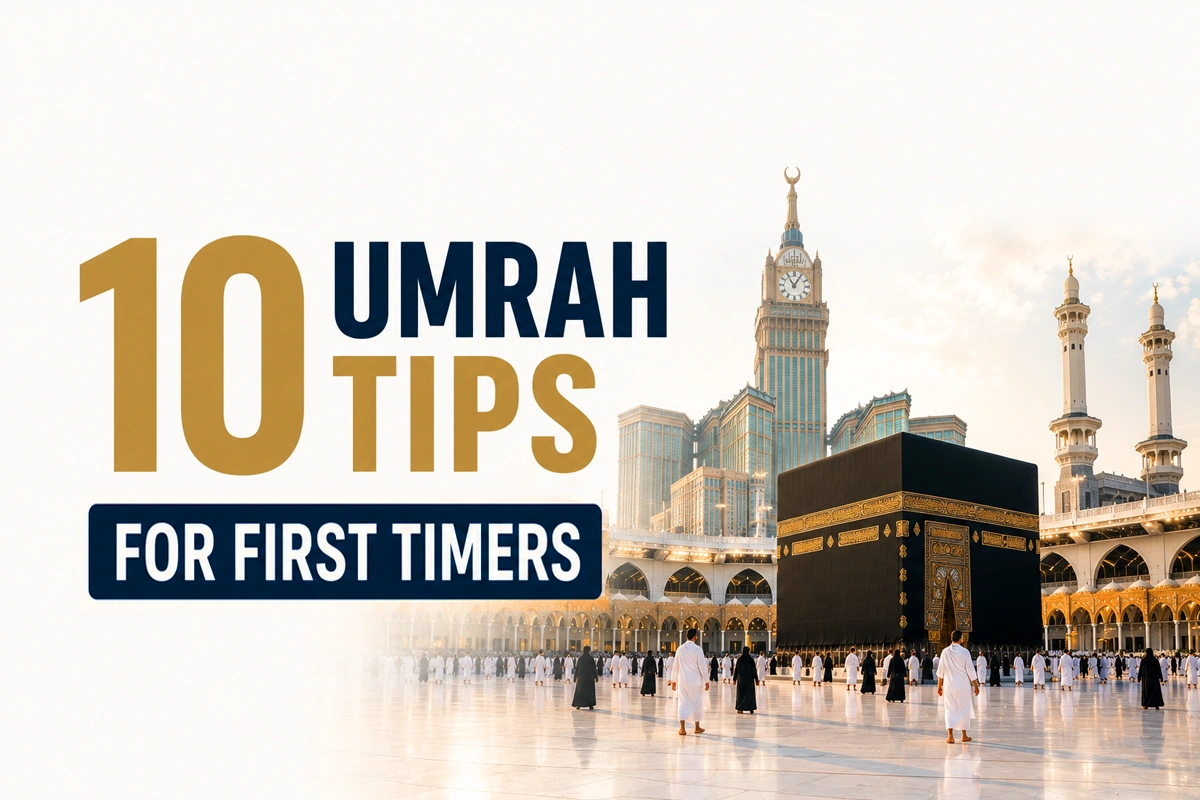
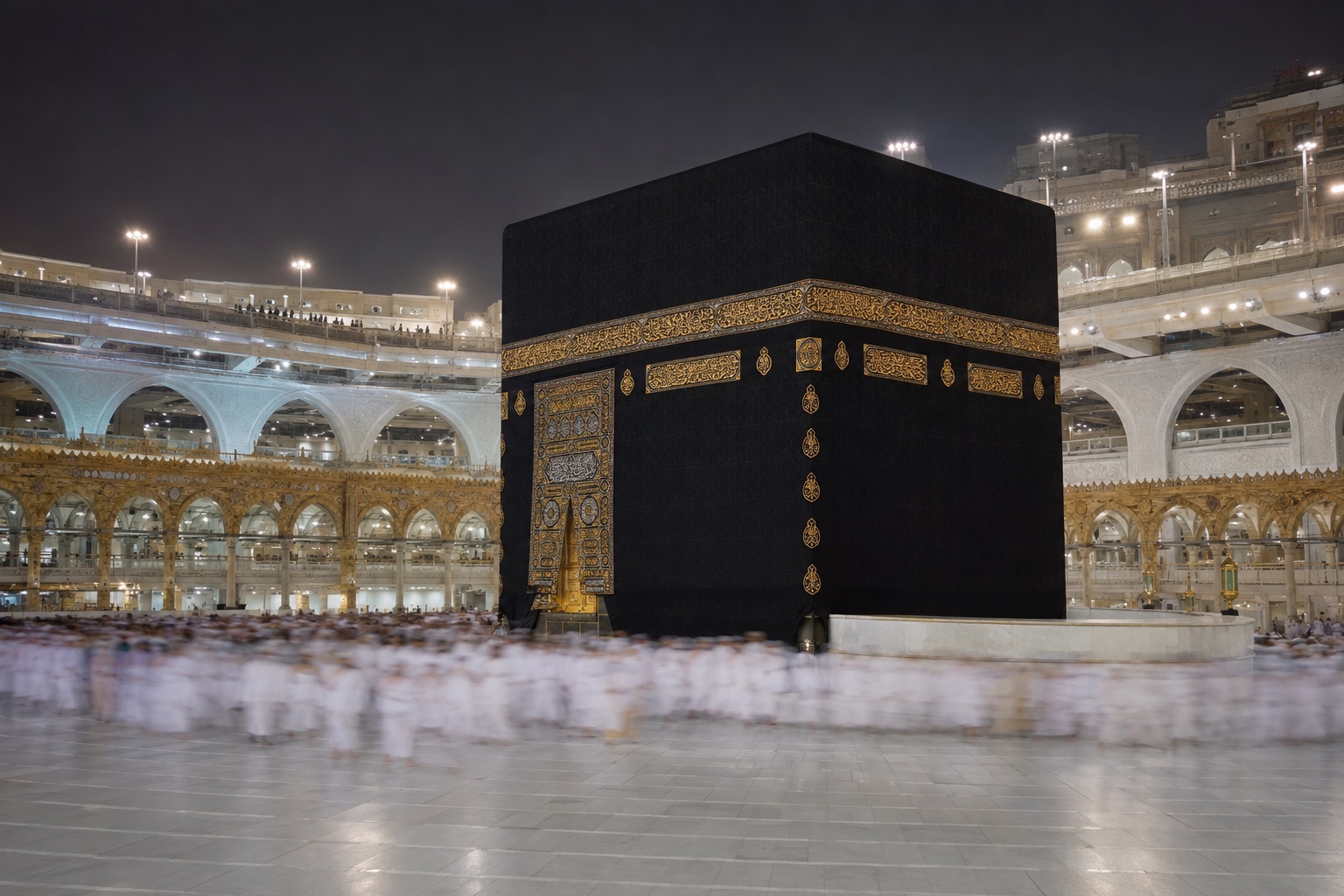
The Kaaba is the cube-shaped building at the centre of Masjid al-Haram in Makkah, about 13 metres tall and empty inside. The Quran records that Ibrahim and Ismail raised its foundations, and that Muslims must face it in prayer. Muslims do not worship it. They face it. It is covered by the Kiswah, a black silk cloth replaced once a year during Hajj season.
Key takeaways
- ✓Muslims face the Kaaba in prayer. They do not worship it, and Islam's own sources say so directly.
- ✓The Quran records that Ibrahim and Ismail raised its foundations (2:127), and that it is the qibla (2:144).
- ✓Hijr Ismail, the low curved wall, marks part of the original footprint left outside when the Quraysh rebuilt it.
- ✓The Kiswah is replaced once a year during the Hajj season, and the old cloth is cut up and given away.
- ✓No ordinary pilgrim enters the Kaaba, and no rite of Hajj or Umrah requires it.
- ✓Claims about zero magnetism, the centre of the earth or satellite radiation have no basis in any Islamic source.
- ✓Late night, between Isha and Fajr, is the quietest time for tawaf close to it.
Quick facts
- Location
- Centre of Masjid al-Haram, Makkah
- Height
- About 13 m
- Covering
- Kiswah, replaced yearly at Hajj
- Built by
- Ibrahim and Ismail (Quran 2:127)
- Entry
- Not open to pilgrims
- Quietest for tawaf
- Between Isha and Fajr
The Kaaba is the cube-shaped building at the centre of Masjid al-Haram in Makkah. Muslims everywhere face it when they pray. It is the oldest and most recognisable structure in Islam, and it is also the most misunderstood by people outside the faith.
This article explains what it is, what the Quran says about it, and what a pilgrim actually sees. For the method of performing tawaf around it, read our step-by-step Umrah guide.
What the Kaaba is
It is a stone building, roughly cube-shaped, standing in an open marble courtyard. It is around 13 metres tall, about 12 metres on its longer side and 11 metres on the shorter. It is empty inside apart from pillars, lamps and an inner covering. Nobody lives in it and no prayers are held inside it as a congregation.
The Quran calls it al-Bayt, the House, and describes it as the first house of worship established for people (Quran 3:96).
It is not worshipped, and that matters
This is the point most worth being clear about, because it is the most common misunderstanding.
Muslims do not worship the Kaaba. They face it. The difference is not a technicality, and Islam's own sources are blunt about it.
When Umar ibn al-Khattab kissed the Black Stone set in the Kaaba's corner, he said in front of the crowd: "I know that you are only a stone and can neither harm nor benefit. Had I not seen the Messenger of Allah kissing you, I would not have kissed you." That is recorded in both Sahih al-Bukhari and Sahih Muslim. He said it publicly, during the pilgrimage season, precisely so that people would hear it and pass it on.
The Kaaba is a direction, and a place made sacred by God's command. It is not an object with power of its own.
What the Quran says about it
Two passages carry most of what is established.
Ibrahim and Ismail raised its foundations. "And when Ibrahim was raising the foundations of the House, with Ismail, saying: Our Lord, accept this from us. You are the All-Hearing, the All-Knowing" (Quran 2:127). Father and son built it together, and the verse records their prayer as they worked.
It is the qibla. "So turn your face toward al-Masjid al-Haram. And wherever you are, turn your faces toward it" (Quran 2:144). Before this verse came down, Muslims prayed toward Jerusalem. The change happened during a prayer in Madinah, and the congregation turned where they stood.
The parts you will hear named
- Hajar al-Aswad, the Black Stone, set in the eastern corner. Tawaf begins and ends here. It has its own article: the Black Stone explained.
- The door, raised well above ground level on one side, in gold. It is opened only rarely.
- The Multazam, the stretch of wall between the door and the Black Stone, where people press themselves and make dua.
- Hijr Ismail, the low curved wall on one side enclosing a semicircle of marble. This area was part of the original structure. Praying inside it counts as praying inside the Kaaba, which is why it is always busy.
- The Rukn al-Yamani, the Yemeni corner, touched during tawaf but not kissed.
- Maqam Ibrahim, the stone in a gold-toned enclosure a short distance from the Kaaba, associated with where Ibrahim stood while building.
The Kiswah, the black cloth
The black covering is called the Kiswah. It is woven from silk, dyed black, and embroidered with Quranic verses in gold thread. A dedicated factory in Makkah makes it.
It is replaced once a year during the Hajj season. The old cloth is removed and cut up, and pieces are given as gifts to institutions and dignitaries.
The Kaaba's interior is also washed in a ceremony held periodically, using water mixed with rosewater and oud. Taif rose oil has long been part of that mixture, which is a small link between the mountain town and the House.
It has been rebuilt more than once
The Kaaba standing today is not the original structure. It has been damaged and rebuilt several times across its history, by flood, by fire and by conflict.
One rebuilding happened during the Prophet's own lifetime, before his prophethood, when the Quraysh repaired it after a flood. They ran short of lawful funds and built on a smaller footprint than Ibrahim's, leaving part of the original area outside the walls. That excluded portion is the semicircle now marked by Hijr Ismail.
The Prophet later told Aisha that he would have rebuilt it on Ibrahim's foundations, had the people not been so recently out of disbelief that the change might unsettle them. That report is in the authentic collections, and it is why the Hijr is treated as part of the House.
What not to believe
A great deal circulates about the Kaaba online that has no basis. Some of it is well meant. None of it is needed.
- That it is the exact geographical centre of the earth. A sphere has no centre on its surface. This claim appears in no Islamic source and does not survive basic geography.
- That it sits in a zone of zero magnetism or zero gravity. Neither is true, and neither is claimed by any traditional authority.
- That satellite images show radiation or light emanating from it. These images are edited.
- That the Kaaba is never covered by shadow, or that compasses fail near it. Both are false.
The Kaaba's status comes from God's command, recorded in the Quran and practised since Ibrahim. It does not need invented physics, and repeating these claims damages the credibility of the people who do it.
What a pilgrim actually sees
Smaller than expected, and more moving than expected. Almost everyone says some version of that.
You come through a gate, along a corridor, and then the courtyard opens and it is there. People stop. There is a widely known practice of making dua at the first sight of it.
Around it, tawaf runs continuously, day and night, in a slow anticlockwise current. Close in, on the marble of the mataf, the crowd is dense and the pace is set by the people around you. On the upper floors the circuit is far longer and much calmer.
You cannot enter the Kaaba. The door is opened only for cleaning and for a small number of invited guests. No ordinary pilgrim goes inside, and no Umrah or Hajj rite requires it. Anyone offering to arrange entry is not telling the truth.
Practical notes for a first visit
- The quietest hours for tawaf near the Kaaba are late at night, between Isha and Fajr.
- The marble courtyard is hot underfoot from May to September. Early morning and after dark are kinder.
- Photography is common in the mosque, but be considerate. People are praying and weeping around you.
- Hijr Ismail is small and always crowded. Praying inside it is not required, and it is not worth being crushed for.
- If you are travelling with elderly parents or children, the upper levels are the sensible choice. Our family Umrah guide covers pacing.
Getting to Makkah
Makkah is open to Muslims only, and it is checked at road checkpoints on every approach. Almost every pilgrim arrives through Jeddah, about 90 km away, a drive of 60 to 90 minutes.
No car reaches the Kaaba. You walk the last stretch from wherever your driver can stop, which at prayer times can be several hundred metres. That makes your hotel's distance from the Haram the decision that shapes the trip. See where to stay in Makkah, and the wider Makkah city page for how the areas compare.
Arriving for Umrah? A pre-booked car meeting you at Jeddah arrivals is worth more than the money it saves when you land in ihram with luggage and family. Our Jeddah Airport to Makkah transfer is a fixed fare per vehicle, from SAR 260, agreed before you fly.
Accuracy note
Religious and historical claims here were checked against the Quran, the authentic hadith collections and reliable historical sources. Popular claims with no such basis are named above rather than quietly omitted. Measurements of the Kaaba vary slightly between sources because of how the structure is measured; the figures given are the commonly cited ones. Verify current visiting conditions before you travel.
Planning your Umrah? Tell our Jeddah-based team your dates and how close to the Haram you want to be, and we will price the stay, the flights and the transport together. Get a free quote.
Frequently asked questions
Planning a Saudi trip?
Pre-book a private car, find a stay, or ask us anything on WhatsApp.
Last updated: 22 August 2026·Sources reviewed by the Wadana Go editorial team.