Complete Umrah Duas — Arabic, Transliteration & Meaning
Religious guidance reviewed against classical sources. Rulings can differ by school and circumstance — for a decision specific to you, consult a qualified scholar. See our editorial policy.
Short answer
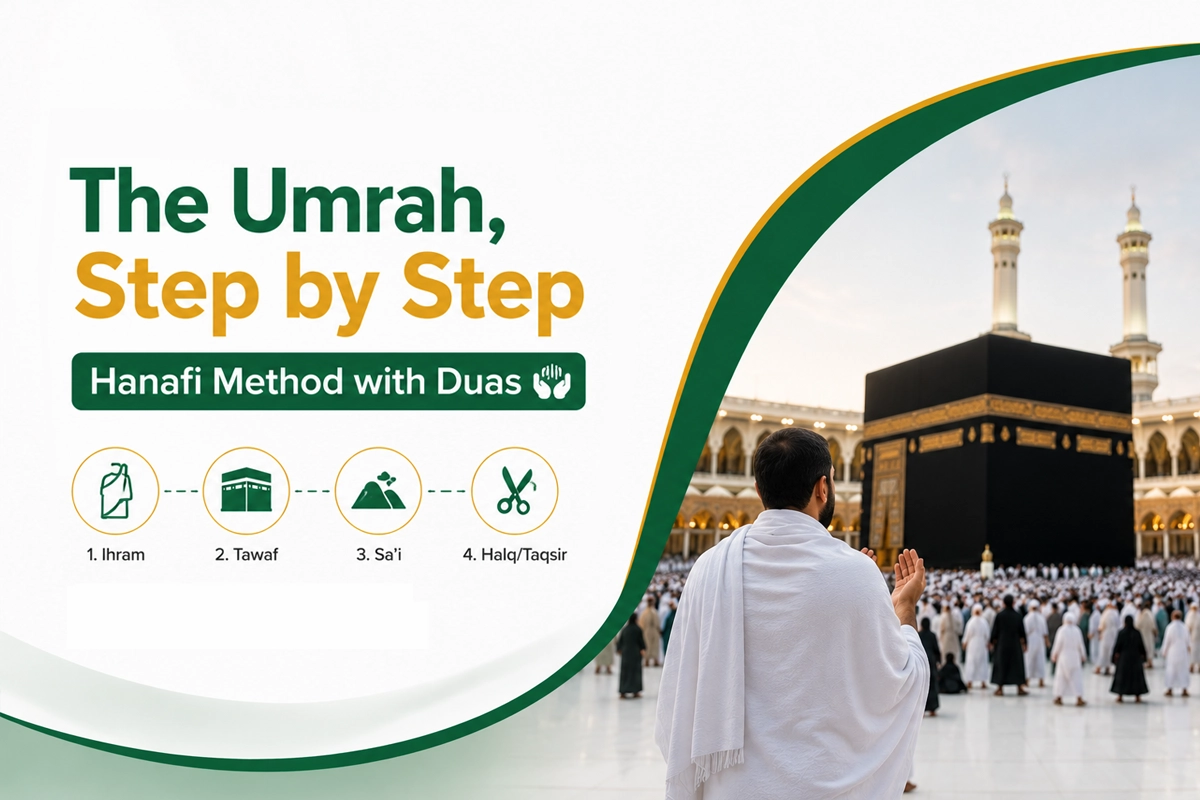
Umrah has only a few established duas: the Talbiyah (from the miqat), the intention for Umrah, 'Bismillāh, Allāhu akbar' when starting each tawaf circuit at the Black Stone, the Qur'anic du'a 'Rabbanā ātinā…' between the Yamani corner and the Black Stone, reciting Qur'an 2:158 approaching Safa, and the takbīr/tahlīl on Safa and Marwah. There is no fixed du'a for each circuit — between the set duas you may make any du'a or dhikr in any language.
Key takeaways
- ✓The Talbiyah is recited on entering ihram and repeated until tawaf begins.
- ✓Start each tawaf circuit facing the Black Stone with 'Bismillāh, Allāhu akbar'.
- ✓Between the Yamani corner and Black Stone, say the Qur'anic du'a 'Rabbanā ātinā fi-d-dunyā ḥasanah…'.
- ✓Approaching Safa, recite Qur'an 2:158; on Safa and Marwah, say the takbīr and tahlīl facing the Kaʿbah.
- ✓There is NO fixed du'a per circuit — 'special du'a per lap' booklets aren't from the Sunnah; make your own du'a freely.
Quick facts
- Talbiyah
- From the miqat
- Tawaf start
- Bismillāh, Allāhu akbar
- Corner du'a
- Rabbanā ātinā…
- Safa
- Qur'an 2:158
- Per-circuit du'a
- None fixed
- Language
- Any, for personal du'a
Many pilgrims worry about memorising a long list of “correct” duas for each circuit of ṭawāf and saʿy. The reassuring reality: there are only a few established duas in Umrah, and between them you may make any du'a or dhikr you wish, in any language. Below are the authentic ones by stage, in Arabic, transliteration and meaning. Texts are well-attested; for pronunciation and fiqh, learn from a qualified teacher.
1. The Talbiyah (from the miqat)
Recited on entering ihram and repeated often until you begin ṭawāf:
Talbiyah
لَبَّيْكَ اللَّهُمَّ لَبَّيْكَ، لَبَّيْكَ لَا شَرِيكَ لَكَ لَبَّيْكَ، إِنَّ الْحَمْدَ وَالنِّعْمَةَ لَكَ وَالْمُلْكَ، لَا شَرِيكَ لَكَ
Labbayk Allāhumma labbayk, labbayka lā sharīka laka labbayk, inna-l-ḥamda wa-n-niʿmata laka wa-l-mulk, lā sharīka lak.
“Here I am, O Allah, here I am. Here I am, You have no partner, here I am. Truly all praise, grace and sovereignty are Yours. You have no partner.”
2. The intention for Umrah
At the miqat, intend Umrah in the heart; it may be voiced simply:
لَبَّيْكَ اللَّهُمَّ عُمْرَةً
Labbayka Allāhumma ʿumrah.
“Here I am, O Allah, for Umrah.”
3. On seeing the Kaʿbah
There is no obligatory fixed du'a here — it is a moment of accepted supplication, so raise your hands and make heartfelt du'a for whatever you wish. Many begin with takbīr (Allāhu akbar) and tahlīl (Lā ilāha illā Allāh).
4. Beginning ṭawāf — the Black Stone
Facing the Black Stone (al-Ḥajar al-Aswad) at the start of each circuit, point or gesture to it and say:
بِسْمِ اللَّهِ، اللَّهُ أَكْبَر
Bismillāh, Allāhu akbar.
“In the name of Allah; Allah is the Greatest.”
Through the rest of each circuit, there is no prescribed du'a — make du'a, recite Qur'an or dhikr freely.
5. Between the Yamani corner and the Black Stone
In the final stretch of each circuit, the Prophet ﷺ used to say this Qur'anic du'a:
Rukn Yamānī → Black Stone
رَبَّنَا آتِنَا فِي الدُّنْيَا حَسَنَةً وَفِي الْآخِرَةِ حَسَنَةً وَقِنَا عَذَابَ النَّارِ
Rabbanā ātinā fi-d-dunyā ḥasanah wa fi-l-ākhirati ḥasanah wa qinā ʿadhāba-n-nār.
“Our Lord, give us good in this world and good in the Hereafter, and protect us from the punishment of the Fire.”
6. Approaching Safa (before saʿy)
As you come to Safa to begin saʿy, recite this verse, then say “I begin with what Allah began with”:
إِنَّ الصَّفَا وَالْمَرْوَةَ مِنْ شَعَائِرِ اللَّهِ
Inna-ṣ-ṣafā wa-l-marwata min shaʿāʾiri-llāh… (Nabdaʾu bimā badaʾa-llāhu bih.)
“Indeed, Safa and Marwah are among the symbols of Allah… We begin with what Allah began with.”
7. On Safa and Marwah (facing the Kaʿbah)
On each of Safa and Marwah, face the Kaʿbah, raise the hands and say (three times), making du'a in between:
On Safa & Marwah
اللَّهُ أَكْبَرُ، اللَّهُ أَكْبَرُ، اللَّهُ أَكْبَرُ، لَا إِلَهَ إِلَّا اللَّهُ وَحْدَهُ لَا شَرِيكَ لَهُ، لَهُ الْمُلْكُ وَلَهُ الْحَمْدُ وَهُوَ عَلَى كُلِّ شَيْءٍ قَدِيرٌ
Allāhu akbar (×3). Lā ilāha illā-llāhu waḥdahu lā sharīka lah, lahu-l-mulku wa lahu-l-ḥamd, wa huwa ʿalā kulli shayʾin qadīr.
“Allah is the Greatest (three times). There is no god but Allah alone, with no partner; His is the dominion and His the praise, and He is able to do all things.”
The key point about ṭawāf duas
Beware booklets that assign a “special du'a” to each of the seven circuits — these are not from the Sunnah. Outside the established duas above, use the circuits and the walk between Safa and Marwah to pour out your own du'a to Allah, in any language. That freedom is a mercy, not a gap. For the full sequence, see the first-time Umrah guide; for ihram, the ihram guide.
Frequently asked questions
Planning a Saudi trip?
Pre-book a private car, find a stay, or ask us anything on WhatsApp.
Last updated: 24 July 2026·Sources reviewed by the Wadana Go editorial team.