Al-Hudaybiyah: The Treaty That Looked Like a Defeat
Short answer
Al-Hudaybiyah, known today as al-Shumaisi, is a place about 22 kilometres west of the Grand Mosque, just outside the boundary of the Haram. In the sixth year after the Hijrah the Prophet Muhammad camped there with about 1,400 companions intending Umrah, was refused entry by the Quraysh, and signed the treaty that carries the name of the place.
Key takeaways
- ✓Al-Hudaybiyah is now called al-Shumaisi and lies about 22 km west of the Grand Mosque.
- ✓In year 6 AH the Prophet came with around 1,400 companions to perform Umrah and was stopped by the Quraysh.
- ✓The Pledge of al-Ridwan was given there under a tree, and the Qur'an records Allah's pleasure with those who gave it.
- ✓The terms looked one-sided, yet Surah al-Fath calls the outcome a clear victory.
- ✓Umar ibn al-Khattab had the tree cut down because people had begun praying at it.
- ✓The exact site of the tree is not known today, and that was the point of removing it.
- ✓It serves as a miqat for people inside the Haram boundary who want to enter ihram.
Quick facts
- City
- Makkah Province, Saudi Arabia
- Modern name
- Al-Shumaisi
- Distance from the Haram
- About 22 km west
- Year of the treaty
- 6 AH
- Companions present
- About 1,400
- Car access
- Yes, on the Jeddah road side of Makkah
- Is the tree there?
- No. Cut down in the time of Umar.
- Part of Umrah?
- No, though it functions as a miqat
Where it is, and what it is called now
Al-Hudaybiyah is about 22 kilometres west of the Grand Mosque, out on the Jeddah side of Makkah. On a modern map you will not find that name. The area is called al-Shumaisi today.
It sits just outside the boundary of the Haram, which is not a coincidence. That boundary is exactly what the events of the sixth year turned on, and it is why the place still works as a miqat for people who need to enter ihram from outside the sacred precinct.
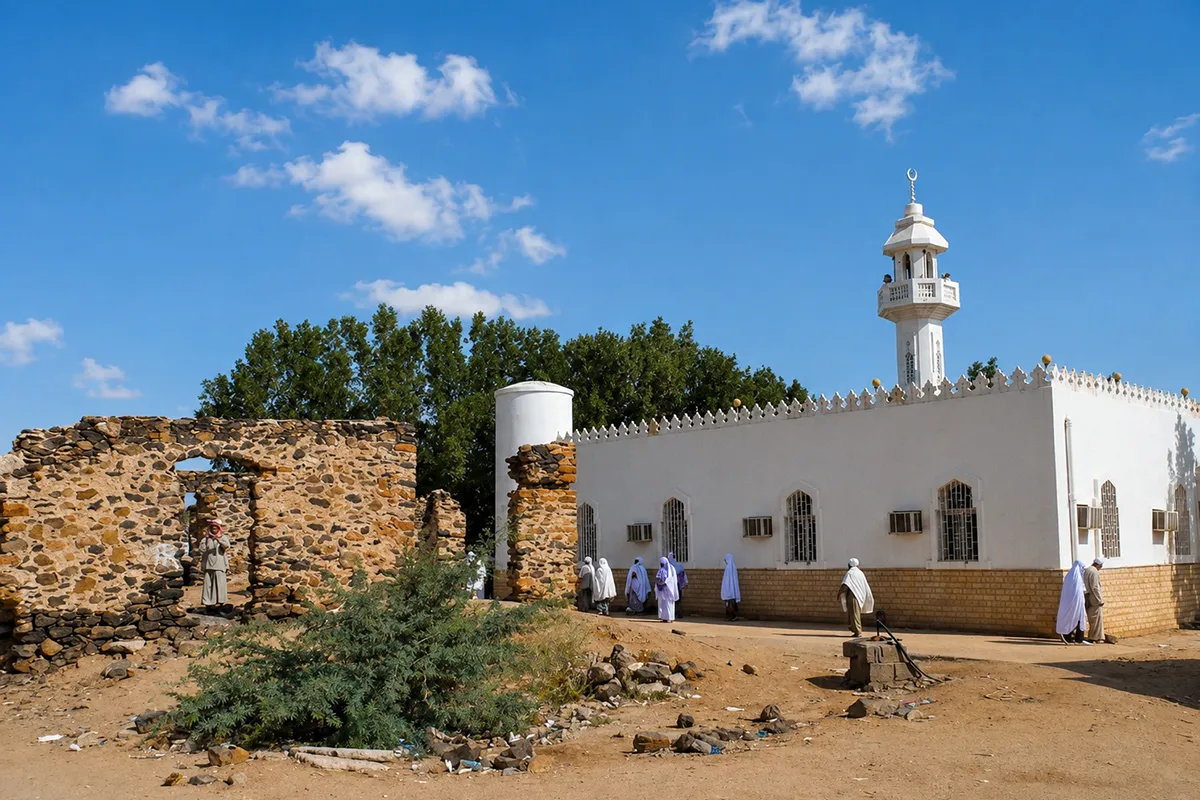
There is a mosque there. What there is not is a preserved battlefield or a marked site, because nothing was built to be preserved and one thing was deliberately removed.
Fourteen hundred men, turned back
In the sixth year after the Hijrah the Prophet Muhammad set out from Madinah for Makkah, intending Umrah. Around 1,400 companions travelled with him. They came in ihram and they brought sacrificial animals with them, which was the plain signal of a pilgrimage rather than an army.
The Quraysh refused to let them in.
The two sides stopped at al-Hudaybiyah and began negotiating. This was the point at which the whole thing could have become a battle, and both sides knew it. Messengers went back and forth.
Uthman ibn Affan was sent into Makkah to talk. Then word came back to the camp that Uthman had been killed.
The Pledge of al-Ridwan
On that news the Prophet called the companions to give him their pledge, and they gave it to him under a tree. It is known as Bay'at al-Ridwan, the Pledge of Good Pleasure.
The name comes from the Qur'an. Surah al-Fath states that Allah was pleased with the believers when they pledged allegiance to the Prophet under the tree, that He knew what was in their hearts, and that He sent down tranquillity upon them and rewarded them with a near victory.
The report of Uthman's death turned out to be false. He returned. But the pledge had been given, and the Qur'an had recorded it.
Why the tree is not there
This is the part of the story that says most about how early Muslims thought, and it is worth telling carefully.
The tree stood after the event. People began to visit it. They began to pray at it. And in his time as caliph, Umar ibn al-Khattab ordered it cut down.
His reason was not that the tree meant nothing. It was that it was starting to mean too much, in a way that would lead people somewhere they should not go.
There is a related report that when companions went back the following year and looked for the tree, they could not agree on which one it was. Scholars discuss whether that means the tree was already gone, or whether it explains why nobody could argue with Umar's decision.
Either way, the outcome is the same. Nobody today can tell you where the tree stood, and any spot pointed out to you as the place is not established. If a guide walks you to a tree at al-Shumaisi and tells you this is the one, that claim has no support at all. The trees you see there now are simply trees.
The terms, and why they looked bad
The agreement signed at al-Hudaybiyah read, at the time, like a list of concessions.
- The Muslims would turn back this year without performing Umrah, and come the following year instead, staying three days.
- There would be a truce of ten years.
- Anyone who came to the Muslims from the Quraysh without their guardian's permission would be returned. Anyone who left the Muslims for the Quraysh would not be.
- Arab tribes were free to enter into alliance with either side.
The third clause in particular was hard to accept, and the companions felt it. Umar's objections at the time are recorded and they are not gentle.
Then Surah al-Fath was revealed, opening with the statement that a clear victory had been granted.
Within two years the reading had changed completely. The truce meant Muslims and Quraysh could travel and talk without fighting, and large numbers accepted Islam in that period. The Quraysh broke the treaty, and the conquest of Makkah followed.
There is a lesson pilgrims take from that, and it does not need embroidering: the companions were not wrong to find the terms painful, and they were wrong about what the terms would produce.
Al-Hudaybiyah as a miqat
Because the site lies outside the Haram boundary, it can be used as a starting point for ihram by someone who is inside that boundary and wants to begin a fresh Umrah.
In practice, most people use Masjid Aisha at Taneem instead, which is far closer and better set up for it. Al-Hudaybiyah is chosen mainly by people who happen to be travelling out that way, or who want to combine the visit with the history.
The same scholarly difference about repeating Umrah within one trip applies here as at Taneem. We set both views out on the Masjid Aisha page rather than repeating them here.
Visiting it today
Be realistic about what there is to see. This is open ground west of Makkah with a mosque on it, in an area now called al-Shumaisi. There is no exhibition, no ruin and no marked spot.
What the visit gives you is scale. Standing there, you can see how far 1,400 men in ihram had come, and how close to Makkah they were told to turn around.
- It is 22 km out, so this is a deliberate trip rather than a stop you pass. Allow an hour and a half or two including the drive.
- Pair it with the Jeddah road if you are travelling that way. It sits on the western side of the city.
- Do not go looking for the tree. There is nothing to find, and being told otherwise is the main thing to be wary of here.
- Non-Muslim travellers cannot enter the Makkah area, so this is a trip for pilgrims already in the city.
A car makes sense for this one in a way it does not for closer sites. There is no useful public transport, and a taxi left at al-Shumaisi is a taxi you may not replace easily. A private car that waits is on our Makkah Ziyarat page, from SAR 200 per vehicle with waiting included. If you are heading on to the airport afterwards, our Jeddah airport transfer runs the same road. Fares reviewed August 2026.
Accuracy note
The expedition of the sixth year, the number of roughly 1,400 companions, the refusal of the Quraysh, the sending of Uthman ibn Affan, the Pledge of al-Ridwan under the tree and the terms of the treaty are recorded in the authentic collections and in the standard early histories.
The Qur'anic references are Surah al-Fath 48:18 for the pledge under the tree, and the opening of the same surah for the description of a clear victory.
That Umar ibn al-Khattab ordered the tree cut down because people had begun praying at it is recorded in the early sources, as is the report that companions returning the following year could not identify it. No present-day tree or spot at al-Shumaisi is established as the site of the pledge, and we have said so plainly.
The modern name al-Shumaisi and the distance of about 22 kilometres west of the Grand Mosque come from Saudi official heritage material on Makkah's historical landmarks. Other sources give slightly different figures for the distance, so treat it as approximate. Fares are our own published rates, reviewed August 2026. Verified August 2026.
Frequently asked questions
Planning a Saudi trip?
Pre-book a private car, find a stay, or ask us anything on WhatsApp.
Last updated: 2 September 2026·Sources reviewed by the Wadana Go editorial team.