Masjid an-Nabawi: The Prophet's Mosque, Explained for Visitors
Short answer
Masjid an-Nabawi is the mosque the Prophet ﷺ built in Madinah after the Hijrah, originally about 1,050 square metres of mud brick and palm trunks. Authentic hadith in Bukhari and Muslim record that a prayer there is worth a thousand elsewhere, and that it is one of only three mosques worth travelling to. Visiting is not a rite of Hajj or Umrah.
Key takeaways
- ✓A prayer in the Prophet's Mosque is better than a thousand prayers elsewhere, except al-Masjid al-Haram. That is in Bukhari and Muslim, and needs no hedging.
- ✓It is one of the three mosques the Prophet ﷺ named as worth travelling to, alongside al-Masjid al-Haram and al-Masjid al-Aqsa.
- ✓Visiting Madinah is not a rite of Hajj or Umrah. Your Umrah is complete without it. It is a virtue, not an obligation.
- ✓The forty-prayer practice rests on a report many scholars grade weak. Do not stretch a trip you cannot afford on the strength of it.
- ✓The Rawdah is about 26.5 m by 15 m, roughly 397.5 square metres, and access is by Nusuk permit. Book before you travel.
- ✓The Green Dome was built in 1279 and painted green in 1837. It is a later addition, not part of the original mosque.
- ✓The Prophet ﷺ expanded the mosque himself in year 7 after the Hijrah. Enlarging it for the people who come is not a modern idea.
- ✓Capacity today is around two million. Arrive twenty to thirty minutes before the adhan if you want to pray inside.
Quick facts
- City
- Madinah
- Founded
- Year 1 after the Hijrah, on the Prophet's arrival
- Original size
- About 1,050 m², mud brick with palm-trunk pillars
- Capacity today
- Around two million worshippers
- Rawdah
- About 26.5 m x 15 m (397.5 m²), Nusuk permit required
- Part of Umrah or Hajj
- No. A recommended visit, not a rite
- Minarets
- Ten, between 70 m and 104 m
- Getting there
- Walk if you are central. Book an airport transfer for arrival
- Quietest time
- Fajr and the hour after it
- Evidence level
- A. Named directly in authentic hadith in Bukhari and Muslim
The Prophet's Mosque began as a rectangle of mud brick with palm-trunk pillars and a roof of palm fronds, about a thousand square metres, built by the Prophet ﷺ and his Companions with their own hands in the first year after the Hijrah.
Today the same building, grown outward again and again for fourteen centuries, holds well over a million people. That is the story on this page: what it was, what it is, what the sources actually say about praying there, and how to visit without stress.
How it started
When the Prophet ﷺ reached Madinah, the first thing built was this mosque. Not a palace, not a fort. A mosque, with a section beside it for those who had nowhere else to live.
The original building covered roughly 1,050 square metres. The pillars were palm trunks. The walls were mud brick. The floor was gravel and sand.
It had three doors. One faced Jerusalem, because that was the first qibla, with the other two on the western and eastern sides. When the qibla was changed towards Makkah, the door in the southern wall was closed and a new one was opened in the northern wall. That single detail tells you the whole history of the qibla change in one sentence of building work.
For a while the Prophet ﷺ gave the khutbah leaning on the trunk of a palm tree. A three-step minbar of tamarisk wood was later made for him.
What the authentic hadith say about praying here
Three reports matter, and all three are in the strongest collections.
One. The Prophet ﷺ said that a prayer in his mosque is better than a thousand prayers anywhere else, except al-Masjid al-Haram. Recorded in Sahih al-Bukhari and Sahih Muslim.
Two. He said that journeys should not be undertaken to any mosque except three: al-Masjid al-Haram, his mosque, and al-Masjid al-Aqsa. Recorded in Bukhari and Muslim. This is why travelling to Madinah is a recognised thing to do in the first place.
Three. He said that the area between his house and his minbar is a garden from the gardens of Paradise. Recorded in Bukhari and Muslim. That area is the Rawdah.
These are level A. You can say them plainly, without hedging, and you should know them before anyone tells you something extra.
Is visiting Madinah part of Umrah or Hajj?
No, and this matters.
Visiting the Prophet's Mosque is not a rite of Hajj and not a rite of Umrah. Your Umrah is complete without it. There is no ihram for it, no fixed number of days, and nothing in your Makkah rites depends on going to Madinah at all.
Almost every pilgrim does go, and travelling to this mosque is one of the three journeys named in the hadith above. But the visit is a virtue, not an obligation, and understanding that removes an enormous amount of anxiety, especially for people short of time or money.
If your visa, your budget or your health only stretches to Makkah, your Umrah is not deficient.
About the forty prayers
You will hear that a pilgrim should pray forty consecutive prayers in the Prophet's Mosque, sometimes called the Arba'in, which works out at about eight days. Many tour packages are built around it.
Here is the honest position. The report about forty prayers in this mosque is recorded in Musnad Ahmad from Anas ibn Malik. Many scholars grade it weak, including al-Albani, who placed it in his collection of weak narrations. Other scholars have cited it as encouragement towards steady worship rather than as a binding proof.
So: it is not an obligation, it is not a condition of anything, and no part of your Hajj or Umrah depends on it.
There is a separate report, in Sunan al-Tirmidhi, also from Anas, about praying forty days in congregation while catching the first takbir, which is graded hasan and is not restricted to Madinah. That one is stronger, and it is available to you in your own city.
None of this is a reason to shorten a Madinah stay you were happy with. It is a reason not to feel you have failed if you only have three days. Do not stretch a trip you cannot afford on the strength of a weak narration.
The Rawdah
The Rawdah is the strip between the Prophet's house and his minbar, named in the authentic hadith above as a garden from the gardens of Paradise. It is marked out today by a distinctive green carpet, while the rest of the mosque is red.
By Saudipedia's figures it measures about 26.5 m long by roughly 15 m wide, around 397.5 square metres.
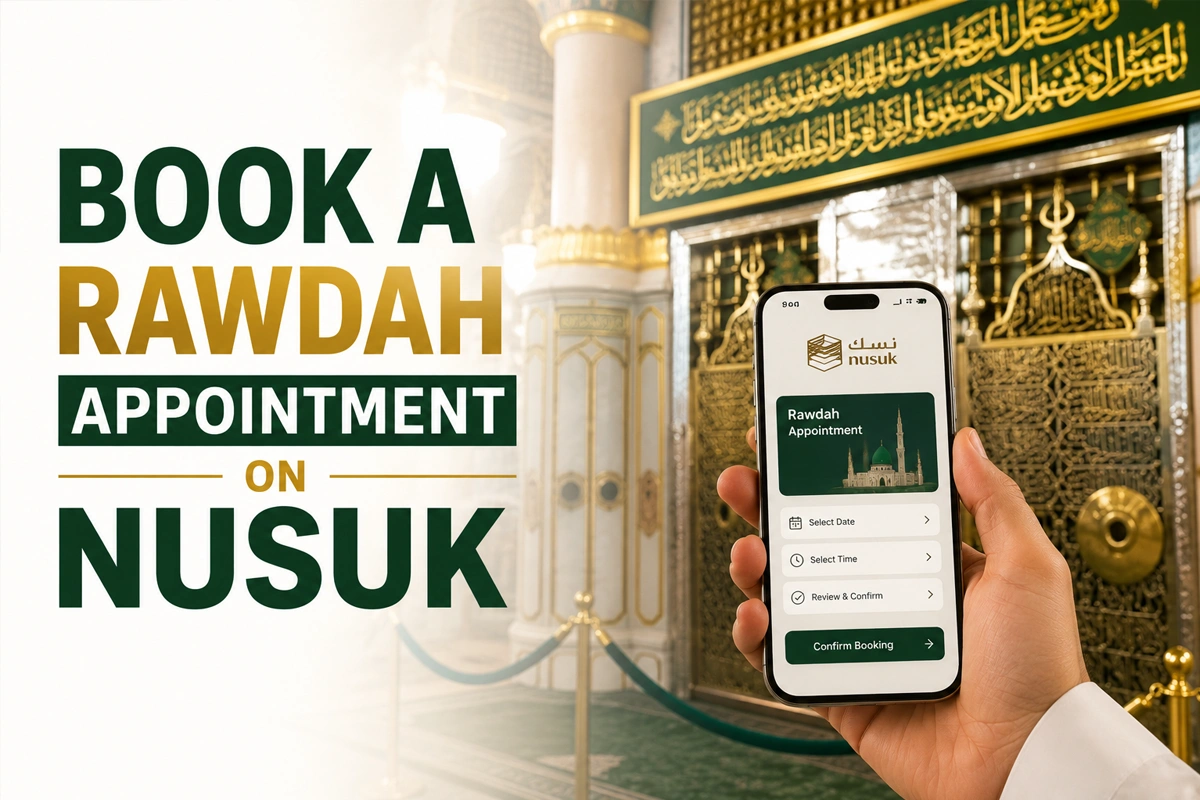
That is very small for the number of people who want to pray in it, which is why access is now managed by permit through the Nusuk app. Turning up and hoping does not work.
Our step-by-step walkthrough is here: how to book a Rawdah appointment on Nusuk. Book early, arrive at your slot time, and expect to be moved along steadily. It is a permit for a short prayer, not a seat for the evening.
The Prophet's chamber and the Green Dome
East of the original mosque stood the room of Aisha, may Allah be pleased with her, where the Prophet ﷺ was buried, and where Abu Bakr and Umar, may Allah be pleased with them, were later buried too. Saudipedia gives the chamber's measurements as roughly 4.9 to 5.24 m north to south by 3.5 m east to west, about 17.75 square metres. It is now enclosed within the mosque.
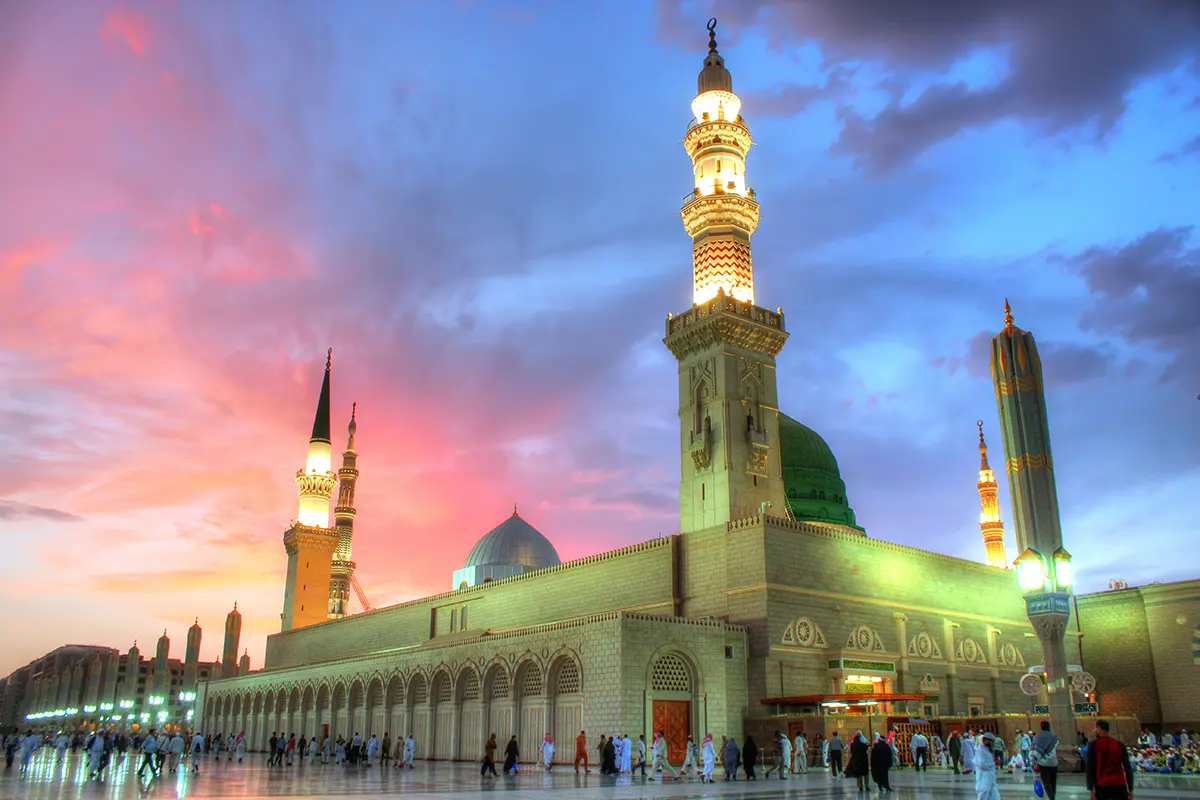
The Green Dome above it was built in 1279, six centuries after the Prophet ﷺ, and it was painted green in 1837 under Ottoman rule. Before that it was not green. It is one of the most recognisable buildings in the world and it is worth knowing that it is a later addition, not part of the original mosque.
On etiquette when you pass the chamber, the simple version that keeps you out of trouble: approach calmly, give salam quietly, keep walking, do not raise your voice, do not push, do not touch or wipe the grilles, and do not pray facing the chamber. Say what you have to say and let the person behind you have their turn.
Fourteen centuries of building
The mosque has been enlarged again and again. These figures are from Saudipedia:
| Period | Year | Added |
|---|---|---|
| The Prophet ﷺ | 628 | 1,425 m² |
| Umar ibn al-Khattab | 638 | 1,100 m² |
| Uthman ibn Affan | 649–650 | 496 m² |
| Al-Walid ibn Abd al-Malik | 706–709 | Umayyad rebuild |
| Al-Mahdi | 777–781 | Abbasid expansion |
| Sultan Qaitbay | 1483 | 120 m² |
| Sultan Abdulmejid | 1848–1860 | 1,293 m² |
| First Saudi expansion | 1949–1953 | 6,024 m², total about 16,548 m² |
| Second Saudi expansion | from 1984 | about 82,000 m², about 235,000 m² with courtyards |
| Third Saudi expansion | from 2012 | towards 1,020,500 m² including roofed squares |
Look at the first two rows. The Prophet ﷺ himself expanded it in year 7 after the Hijrah. Enlarging this mosque to fit the people who come is not a modern idea. It started with him.
The mosque today
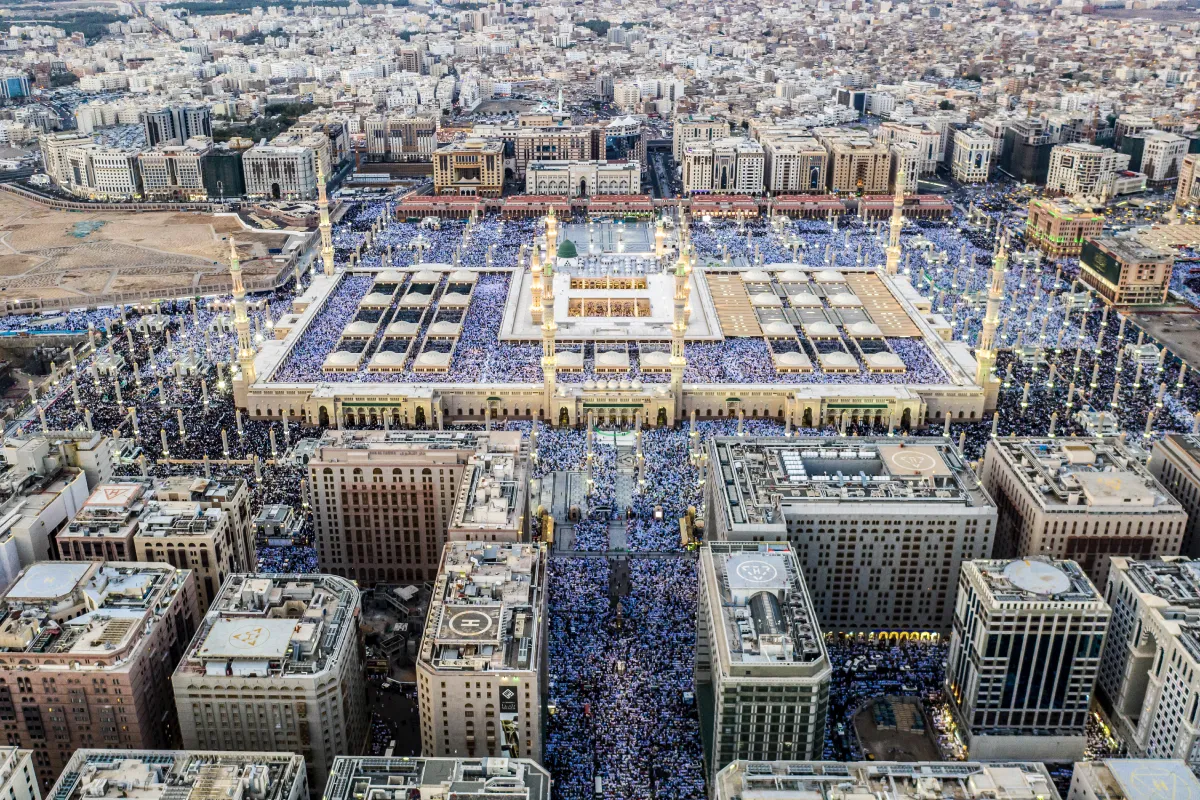
Saudipedia puts the current capacity at around two million worshippers, with the third expansion designed to take it from one million to 1.8 million in the covered areas alone.
Other features you will notice:
- Ten minarets, between 70 m and 104 m tall.
- Sliding domes over sections of the roof, which open at night and in cool weather. Twenty-seven of them is the commonly published figure.
- Retractable umbrellas in the courtyards, opening in the morning and folding at night. Published figures put the total at around 250 across the plazas.
- Zamzam water brought in daily from Makkah. Saudipedia gives about 300 tonnes a day normally, rising to 400 in busy seasons, served from around fourteen thousand refrigerated containers.
The umbrellas are worth watching once. Standing in a courtyard at mid-morning as they open together is one of the small pleasures of a Madinah trip.
Practical advice for your visit
- Arrive early for prayer, not on time. Twenty to thirty minutes before the adhan is the difference between praying inside and praying in a courtyard.
- Learn one gate number. The mosque is very large and every side looks similar. Pick the gate nearest your hotel and use it every time.
- Take a bag for your shoes. Shoe racks fill up, and finding your own shoes in a rack of ten thousand pairs after Maghrib is not a spiritual experience.
- Fajr and the hour after it are the calmest time in the whole day. If you only manage one unhurried visit, make it that one.
- Women's sections and Rawdah timings are separate and change. Check on Nusuk rather than relying on what a friend did last year.
- Wheelchairs are available, and the courtyards are broadly step-free. Our accessibility guide covers both Haramayn in detail.
- Stay close if you can. Ten minutes of walking, five times a day, in Madinah heat, is a real factor for older travellers. Our guides on where to stay in Madinah and how far from the Haram is too far go into this properly.
Beyond the mosque
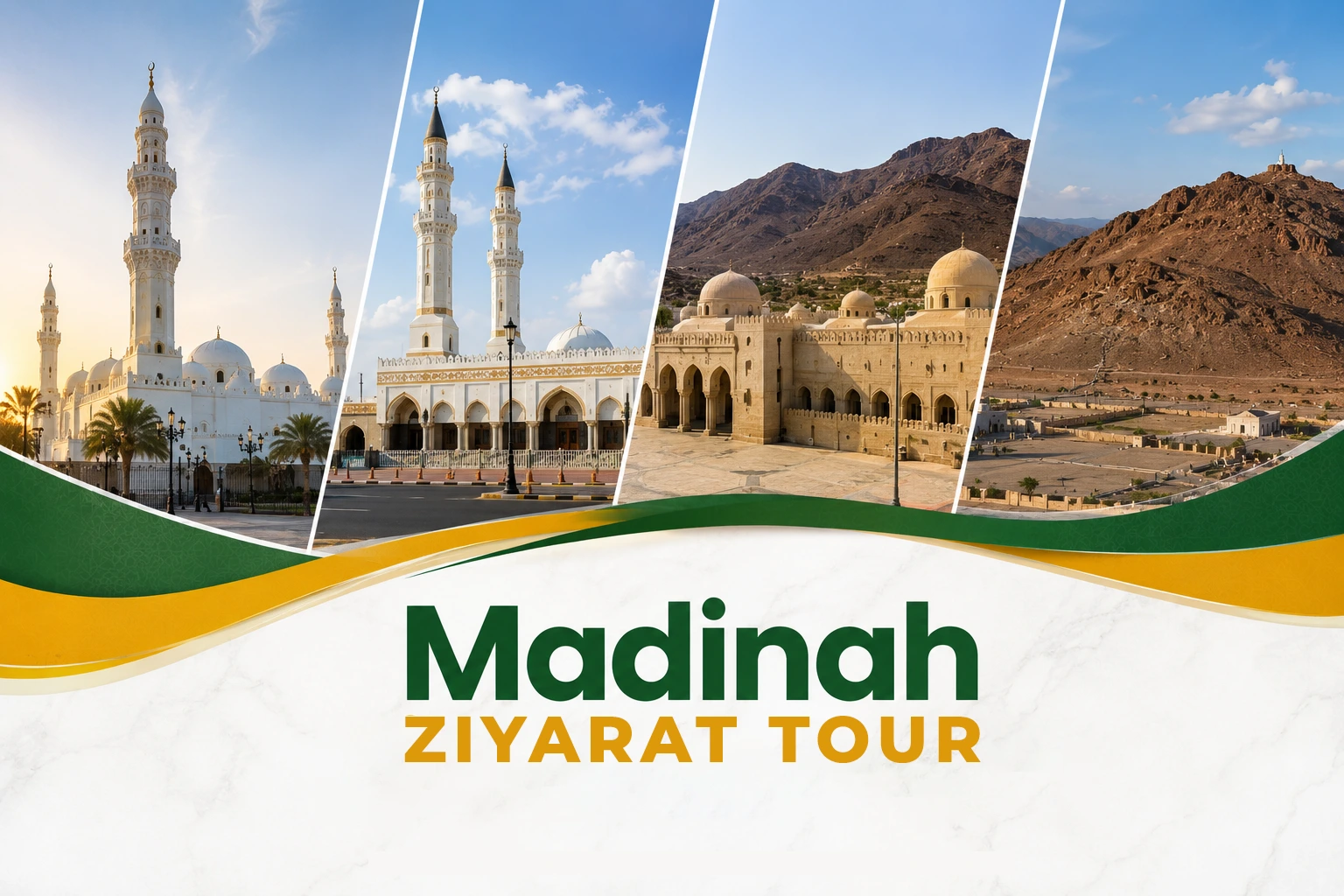
Madinah is compact, and most of the historic sites are within a short drive. Jannat al-Baqi is beside the mosque itself. Masjid Quba, the first mosque built in Islam, is a few minutes south. Masjid al-Qiblatayn, where the qibla change happened, and Mount Uhud with the martyrs' cemetery are both a short drive out.
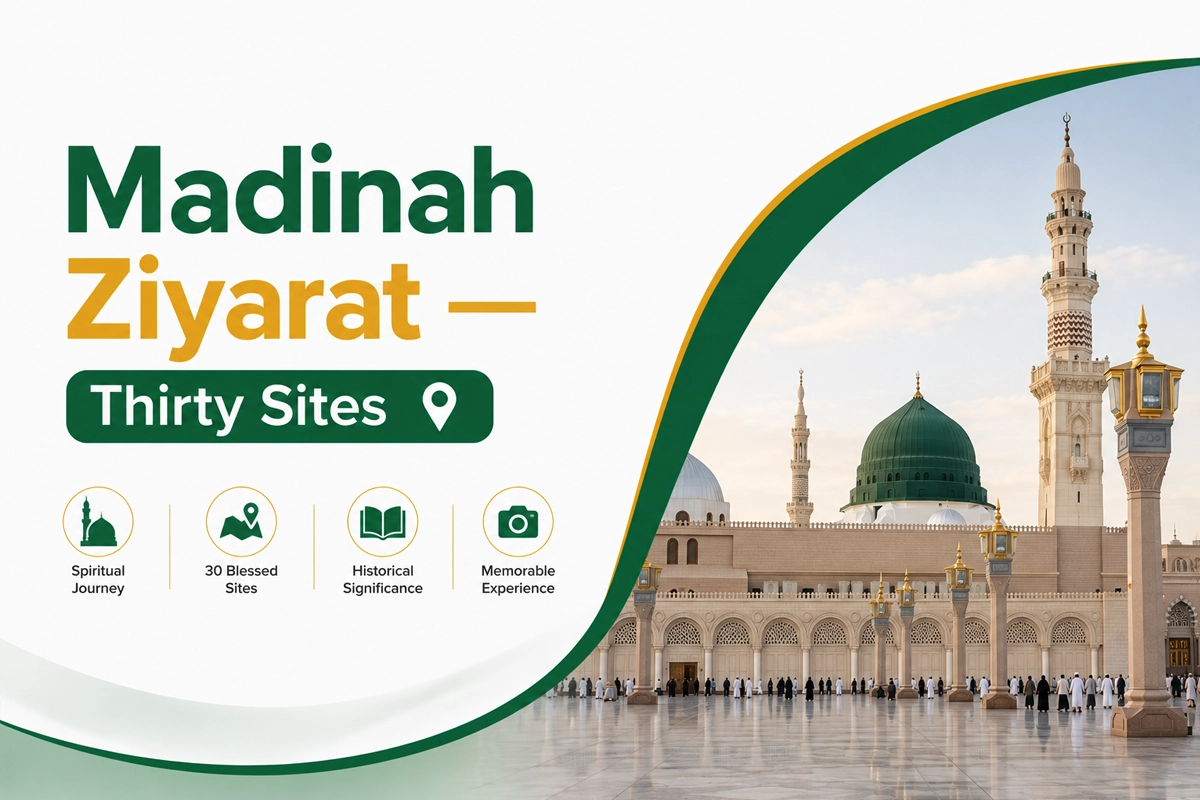
Our Madinah Ziyarat guide goes through thirty sites one by one and gives the evidence for each, which is the honest way to decide what is worth your morning. If you would rather have the round arranged for you, the Madinah Ziyarat tour covers the main stops. For the city in general, including food, walking distances and neighbourhoods, see the Madinah travel guide.
Getting there and getting around
You do not need a car for the mosque itself. If you are staying in the central area you will walk, and that is the whole point of staying central.
Where transport matters is the arrival and the Ziyarat run:
From the airport. Madinah airport is a short drive from the central hotels. Booking ahead means a driver waiting rather than a queue at one in the morning with luggage and a tired family. See our Madinah airport transfer fares and the airport to hotel guide for all the options.
For Ziyarat. Quba, Qiblatayn, Uhud and the Trench sites are spread out, and doing them by taxi one at a time wastes half a morning. The Madinah Ziyarat private car covers the round on a fixed fare for the vehicle with the driver waiting at each stop.
Between the two cities. The Haramain high-speed train is fast and comfortable; a private car is door to door and lets you stop at Badr or along the old route. Both are reasonable, for different reasons.
Accuracy note
The reports on the reward of prayer in the Prophet's Mosque, on travelling to three mosques, and on the Rawdah are all recorded in Sahih al-Bukhari and Sahih Muslim. The report about forty consecutive prayers in this mosque is in Musnad Ahmad from Anas ibn Malik and is graded weak by many scholars, including al-Albani; the stronger report about forty days of congregational prayer catching the first takbir is in Sunan al-Tirmidhi and is graded hasan. Visiting Madinah is not a rite of Hajj or Umrah. The original mosque area, the doors and the qibla change, the minbar, the Rawdah and chamber measurements, the Green Dome dates, the expansion table, the capacity, the ten minarets and the Zamzam figures are taken from Saudipedia, the Saudi national encyclopaedia. The counts of 27 sliding domes and around 250 courtyard umbrellas are commonly published figures rather than Saudipedia's. Rawdah access is managed through the Nusuk app and the rules change, so check the app rather than this page for current slots. Content verified August 2026. If anything here is out of date, tell us and we will correct it.
Frequently asked questions
Planning a Saudi trip?
Pre-book a private car, find a stay, or ask us anything on WhatsApp.
Last updated: 9 October 2026·Sources reviewed by the Wadana Go editorial team.