Hijr Fort and the Syrian Hajj Route: The Layer Nobody Photographs
Short answer
The fort at al-Hijr was built between 1744 and 1757 on the orders of As'ad Pasha al-Azm, Ottoman governor of Damascus, as a one-day water and supply stop on the Hajj caravan route from Damascus to Madinah. The Hejaz Railway, built 1901 to 1908, ended the caravan era. Its station at al-Hijr opened in 1907.
Key takeaways
- ✓Pilgrims from Anatolia, the Balkans, Persia and the Levant gathered at Damascus and travelled south as one caravan, roughly forty days each way.
- ✓The Ottoman Hajj forts were about water and supply more than defence: a well, a cistern, storerooms and a small garrison.
- ✓The fort at al-Hijr was built between 1744 and 1757 by order of As'ad Pasha al-Azm, governor of Damascus.
- ✓It was a one-day stop, with a cistern fed by a large well, and dates, lemons and oranges sold to passing pilgrims.
- ✓Charles Doughty stayed there two months in the 1870s and left one of the fuller accounts of it in use.
- ✓The Hejaz Railway ran 1,300 km from Damascus to Madinah, built 1901 to 1908. It never reached Makkah.
- ✓The station at al-Hijr opened in 1907 with about sixteen buildings, and over 19,000 pilgrims stopped there in 1912.
Quick facts
- Where
- Beside the Hegra site, AlUla
- Fort built
- Between 1744 and 1757
- Ordered by
- As'ad Pasha al-Azm, governor of Damascus
- Its job
- One-day water and supply stop for the Hajj caravan
- Caravan journey
- About forty days each way from Damascus
- Railway built
- 1901 to 1908, about 1,300 km
- Station opened
- 1907. About sixteen buildings
- Pilgrims in 1912
- More than 19,000 stopped at the station
- Station today
- Restored, now a hotel opened in 2024
Almost everyone who goes to Hegra goes for the Nabataean tombs. Very few look twice at the square stone fort near the entrance, which is a shame, because it belongs to a story that ran for a thousand years and ended within living memory.
That story is the Syrian Hajj route: the road pilgrims took from Damascus to Madinah and Makkah.
The road from Damascus
Pilgrims from Anatolia, the Balkans, Persia and the Levant gathered at Damascus and travelled south as one enormous caravan, under an official appointed to lead it.
The route ran down the eastern side of the Hijaz through Ma'an, Tabuk, al-Hijr and al-'Ula to Madinah, and on to Makkah. It took roughly forty days each way, and it ran through some of the driest country in Arabia.
Which is why it needed forts.
What the forts were for
Not defence in the ordinary sense. The Ottoman Hajj forts were mainly about water and supply.
Each was a walled compound with a well, a large cistern, storerooms and a small garrison. The caravan arrived, watered thousands of animals and tens of thousands of people, restocked, slept, and moved on the next day. Between stops there was nothing.
Stores were also laid down in advance, so that a caravan of that size did not have to carry forty days of food from Damascus.
The fort at al-Hijr
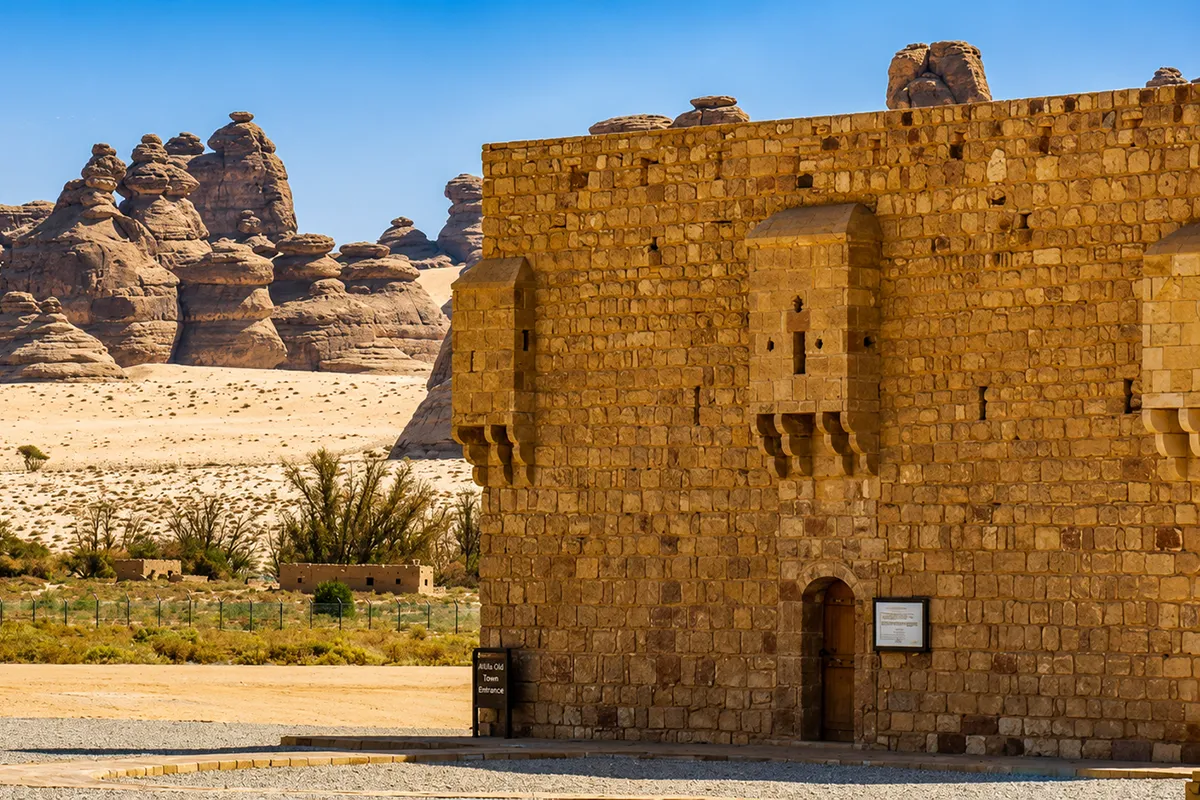
The fort at al-Hijr was built between 1744 and 1757, on the orders of As'ad Pasha al-Azm, the Ottoman governor of Damascus, as part of the fortifications protecting the pilgrimage road.
It served as a one-day stop for the caravan. Its cistern was supplied by a large well. Accounts of the place record dates, lemons and oranges being sold there to passing pilgrims.
The English traveller Charles Doughty stayed at the fort for two months in the 1870s, and his account is one of the fuller descriptions we have of it in use. He notes a permanent Bedouin encampment just outside.
Think about that for a moment. Pilgrims camping at al-Hijr, of all places, buying oranges.
Then the railway
The caravan era ended quickly, and the thing that ended it was built by the same empire.
The Hejaz Railway was constructed between 1901 and 1908 on the orders of Sultan Abdul Hamid II, running from Damascus to Madinah: about 1,300 kilometres of track.
It never reached Makkah. Proposals to extend it were abandoned in the face of opposition from tribes whose traditional livelihood was carrying pilgrims, and who stood to lose it.
The station at al-Hijr opened in 1907. It was one of the largest on the line, with around sixteen buildings and a locomotive maintenance depot, offices and dormitories for railway staff. In 1912, more than 19,000 pilgrims stopped there.
Forty days by camel became a few days by train. Then the First World War came, the line was attacked and cut, and south of Ma'an it never ran again.
What is there now
The fort still stands near the entrance to the Hegra site.
The railway station has been restored. The buildings now form a five-star hotel, opened in 2024, with the old maintenance depot converted into a restaurant and a restored locomotive on display.
You can decide for yourself what you think about that. What is not in doubt is that the buildings survive and are maintained, which is more than most of the line can say.
Why this layer is worth ten minutes
Because it makes the place legible.
The same valley holds a Nabataean city, a Qur'anic warning, an Ottoman water stop and a railway that changed how the Hajj was made. Four periods, one reason: this is where the road went, and the road went where the water was.
Stand at the fort and the whole geography clicks into place.
Getting there, honestly
We do not run a scheduled service this far north and there is no published Wadana Go fare for it. Flying to the regional airport and hiring a car, or arranging a private car in advance, are the practical options. See driving yourself versus a private driver and renting a car in Saudi Arabia. Our Beyond the Haramayn guide puts this region alongside Badr, Khaybar, AlUla and Taif.
Is visiting part of Hajj or Umrah?
No. The fort served the Hajj; visiting it is not a rite of anything.
Related reading
- Al-Hijr, Hegra and Mada'in Salih — the site and the hadith.
- Wadi al-Qura — the valley, in the seerah.
- Tabuk Castle — the next fort north on the same road.
- The AlUla and Hegra guide — the practical side.
Accuracy note
The construction of the fort at al-Hijr between 1744 and 1757 on the orders of As'ad Pasha al-Azm, Ottoman governor of Damascus, as part of the fortifications protecting the pilgrimage route, its use as a one-day stop for the Hajj caravan, its cistern supplied by a large well, and the sale of dates, lemons and oranges there, follow published historical accounts of the site. Charles Doughty's two-month stay at the fort in the 1870s and his note of a permanent Bedouin encampment outside are from his published travel account. The Hejaz Railway's construction between 1901 and 1908 on the orders of Sultan Abdul Hamid II, the roughly 1,300 kilometres from Damascus to Madinah, the abandonment of proposals to extend it to Makkah in the face of tribal opposition, the opening of the station at al-Hijr in 1907 with around sixteen buildings including a locomotive maintenance depot, offices and dormitories, and the more than 19,000 pilgrims who stopped there in 1912, follow published railway histories. The conversion of the restored station buildings into a five-star hotel opened in 2024, with the maintenance depot as a restaurant and a restored locomotive displayed, is reported in published coverage. The roughly forty-day journey each way is the figure generally given for the Damascus caravan and should be read as an approximation, since it varied. Visiting is not a rite of Hajj or Umrah. We do not run a scheduled service to AlUla and have not quoted a fare. Content verified August 2026. Correction? Tell us.
Frequently asked questions
Planning a Saudi trip?
Pre-book a private car, find a stay, or ask us anything on WhatsApp.
Last updated: 1 September 2026·Sources reviewed by the Wadana Go editorial team.