Jawatha Archaeological Site: Ten Thousand Years on One Oasis
Short answer
Jawatha lies about eighteen kilometres from Hofuf in al-Ahsa. Saudi sources record artefacts from 7,000 to 8,000 BCE, settlement from around 2,400 BCE with Dilmun remains, links to the Gerrha civilisation, and a role as a market connecting southern and northern Arabia with Mesopotamia into the early Abbasid period.
Key takeaways
- ✓The site lies about eighteen kilometres from the north-eastern corner of Hofuf, in al-Ahsa.
- ✓Artefacts from the site are recorded as dating to between 7,000 and 8,000 BCE.
- ✓Settled occupation goes back to the mid-third millennium BCE, around 2,400 BCE, with Dilmun civilisation remains.
- ✓The story continues into the early stages of the Gerrha civilisation, a wealthy Gulf trading world.
- ✓It worked as a market connecting southern and northern Arabia with Mesopotamia, sending out dates, produce and perfumes.
- ✓It remained a commercial centre through the Umayyad period and into the early Abbasid, roughly 750 to 847.
- ✓What survives is mounds under dunes, with pottery and coloured and clear glass on the surface. Manage your expectations.
Quick facts
- Where
- Al-Ahsa Governorate, Eastern Province
- Distance
- About 18 km from Hofuf
- Earliest artefacts
- 7,000 to 8,000 BCE
- Settled occupation
- Mid-third millennium BCE, around 2,400 BCE
- Civilisations recorded
- Dilmun, then early Gerrha
- Trade role
- Market linking south and north Arabia with Mesopotamia
- Exports
- Dates, agricultural produce, perfumes
- Still thriving until
- The early Abbasid period, roughly 750 to 847
- What you see
- Mounds under dunes, pottery and glass on the surface
The mosque is what people come for. The town it belonged to is the bigger story, and almost nobody tells it.
Jawatha was a place before Islam by a very long way.
Where
The site lies in al-Ahsa Governorate in the Eastern Province, about eighteen kilometres from the far north-eastern corner of Hofuf.
Al-Ahsa is one of the largest oases in the world. That is the reason for everything that follows.
How far back it goes
Saudi heritage sources record artefacts from the site dating to between 7,000 and 8,000 BCE.
Take a moment with that number. That is not early Islamic, and it is not classical. It is nine to ten thousand years ago, which puts human presence here among the earliest in the region.
Settled occupation is recorded from the mid-third millennium BCE, around 2,400 BCE, with remains of the Dilmun civilisation.
Dilmun is the Gulf trading power known from Mesopotamian records: the intermediary between Mesopotamia and the trade coming up from the south and east. Finding Dilmun material at Jawatha places this oasis inside that network.
Gerrha
The site's story continues into the early stages of the Gerrha civilisation.
Gerrha is one of the great half-lost cities of Arabia, described by classical writers as an enormously wealthy trading centre on the Gulf coast. Its exact location is still debated. What is not debated is that the eastern Arabian oases were part of the same commercial world.
What it was for
Saudi heritage sources describe Jawatha as a commercial market connecting southern and northern Arabia with Mesopotamia.
Caravans came here and left carrying dates, agricultural produce and perfumes.
The city remained a working commercial centre through the Umayyad period and into the early Abbasid, roughly 750 to 847.
So the sequence runs: stone age presence, Dilmun-era settlement, a Gulf trading centre, a tribe of Abd al-Qays who send a delegation to Madinah and come back and build a mosque, and then several more centuries as a market town. All on one oasis, because it had water and it sat where the routes crossed.
What is on the ground
Honest answer: not much to look at.
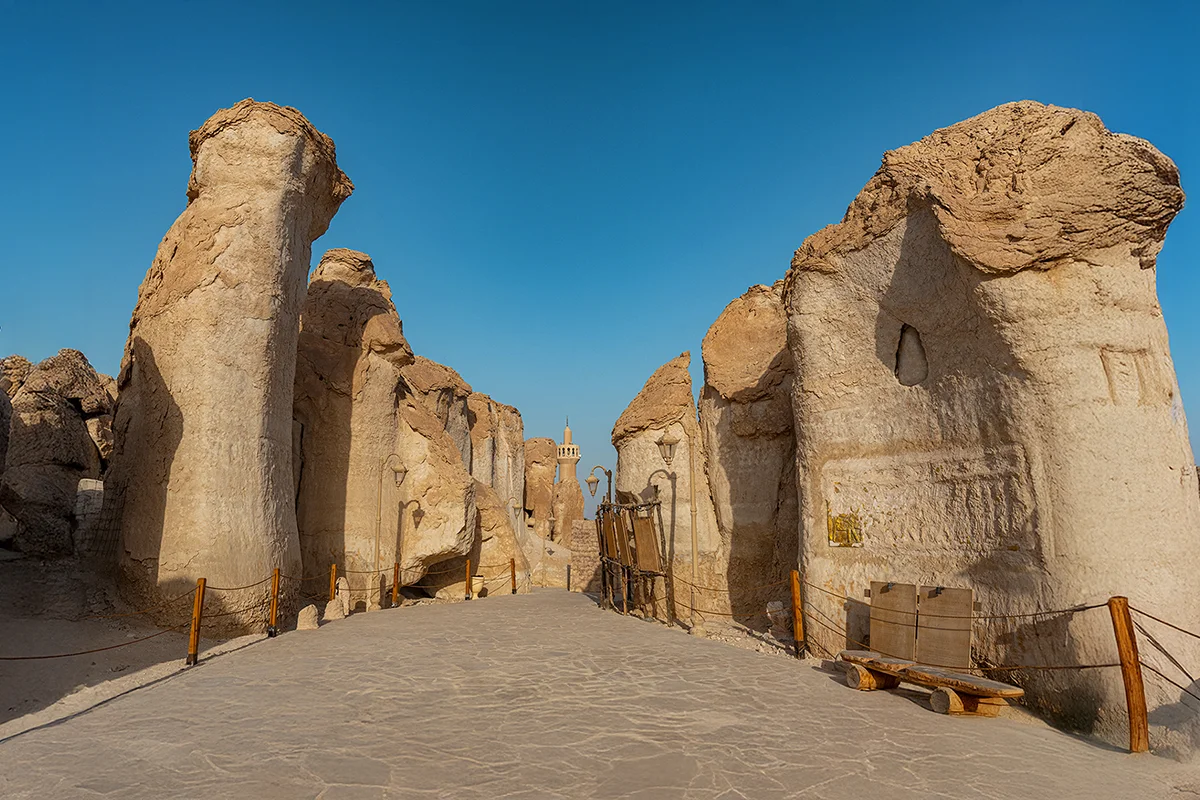
The site is recorded as archaeological mounds covered by sand dunes, with finds including pottery fragments and coloured and transparent white glass.
Mounds under dunes is what an unexcavated ancient town looks like. If you go expecting standing architecture you will be disappointed, and that is a failure of expectation rather than of the site.
Why the glass is interesting
Glass is a trade good and a status good. Coloured and clear glass turning up in the surface material of an eastern Arabian oasis is exactly the kind of small find that confirms the big claim about long-distance commerce.
Pottery tells you who lived somewhere. Glass tells you who they were connected to.
Visiting
- Pair it with the mosque. Neither makes complete sense alone.
- Manage your expectations. Mounds, sand and surface scatter.
- Do not pick anything up. A sherd on the surface is data; in your pocket it is nothing.
- Do not dig, at all.
- See the wider oasis too. Al-Ahsa's palm groves and springs are the context, and they are a UNESCO-listed cultural landscape.
Is visiting part of Hajj or Umrah?
No. Not a rite of either.
Getting there, honestly
We do not run a scheduled service to al-Ahsa and there is no published Wadana Go fare for it. Al-Ahsa has its own airport and is a straightforward drive from Dammam and Khobar. See our Khobar and Eastern Province guide for the region, and renting a car in Saudi Arabia if you plan to drive. Our Beyond the Haramayn guide covers ziyarat outside Makkah and Madinah.
Related reading
- Jawatha Mosque — and Bukhari 892.
- Dumat al-Jandal oasis — the same pattern at the other end of the country.
- Khobar — the Eastern Province base.
- The Eastern Province guide — planning the region.
Accuracy note
The location of the Jawatha archaeological site in al-Ahsa Governorate in the Eastern Province, about eighteen kilometres towards the far north-eastern corner of Hofuf; artefacts dating to between 7,000 and 8,000 BCE; settlement from the mid-third millennium BCE around 2,400 BCE with remains of the Dilmun civilisation; continuation into the early stages of the Gerrha civilisation; its function as a commercial market connecting southern and northern Arabia with Mesopotamia, with caravans carrying dates, agricultural produce and perfumes; its continuation as a thriving commercial centre through the Umayyad period and into the early Abbasid period, roughly 750 to 847; and the surface remains consisting of archaeological mounds covered by sand dunes with pottery fragments and coloured and transparent white glass, all follow Saudi heritage sources including Saudipedia. The characterisation of Dilmun as a Gulf trading intermediary known from Mesopotamian records, and of Gerrha as a wealthy trading centre whose exact location remains debated, follows published scholarship and is included as context rather than as a claim about this site. The observation that glass indicates long-distance connection is our own reading and is offered as such. Al-Ahsa Oasis is inscribed as a UNESCO World Heritage cultural landscape. Do not remove surface material or dig at the site. Visiting is not a rite of Hajj or Umrah. We do not run a scheduled service to al-Ahsa and have not quoted a fare. Content verified August 2026. Correction? Tell us.
Frequently asked questions
Planning a Saudi trip?
Pre-book a private car, find a stay, or ask us anything on WhatsApp.
Last updated: 29 August 2026·Sources reviewed by the Wadana Go editorial team.