Khaybar: The Oasis, the Forts, and What Is Actually There
Short answer
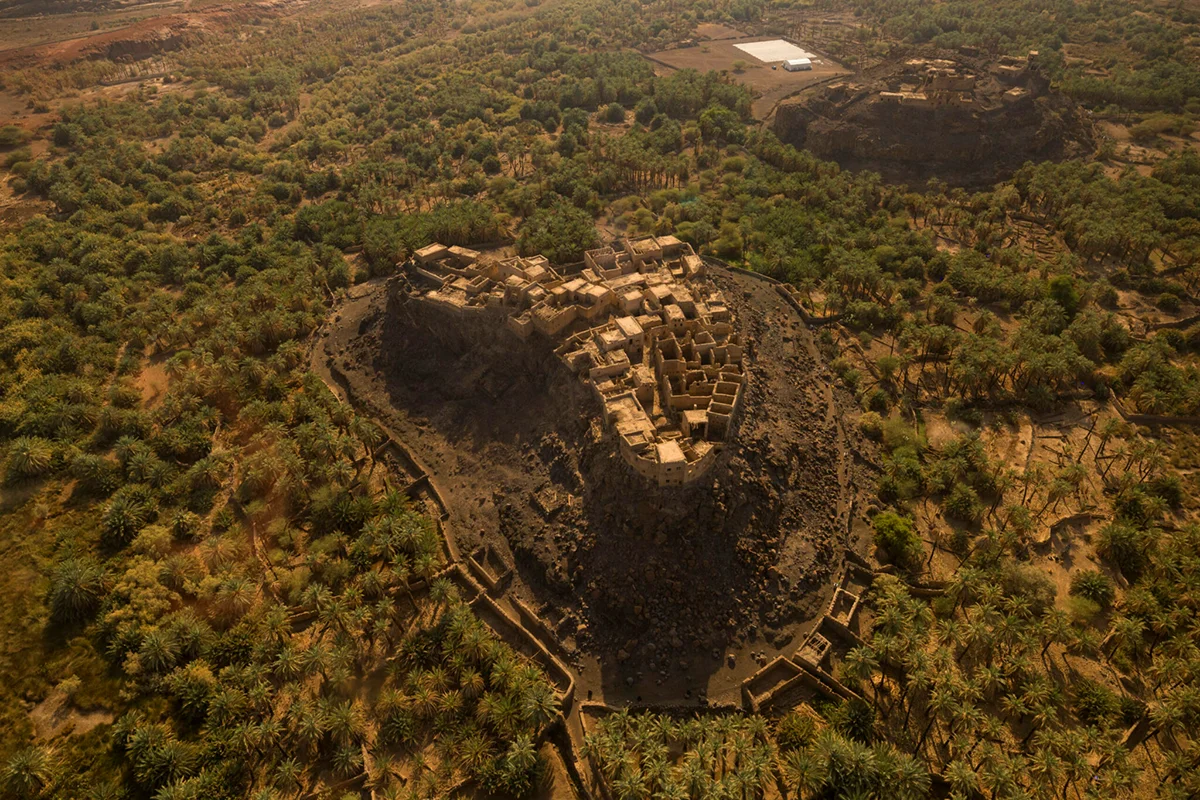
Khaybar is an oasis about 153 km north of Madinah, set in depressions that catch rainwater and surrounded by lava fields including Harrat Khaybar. It was not a single fortress but a network of strongholds, and was the site of a campaign in the seventh year after the Hijrah. Visiting is not a rite of Hajj or Umrah.
Key takeaways
- ✓Khaybar is an oasis about 153 km north of Madinah, in depressions that collect rainwater from the surrounding lava fields.
- ✓The largest of those fields, Harrat Khaybar, is named after it. The impermeable rock is why there is water here at all.
- ✓Khaybar was not a castle. It was a network of fortified strongholds across the oasis, each with its own defenders.
- ✓The classical sources name the fortress of Na'im in the al-Na'im area, and al-Qamus as the strongest and most critical.
- ✓The campaign took place in year seven after the Hijrah, after al-Hudaybiyah had secured the southern front.
- ✓The site layers four periods: pre-Islamic forts, Islamic-era settlement, King Abdulaziz-era mud-brick villages, and the modern town.
- ✓The main fortress area is fenced off as unsafe and under archaeological study. Do not climb the remains or pass a fence.
Quick facts
- Location
- Madinah Province, about 153 km north of Madinah
- What it is
- A date oasis in depressions ringed by lava fields
- Named after it
- Harrat Khaybar, the largest of the lava fields
- The forts
- A network of strongholds, not one castle
- Strongest fort
- Al-Qamus, per the classical sources
- The campaign
- Year 7 after the Hijrah, following al-Hudaybiyah
- Main fortress access
- Fenced off. Unsafe and under archaeological study
- Part of Umrah or Hajj
- No
- Best season
- Winter. Black rock country holds heat
- Wadana Go service
- No scheduled service. Arrange a car in advance
Khaybar is an oasis about 153 kilometres north of Madinah, sitting in a series of depressions that catch rainwater, surrounded by black lava fields. The largest of those fields, Harrat Khaybar, is named after it.
People have grown dates here for millennia. In the seventh year after the Hijrah it was the site of a campaign that changed the northern balance completely, and today it is one of the most visually extraordinary places in Saudi Arabia that almost no pilgrim visits.
Why an oasis was here at all
Geology.
The lava fields around Khaybar are impermeable. Rain that falls on the harrah runs off and collects in the depressions below, and that water sits where palms can reach it. That is the entire explanation for a green place in the middle of black volcanic rock.
It also explains the wealth. An oasis with reliable water on a trade route north is not a village. It is an asset.
Not one fortress
This is the most common misunderstanding about Khaybar, so it goes near the top.
Khaybar was not a castle. It was a network of fortified strongholds spread across the oasis, each with its own defenders and its own ground.
The classical seerah sources group them, and name among them the fortress of Na'im in the al-Na'im area, and al-Qamus, described as the strongest and most critical of them.
That is why the campaign took time. It was not one assault. It was a series of them, fort by fort.
The campaign, briefly
It took place in the seventh year after the Hijrah, following the treaty of al-Hudaybiyah, which had secured the southern front and freed the Muslims to deal with the north.
The forts fell in sequence. Our article on the Battle of Khaybar site covers the campaign itself in detail.
What is there today
Layers, and this is the reason to come.
- Pre-Islamic volcanic country and ancient forts, some of them very old indeed.
- The Islamic-era settlement, and the fortress remains.
- Villages from the era of King Abdulaziz, mud-brick and abandoned.
- The modern town.
You can walk through several centuries in an afternoon, which is rare.
An important practical warning. The area immediately around the main fortress is fenced off, partly because the structure is considered unsafe and partly because it is under archaeological study. Do not climb on the remains and do not try to get past a fence. This is not a preserved castle set up for tourists.
Planning a visit
- A long day from Madinah. Around 150 km each way on good road.
- Winter, not summer. This is black volcanic country and it holds heat.
- Combine it with AlUla if you are going north anyway. It is on that road.
- Take everything with you. Water, food, fuel. Facilities are limited.
- Do not expect signage in English, or a visitor centre of the kind you get at Hegra.
Is visiting part of Hajj or Umrah?
No. Not a rite of either, no prescribed prayer, no reported reward for visiting.
The honest verdict
Khaybar is for the traveller with time, not the pilgrim with three days.
If you have a week and a car and you are interested in history rather than only in Ziyarat, it is genuinely worth the drive: the lava fields alone are extraordinary, and the layering of periods is something you will not get in Makkah or Madinah.
If you have four days for Umrah, go to Quba and Uhud instead, and come back for Khaybar another time.
Related
- The Battle of Khaybar — the campaign in detail.
- Na'im Fort — the first of the strongholds.
- Khaybar martyrs' cemetery.
- AlUla — further up the same road.
Getting there, honestly
We do not run a scheduled service to Khaybar and we are not going to pretend otherwise. There is no published Wadana Go fare for it.
What works: a private car arranged in advance from Madinah, treated as a long day out, or a hire car if you are comfortable driving in Saudi Arabia. Our guide on driving yourself versus a private driver sets out the trade-offs, and renting a car in Saudi Arabia covers the paperwork.
If you want us to arrange a car and driver for a Khaybar day, ask before you travel rather than on the morning. It is a long run and the driver has to plan for it.
Our Beyond the Haramayn guide covers Khaybar alongside Badr, Taif, Tabuk and al-Hijr, and is the right place to start if you are building a trip beyond the two cities.
Accuracy note
Khaybar's location as an oasis in Madinah Province some 153 kilometres north of Madinah, its setting in a series of depressions that collect rainwater, its surrounding lava fields including Harrat Khaybar which is named after it, and its millennia of date cultivation, follow published geographic and heritage descriptions; other sources give distances between roughly 150 and 170 km. That Khaybar was not a single fortress but a network of fortified strongholds, and that the classical seerah sources name among them the fortress of Na'im in the al-Na'im area and al-Qamus as the strongest, follows the seerah literature and published summaries of it. The campaign took place in the seventh year after the Hijrah, following the treaty of al-Hudaybiyah. The layering of pre-Islamic volcanic country and ancient forts, Islamic-era settlement, villages from the era of King Abdulaziz and the modern town, and the fact that the area immediately around the main fortress is fenced off because the structure is deemed unsafe and is under archaeological study, follow published heritage accounts. We do not run a scheduled service to Khaybar and have not quoted a fare for it. Visiting is not a rite of Hajj or Umrah and no reward for visiting is reported. Content verified August 2026. Correction? Tell us.
Frequently asked questions
Planning a Saudi trip?
Pre-book a private car, find a stay, or ask us anything on WhatsApp.
Last updated: 5 September 2026·Sources reviewed by the Wadana Go editorial team.