Masjid al-Qiblatayn: The Mosque of the Two Qiblas
Short answer
Masjid al-Qiblatayn stands about 3.8 km northwest of Masjid an-Nabawi. It is named for the change of the qibla from Jerusalem to the Kaaba, which the Qur'an records in Surah al-Baqarah. The traditional account places that prayer at this mosque of Banu Salimah. The old niche facing Jerusalem was removed in the 1987 renovation.
Key takeaways
- ✓The qibla change from Jerusalem to the Kaaba is established in the Qur'an, in Surah al-Baqarah. That part is beyond doubt.
- ✓That the change happened during a prayer at this particular mosque is the traditional historical account, widely accepted but not fixed by an authentic hadith.
- ✓Sahih al-Bukhari records a separate event: people at Quba turning during Fajr when the news reached them. The two are often confused.
- ✓There are no longer two mihrabs at floor level. The niche facing Jerusalem was removed in the 1987 renovation, with a marker placed high on the wall.
- ✓No authentic report gives a special reward for praying in this mosque, unlike Quba. Do not accept a claim of one.
- ✓The mosque is recorded as built in the second year after the Hijrah, attributed to Sawad ibn Ghanam ibn Ka'b for the Banu Salimah.
- ✓Fifteen minutes is a complete visit. It works best as the middle stop between Quba and Uhud.
Quick facts
- City
- Madinah, northwest of the centre
- Distance
- About 3.8 km from Masjid an-Nabawi
- Built
- Second year after the Hijrah, for the Banu Salimah
- Two mihrabs today
- No. The Jerusalem niche was removed in 1987
- Special prayer or reward
- None authentically reported
- Part of Umrah or Hajj
- No
- Can a car reach it
- Yes, with parking. Not a sensible walk
- Typical visit
- About 15 minutes
- Evidence level
- A for the qibla change; B for this being the exact site
Masjid al-Qiblatayn is the Mosque of the Two Qiblas, about 3.8 km northwest of Masjid an-Nabawi. Its name comes from the day Muslims stopped praying towards Jerusalem and turned towards the Kaaba.
One warning before you go, because it saves disappointment: there are no longer two mihrabs to look at. More on that below.
What happened, and what the Qur'an says
For roughly sixteen or seventeen months after the Hijrah, the Muslims prayed facing Bayt al-Maqdis in Jerusalem. Then the command came to face the Kaaba in Makkah.
The Qur'an records this directly. In Surah al-Baqarah, Allah addresses the Prophet ﷺ about turning his face towards the sacred mosque, and instructs the believers to turn their faces towards it wherever they are.
The change of qibla is therefore established beyond any doubt. It is in the Qur'an, and the hadith literature records how the news spread.
Sahih al-Bukhari records that while people at Quba were praying Fajr, someone came and told them the Prophet ﷺ had been ordered to face the Kaaba, so they turned towards it during the prayer. That is a separate event from the one this mosque is named for, and the two are often mixed up.
Why this mosque carries the name
The traditional account, preserved in the historical and seerah literature, is that the Prophet ﷺ was visiting the tribe of Banu Salimah and leading them in prayer when the command came, and that he turned mid-prayer towards the Kaaba with the congregation following him. Their mosque became known as the Mosque of the Two Qiblas.
Be clear about the levels here, because they are different:
- The qibla change itself: established. Qur'an and authentic hadith.
- That it happened during a prayer at this particular mosque: historically reported. This is the account carried in the historical literature and it is widely accepted, but it is not fixed by an authentic hadith the way the change itself is.
That distinction does not make the visit pointless. It just means you should not say "this is where it happened" with the same certainty you would say "the qibla changed".
The mosque is recorded as having been built in the second year after the Hijrah, and is attributed in the sources to Sawad ibn Ghanam ibn Ka'b, for the Banu Salimah.
The two mihrabs, and why you cannot see them
For centuries the mosque had two prayer niches: one facing Jerusalem, one facing Makkah. That is what gave the building its character and its name.
In the 1987 renovation the mosque was rebuilt, and the old niche facing north towards Jerusalem was removed. The mihrab facing Makkah remained. A small marker was set high on the wall to indicate the old direction, linked to the main dome by a small vault, as a symbolic reference to the change.
So visitors arrive expecting two mihrabs side by side at floor level, and do not find them. Now you know why, and you can look for the marker overhead instead.
What it is like today
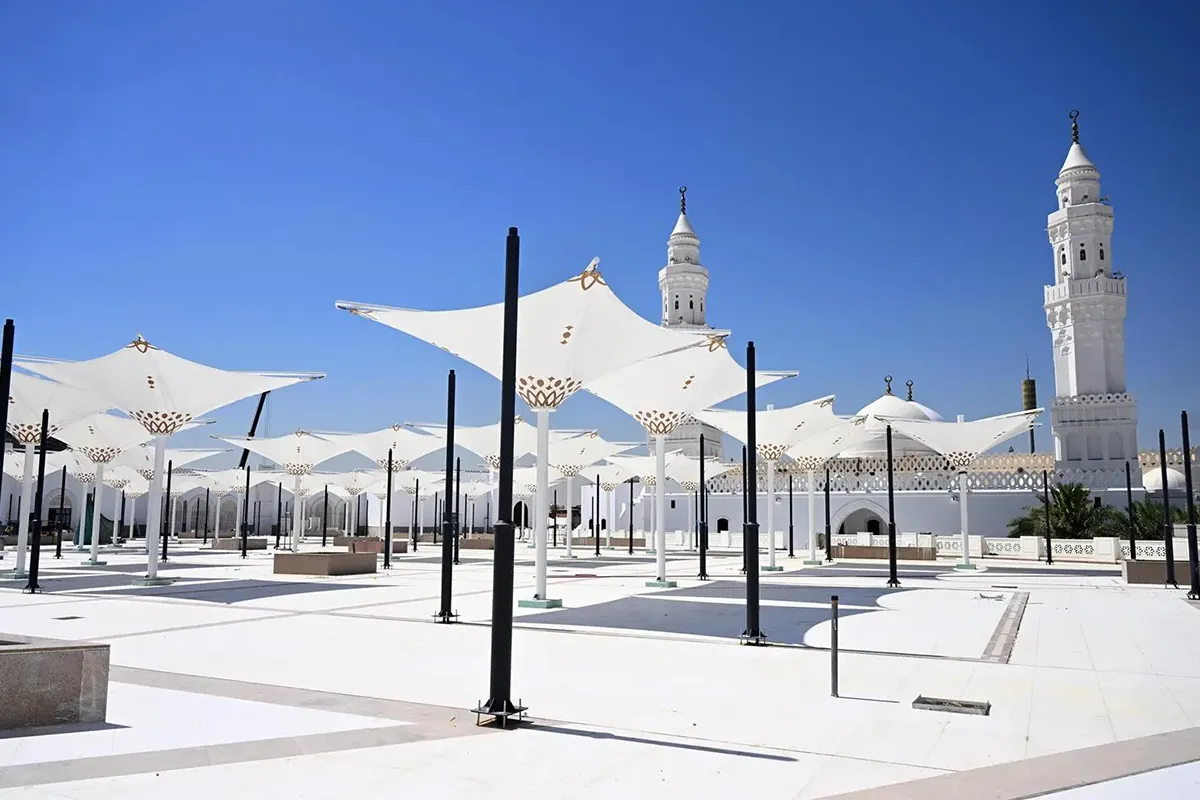
A clean, modern, white mosque with twin minarets and two domes, on rising ground with a view over that side of the city. It is a working neighbourhood mosque as well as a Ziyarat stop.
It is usually visited as the second or third stop on the standard Madinah round, and most groups spend fifteen minutes there.
Is there a special prayer here?
No. Visiting Masjid al-Qiblatayn is not part of Hajj or Umrah, and there is no authentic report of a special reward for praying in it, of the kind that exists for Quba.
You may of course pray two rak'ahs as you would in any mosque you enter. Just do not let anyone tell you a specific reward is attached to this one, because we know of no sound evidence for that.
The real value here is understanding. Standing in a place connected with the moment the direction of prayer changed makes a Qur'anic passage concrete in a way reading it does not.
Practical notes
- Fifteen minutes is enough. It is a small site and there is not much to see beyond the building itself.
- Go between prayer times if you want to look around, and avoid arriving just as the congregation forms.
- Look up for the old qibla marker, since there is nothing to find at floor level.
- Modest dress and quiet voices. It is a functioning mosque with a local congregation.
- Combine it. It sits between the city and Uhud, so the natural order is Quba first, then Qiblatayn, then Uhud.
Nearby
- Masjid Quba — the first mosque in Islam, with a sound hadith behind praying there.
- Mount Uhud — north of the city, on the same round.
- Masjid an-Nabawi — and its own history of the qibla change, visible in the position of its doors.
- Madinah Ziyarat guide — thirty sites with the evidence for each.
Getting there
About 3.8 km from Masjid an-Nabawi, northwest. It is a short drive and not a sensible walk in most weather.
The efficient way to see it is as part of the Madinah round rather than as a trip on its own. Our Madinah Ziyarat private car covers Quba, Qiblatayn, Uhud and the Trench mosques on one fixed fare for the vehicle, with the driver waiting at each stop, which beats finding a new taxi at every kerbside. If you prefer a guided arrangement, see the Madinah Ziyarat tour.
Accuracy note
The change of the qibla from Jerusalem to the Kaaba is established in the Qur'an, in Surah al-Baqarah, and the hadith literature records how the news reached the Muslims; the report of the people of Quba turning during Fajr is in Sahih al-Bukhari. The account that the change occurred during a prayer led by the Prophet ﷺ at the mosque of Banu Salimah, giving this mosque its name, is carried in the historical and seerah literature and is level B, not a hadith-fixed fact. The construction in the second year after the Hijrah and the attribution to Sawad ibn Ghanam ibn Ka'b follow the historical sources. The 1987 renovation, in which the niche facing Jerusalem was removed and a marker placed above, is documented in published architectural accounts. We know of no authentic report of a special reward for praying in this mosque, and have not implied one. Visiting is not a rite of Hajj or Umrah. Content verified August 2026. If this needs updating, tell us.
Frequently asked questions
Planning a Saudi trip?
Pre-book a private car, find a stay, or ask us anything on WhatsApp.
Last updated: 25 September 2026·Sources reviewed by the Wadana Go editorial team.