Dumat al-Jandal: The Oasis Where the First Great Split Was Argued
Short answer
Dumat al-Jandal in al-Jawf sits north of the Nafud at one end of Wadi Sirhan, on a junction of ancient routes. It appears in Assyrian records as Adummatu, was the target of three expeditions in the Prophet's ﷺ lifetime, and was chosen in 37 AH as the neutral site for the arbitration after Siffin.
Key takeaways
- ✓The name means Dumah of the stone. Al-Jawf means depression, referring to Wadi Sirhan.
- ✓It stands north of the Nafud desert at a junction of routes between Mesopotamia, Syria and inner Arabia. Position is the whole story.
- ✓It is Adummatu in Akkadian and appears on the Esarhaddon Prism of 673 to 672 BC as the strong city of the Arabians.
- ✓Assyrian records connect it with a series of powerful Arab queens, including one who was a high priestess.
- ✓Three expeditions reach it: July 626 led by the Prophet ﷺ, October 630 when Khalid captured Ukaydir, and April 631 when the idol Wadd was destroyed.
- ✓Wadd is named in Surah Nuh 71:23, and the historical accounts connect that name with the object at al-Jawf.
- ✓In 37 AH the arbitration after Siffin was held here, chosen as midway between Kufa and Damascus. It settled nothing.
Quick facts
- Where
- Al-Jawf Province, northern Saudi Arabia
- Name means
- Dumah of the stone
- Akkadian name
- Adummatu
- First outside record
- Esarhaddon Prism, 673 to 672 BC
- Ruled by
- A series of Arab queens, per Assyrian records
- Expeditions
- July 626, October 630, April 631
- The idol destroyed
- Wadd, named in Surah Nuh 71:23
- The arbitration
- 37 AH, January 658, after Siffin
- Why here
- Midway between Kufa and Damascus
Dumat al-Jandal sits at the top of Saudi Arabia, in al-Jawf, and it is one of the oldest continuously important places in Arabia.
Three separate moments in early Islamic history happened here, and one of them changed everything that came after.
The name and the place
The name means Dumah of the stone. Al-Jawf means depression, referring to the great Wadi Sirhan.
Its position is the whole story. It stands north of the Nafud desert, at one end of Wadi Sirhan, at a junction of ancient trade routes running between Mesopotamia, Syria and the Arabian interior.
Before Islam
It is Adummatu in Akkadian, and it appears on the Esarhaddon Prism of 673 to 672 BC as the strong city of the Arabians.
Assyrian records connect it with a series of powerful Arab queens, among them Zabibe, Shamshi, Tabua and Te'elhunu, the last of whom was a high priestess.
Queens ruling a fortified desert city, recorded by an Assyrian empire that had to deal with them. That is not a footnote.
The expeditions
Dumat al-Jandal comes into the seerah three times.
| When | What |
|---|---|
| July 626 | The Prophet ﷺ led an expedition here. Those gathered dispersed and no fighting is reported. |
| October 630 | During the Tabuk campaign, Khalid ibn al-Walid was sent here and captured its ruler, Ukaydir ibn Abd al-Malik. Terms followed. |
| April 631 | Khalid was sent again, and the idol Wadd, worshipped by Banu Kalb, was destroyed. |
Wadd is one of the five idols named in the Qur'an in Surah Nuh (71:23), which is worth noticing. The name in the verse and the object in al-Jawf are connected in the historical accounts.
Why the Prophet ﷺ came this far north
Because of the road.
Dumat al-Jandal controlled the northern approach. Whoever held it influenced what moved between Arabia and Syria. It was not about the town; it was about the corridor.
The same logic explains the second visit. Tabuk was about the northern frontier, and Dumat al-Jandal is part of that frontier.
And then the thing that changed everything
In 37 AH, January 658, Dumat al-Jandal was chosen as the site of the arbitration after the battle of Siffin.
It was picked because it lies midway between Kufa and Damascus. Neutral ground, in the geographical sense.
Abu Musa al-Ash'ari represented Ali. Amr ibn al-As represented Mu'awiyah. Each side is reported to have sent a body of several hundred to witness it.
What happened at the meeting is reported differently in different sources, and the differences are not small. We are not going to adjudicate between Companions on a transport company's website, and you should be suspicious of anyone who does it casually.
What is not disputed is the outcome: the arbitration did not settle the dispute, and the disagreement over accepting arbitration at all had already produced a further split within Ali's own camp.
Sit with the geography for a second. A quiet oasis at the top of the map, chosen precisely because it was nobody's home ground, and it is where the first great division was argued and not resolved.
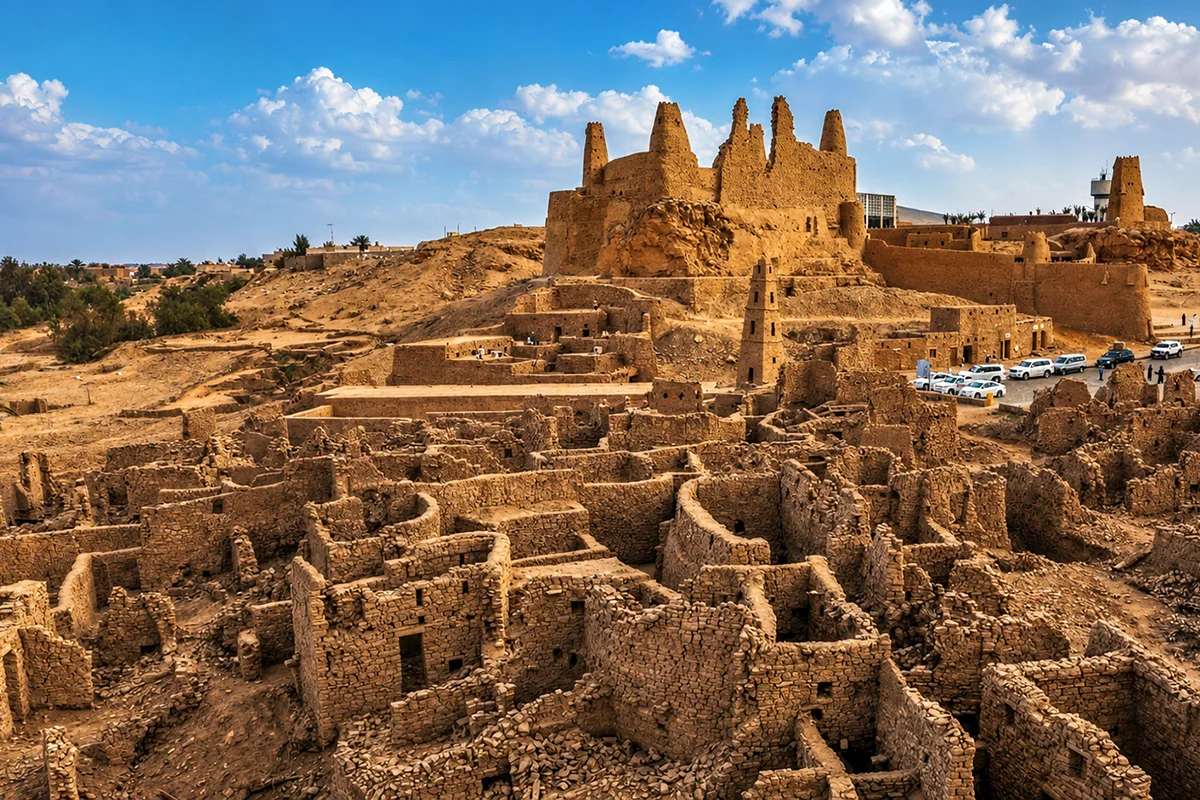
What is there
Three things, and each has its own page or paragraph.
- Qasr Marid, the castle, which is recorded as having withstood attack in the third century AD, during the campaigns associated with Zenobia of Palmyra.
- The mosque named for Umar ibn al-Khattab, with its remarkable early minaret. The attribution is contested, and that page sets out why.
- The old quarter, al-Dir'i, where Islamic-period buildings stand on foundations of the mid-first millennium BC.
Is visiting part of Hajj or Umrah?
No. Not a rite of either.
Getting there, honestly
We do not run a scheduled service to al-Jawf and there is no published Wadana Go fare for it. Al-Jawf has a regional airport at Sakaka, and the practical options are flying and hiring a car, or arranging a private car in advance. See driving yourself versus a private driver and renting a car in Saudi Arabia. Our Beyond the Haramayn guide covers ziyarat outside Makkah and Madinah.
Related reading
- The Umar ibn al-Khattab Mosque — the minaret, and the contested attribution.
- The historic oasis and old town — Qasr Marid and al-Dir'i.
- The expedition of Tabuk — where Khalid was sent from.
- Beyond the Haramayn — the wider ziyarat picture.
Accuracy note
The meaning of the name as Dumah of the stone, al-Jawf as depression referring to Wadi Sirhan, the site's position north of the Nafud desert at one end of Wadi Sirhan on a junction of ancient trade routes, the Akkadian name Adummatu and its appearance on the Esarhaddon Prism of 673 to 672 BC as the strong city of the Arabians, and the Assyrian records connecting the city with Arab queens including Zabibe, Shamshi, Tabua and Te'elhunu, follow published scholarship and reference works. The three expeditions, in July 626 led by the Prophet ﷺ with those gathered dispersing and no fighting reported, in October 630 when Khalid ibn al-Walid was sent from the Tabuk campaign and captured Ukaydir ibn Abd al-Malik, and in April 631 when the idol Wadd worshipped by Banu Kalb was destroyed, follow the seerah and historical accounts and are level B; Wadd is named in Surah Nuh 71:23, which is level A, and the connection between that name and the object at al-Jawf is made in the historical accounts. The arbitration after Siffin took place at Dumat al-Jandal in 37 AH, January 658, chosen as lying midway between Kufa and Damascus, with Abu Musa al-Ash'ari representing Ali and Amr ibn al-As representing Mu'awiyah, and several hundred sent by each side to witness. Accounts of what was said and done at the meeting differ substantially between sources; we have deliberately not adjudicated between them, and readers should be wary of confident single-version retellings. What is not disputed is that the arbitration did not settle the dispute and that disagreement over accepting arbitration had already produced a further split. Qasr Marid is recorded as having withstood attack in the third century AD during the campaigns associated with Zenobia of Palmyra. The al-Dir'i quarter contains Islamic-period buildings standing on foundations of the mid-first millennium BC. Visiting is not a rite of Hajj or Umrah. We do not run a scheduled service to al-Jawf and have not quoted a fare. Content verified August 2026. Correction? Tell us.
Frequently asked questions
Planning a Saudi trip?
Pre-book a private car, find a stay, or ask us anything on WhatsApp.
Last updated: 29 August 2026·Sources reviewed by the Wadana Go editorial team.