The Umar Mosque at Dumat al-Jandal: A Minaret With No Twin
Short answer
The mosque named for Umar ibn al-Khattab at Dumat al-Jandal is built of carved stone, about 32.5 by 18 metres, and keeps its original columns and minbar. Its minaret rises in five tapering storeys to about fifteen metres and is the earliest surviving of its type in northern Arabia. The attribution to Umar is contested.
Key takeaways
- ✓The mosque is roughly rectangular, built of carved stone, about 32.5 metres east to west and 18 metres wide.
- ✓It keeps much of its original fabric, including the central columns and the minbar, which is unusual for the region.
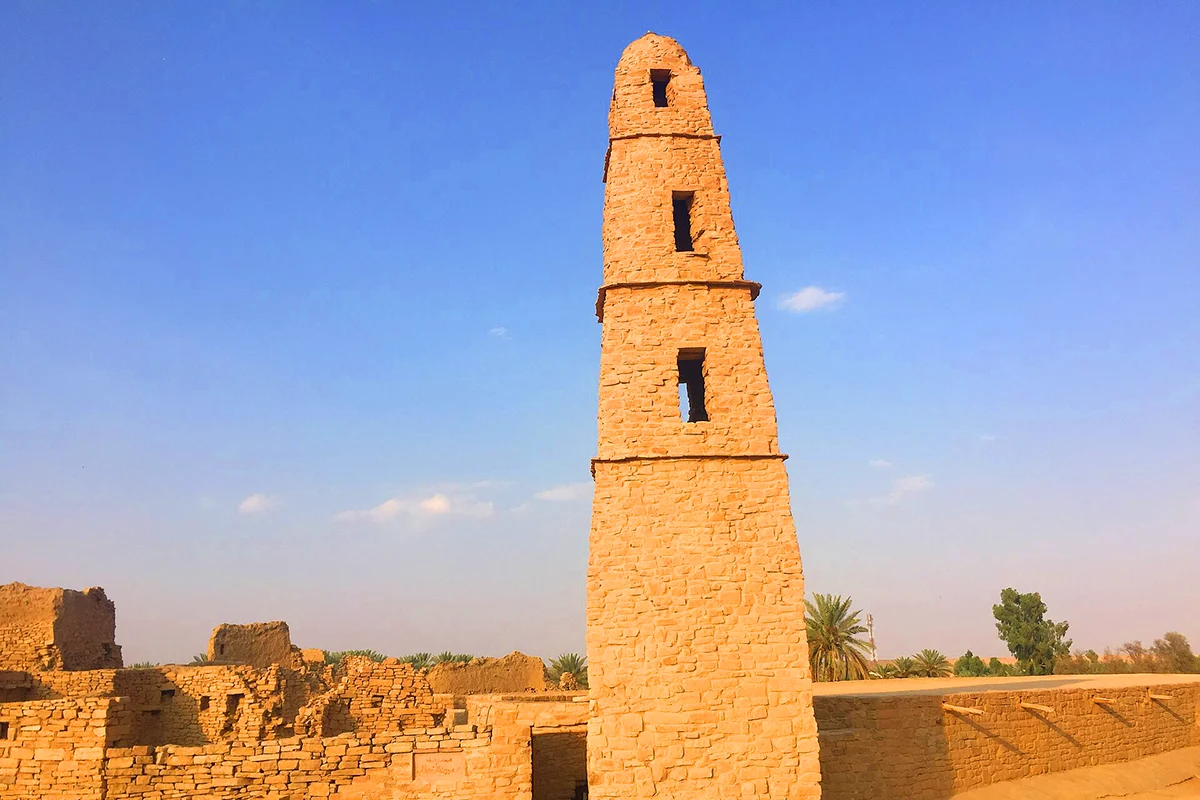
- ✓The minaret stands at the south-west corner, rises in five tapering storeys to about fifteen metres, and ends in a small pyramid.
- ✓It is described as the earliest surviving minaret of its type in northern Arabia, and it looks nothing like a modern minaret.
- ✓The attribution to Umar ibn al-Khattab is traditional and contested. Published assessments place the fabric later.
- ✓Some scholars attribute it instead to the Umayyad caliph Umar ibn Abd al-Aziz, about ninety years after the first Umar.
- ✓Restored by the Saud family in the mid-nineteenth century, and again in 1975 when surrounding buildings were removed.
Quick facts
- Where
- Old quarter of Dumat al-Jandal, al-Jawf
- Next to
- Qasr Marid
- Plan
- About 32.5 m east-west by 18 m wide, carved stone
- Minaret
- Five tapering storeys, about 15 m, pyramid top
- Position
- South-west corner of the prayer hall
- Claim
- Earliest surviving minaret of its type in north Arabia
- Attribution
- Contested. Level C for Umar ibn al-Khattab
- Restorations
- Mid-19th century, and again in 1975
- Part of Umrah or Hajj
- No
In the old quarter of Dumat al-Jandal, next to the castle, there is a stone mosque with a tapering minaret that looks like nothing else in northern Arabia.
It is named for Umar ibn al-Khattab. Whether he built it is a genuinely open question, and this page treats it as one.
The building
It is roughly rectangular and built of carved stone, running about 32.5 metres east to west and 18 metres wide.
It has kept a great deal of its original fabric, including the central columns and the minbar. That is unusual. Most early mosques in the region have been rebuilt out of existence.
The minaret
This is the thing worth travelling for.
It stands at the south-west corner of the prayer hall, rises in five tapering storeys to about fifteen metres, and finishes in a small pyramid.
It is described as the earliest surviving minaret of its type in northern Arabia, and it does not look like the minarets you know. No balcony ring, no slender shaft, no dome. A stack of square tiers, each smaller than the one below, narrowing to a point.
Stand under it and you are looking at an early answer to a question that had not been settled yet: what shape should a minaret be?
The attribution
Here is the honest position, and it is more interesting than the confident one.
The traditional attribution holds that Umar ibn al-Khattab built or founded it, and the mosque carries his name accordingly.
The problem is that the standing building does not obviously belong to his caliphate. Published assessments place the fabric later, into the seventh to eighth centuries, and some scholars attribute it instead to the Umayyad caliph Umar ibn Abd al-Aziz.
Notice how neat that alternative is. Two caliphs named Umar, one about ninety years after the other, and a mosque called the mosque of Umar. That is exactly the kind of slippage that produces a firm tradition out of a genuine ambiguity.
We are not settling it. What we can say is that the attribution to Umar ibn al-Khattab is contested and should not be repeated as established fact, and that the same doubt applies at other sites carrying his name.
Does it matter?
For accuracy, yes, because saying something is certain when it is not is a habit that spreads.
For the value of the building, not much. Whether it belongs to the 640s or the 720s, it is an extremely early mosque with a minaret of a form that barely survives anywhere. That is remarkable at either date.
Later work
The mosque was restored by the Saud family in the mid-nineteenth century. In 1975 buildings that had grown up around the minaret to the south and west were removed, and the mosque and minaret were restored again.
So what you see has been worked on. That is normal and it is not a criticism; a building of this age survives because people keep repairing it.
The evidence, plainly
- An early mosque here with a rare early minaret: established.
- The minaret's form, five tapering storeys to about fifteen metres: published descriptions.
- Construction by Umar ibn al-Khattab: traditional attribution, contested. Level C for the specific attribution.
- Attribution to Umar ibn Abd al-Aziz: proposed by some scholars. Also not settled.
- Any special virtue or prescribed prayer here: none that we could verify.
If you go
- Pray there as you would anywhere. Nothing extra is prescribed.
- Look at the minaret properly. It is the reason to come.
- Combine it with the castle and the old quarter. They are all within a few minutes' walk.
- Confirm access. Arrangements at heritage sites change.
Is visiting part of Hajj or Umrah?
No. Travel for prayer is prescribed for three mosques only: al-Masjid al-Haram, the Prophet's Mosque and al-Masjid al-Aqsa.
Getting there, honestly
We do not run a scheduled service to al-Jawf and there is no published Wadana Go fare for it. Al-Jawf has a regional airport at Sakaka, and the practical options are flying and hiring a car, or arranging a private car in advance. See driving yourself versus a private driver and renting a car in Saudi Arabia. Our Beyond the Haramayn guide covers ziyarat outside Makkah and Madinah.
Related reading
- Dumat al-Jandal — the history of the place.
- The historic oasis and old town — Qasr Marid and the quarter around it.
- Masjid al-Tawbah, Tabuk — the same question of attribution, elsewhere.
- Beyond the Haramayn — the wider ziyarat picture.
Accuracy note
The mosque stands beside Marid Castle within the old quarter of Dumat al-Jandal in al-Jawf; the quarter's name is transliterated variously as al-Dir'i, al-Dar'i and al-Dara'. Its roughly rectangular plan of carved stone measuring about 32.5 metres east to west by 18 metres wide, its retention of original structural components including the central columns and the minbar, and its minaret at the south-west corner of the prayer hall rising in five tapering storeys to about fifteen metres and ending in a pyramidion, follow published descriptions; it is described as the earliest surviving minaret of its type in northern Arabia. The attribution of the mosque to the caliph Umar ibn al-Khattab is a traditional attribution and is contested: published assessments place the standing fabric later, into the seventh to eighth centuries, and some scholars attribute it instead to the Umayyad caliph Umar ibn Abd al-Aziz. We have not settled the question and readers should not repeat the attribution to Umar ibn al-Khattab as established fact. Our observation that two caliphs named Umar, roughly ninety years apart, offer an easy route to that confusion is our own reading and is offered as such. The restoration by the Saud family in the mid-nineteenth century, and the removal in 1975 of buildings that had grown around the minaret to the south and west followed by further restoration, follow published accounts. We could not verify any special virtue or prescribed prayer for this mosque; travel for prayer is prescribed for three mosques only. Arrangements at Saudi heritage sites change; confirm access before travelling. Visiting is not a rite of Hajj or Umrah. We do not run a scheduled service to al-Jawf and have not quoted a fare. Content verified August 2026. Correction? Tell us.
Frequently asked questions
Planning a Saudi trip?
Pre-book a private car, find a stay, or ask us anything on WhatsApp.
Last updated: 28 August 2026·Sources reviewed by the Wadana Go editorial team.