Jannat al-Mu'alla: Makkah's Oldest Cemetery, and Who Rests There
Short answer
Jannat al-Mu'alla, also called al-Ma'la or al-Hajun, is Makkah's oldest cemetery, about one kilometre north of the Grand Mosque. Khadijah bint Khuwaylid, the Prophet's first wife, is buried there, along with his son al-Qasim, Asma bint Abi Bakr and members of his family. The graves are unmarked and the cemetery is still used for burials today. Visiting is not part of Umrah.
Key takeaways
- ✓Jannat al-Mu'alla is about 1 km north of the Grand Mosque, on the slope of al-Hajun, and predates Islam.
- ✓Saudipedia names Khadijah bint Khuwaylid, al-Qasim ibn Muhammad and Asma bint Abi Bakr among those buried there.
- ✓No grave is marked or identified. Nobody can show you a specific person's resting place.
- ✓Aminah, the Prophet's mother, is widely listed here but the early sources place her grave at al-Abwa.
- ✓The domed tombs were removed in 1925 and 1926. What remains is plain stone.
- ✓Visiting graves is a sunnah, to remember death and make dua for the dead, not to ask anything of them.
- ✓The cemetery is still in daily use for burials, and access can close during a funeral.
Quick facts
- City
- Makkah, Saudi Arabia
- Also called
- Al-Ma'la, al-Hajun, the Cemetery of Makkah
- Distance from the Haram
- About 1 km north
- Car access
- Yes, right up to the boundary
- Entry fee
- None
- Best time
- After Fajr or after Asr
- Typical visit
- 10 to 15 minutes
- Still in use
- Yes, burials continue today
- Graves marked?
- No. Plain and unidentified since 1925-26.
- Part of Umrah?
- No. Not a rite of Hajj or Umrah.
Makkah's oldest burial ground, a kilometre from the Haram
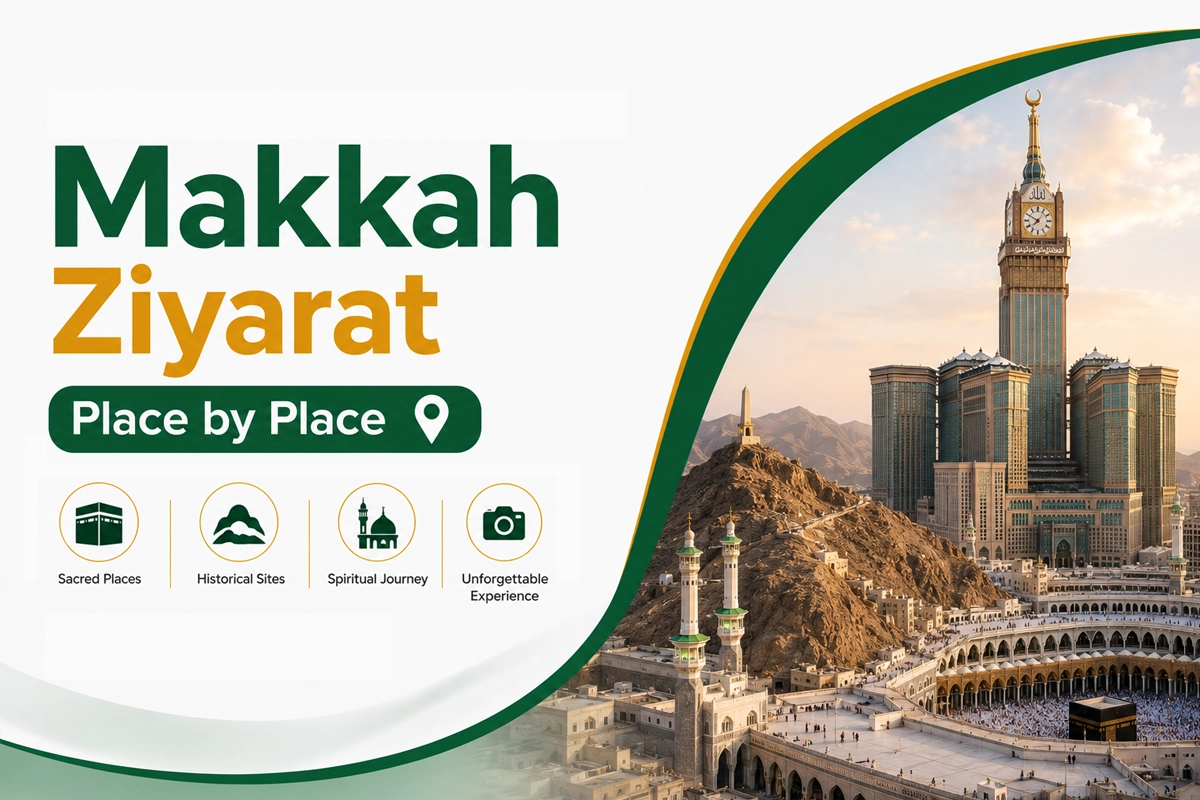
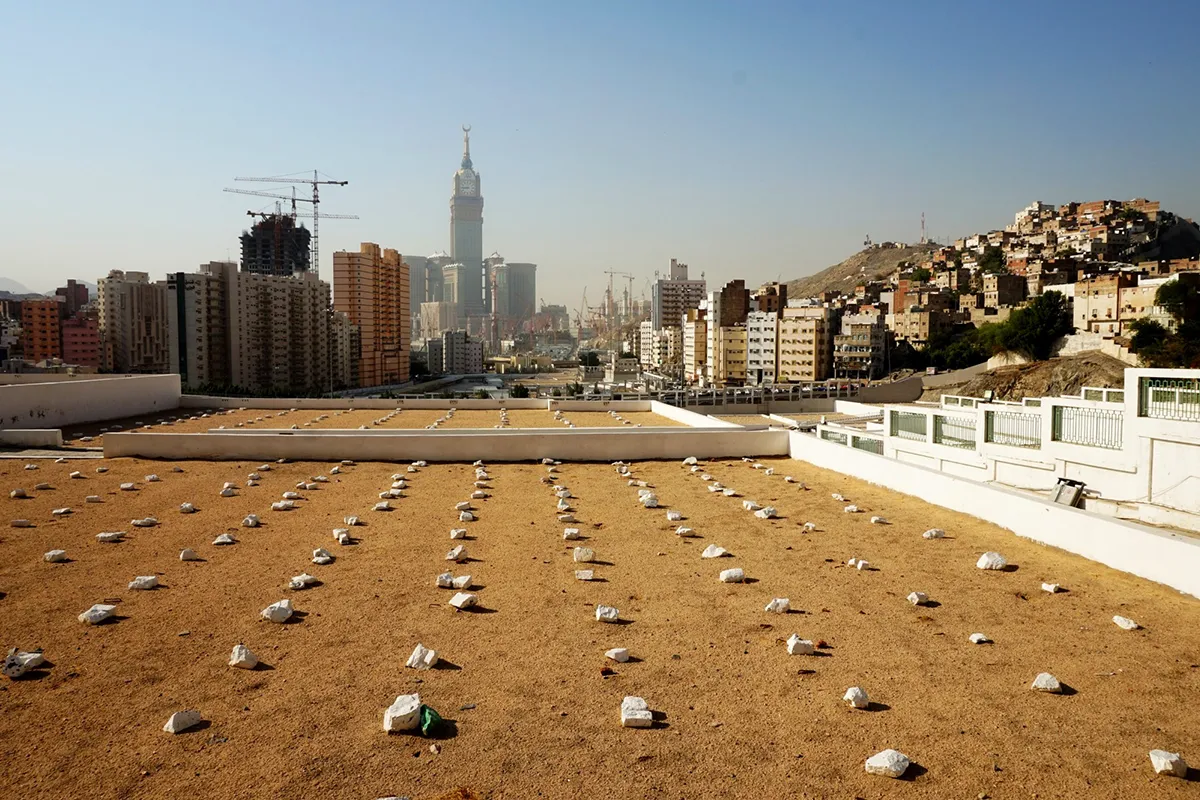
Jannat al-Mu'alla lies on the slope of al-Hajun, roughly a kilometre north of the Grand Mosque. You pass it on the way in from Mina, and many pilgrims see the wall from the car without knowing what is behind it.
Saudipedia calls it one of the largest and oldest cemeteries in Makkah, and dates its use back to before Islam. The people of Makkah were burying their dead here long before the Prophet Muhammad was born, which is why so many names from the generation before him are attached to it.
Other names for it are al-Ma'la, the Cemetery of Makkah, and al-Hajun after the hill it sits on. All four refer to the same place.
It is still working. This is not a preserved site or a monument. Funerals arrive, graves are dug, and families come. If you visit and the gates are busy, that is why.
Who is buried there
The best-attested name is Khadijah bint Khuwaylid, the Prophet's first wife, and the first person to believe in him. She died in Makkah about three years before the Hijrah, in the year the Prophet also lost his uncle Abu Talib. Saudipedia names her among those buried at al-Ma'la.
The same source names al-Qasim, the Prophet's son who died in infancy, and Asma bint Abi Bakr, who lived to great age and died in Makkah after the killing of her son Abdullah ibn al-Zubayr.
Historical accounts also place several of the Prophet's forefathers and close family there, including his grandfather Abd al-Muttalib, his uncle Abu Talib, and earlier ancestors of the line of Quraysh. These are recorded in history rather than in the Qur'an or hadith, which is a weaker footing than Khadijah's case but a serious one.
Later centuries added scholars, jurists and notables who died in Makkah, right up to the modern period.
One honest caution about all of these. No individual grave in the cemetery is marked, and no one can point to a specific spot and tell you whose it is. What history records is that these people were buried in this cemetery. Anyone who walks you to a particular patch of ground and names a person is going beyond what the evidence supports.
One name that keeps appearing, and should not
A large number of travel sites list Aminah bint Wahb, the Prophet's mother, among the burials at Jannat al-Mu'alla. It is repeated so often that it has become one of the standard facts about the place.
It is very probably wrong.
The early sources record that Aminah died at al-Abwa, a village on the road between Makkah and Madinah, when her son was about six years old, and that she was buried there. Sahih Muslim records that the Prophet later visited his mother's grave and wept, and made those with him weep. Al-Abwa still sits on that road today.
Saudipedia's entry on al-Ma'la does not name her. Neither does the burial list on Wikipedia. The claim seems to have spread through Ziyarat blogs copying one another.
We are flagging it because pilgrims stand at that wall making dua for a person who is not there, and because a site that tells you this one is more likely to be careful with the rest.
What you see today
Plain stone, low walls, and rows of unmarked graves. That is it.
It did not always look like this. The Ottoman traveller Evliya Celebi, writing in the seventeenth century, described seventy-five domed tombs in the cemetery, including ones marking the graves of the Prophet's uncle and grandfather. In 1925 and 1926, after the Hejaz came under the rule of Ibn Saud, the domed structures at al-Mu'alla and at al-Baqi in Madinah were removed as part of a wider religious and urban policy of the new Saudi state.
What replaced them is what you see: graves marked, if at all, by a plain stone or a small pile of rock, in the same manner for everyone.
The cemetery is still yielding history. Saudipedia records that twenty-four ancient inscribed pieces were recovered from al-Ma'la and handed to the Ministry of Tourism, some dating back to 655 AH.
Visiting graves: what is actually prescribed
Visiting a cemetery is a sunnah, and the reason given for it is specific. The Prophet said, as recorded in Sahih Muslim, that he had forbidden visiting graves and now instructed his companions to visit them, because they are a reminder of the Hereafter.
So the purpose is to remember death, and to make dua for the dead. That is the whole of it.
What is not prescribed at Jannat al-Mu'alla:
- No special prayer at the cemetery, and no reward attached to visiting this cemetery over any other.
- No asking anything of the people buried there. Dua is made to Allah, for them.
- No touching, kissing or wiping the graves or the wall.
- No sitting on the graves, and no walking over them.
- Visiting is not part of Hajj or Umrah. Your Umrah is complete without it.
Saudi authorities keep the cemetery plain and unmarked for exactly these reasons, and staff at the gate will stop anything that looks like veneration of a grave.
The greeting given on entering a Muslim cemetery, taught by the Prophet, is peace upon you, people of this place, believers and Muslims, and we will, God willing, be joining you.
Visiting, in practice
There is no ticket, no opening ceremony, and nothing to see in the tourist sense. Most visits last ten or fifteen minutes.
A few practical points, based on how the site is normally run rather than on any published rule:
- Men walk in. Women generally give their salam and make dua from outside the boundary, as at al-Baqi in Madinah. Arrangements are set by the authorities and can change, so check at the gate.
- Access can close during a burial. Funerals take priority. If one is under way, wait or come back.
- Keep your phone in your pocket. Photography is discouraged, and families are burying relatives a few metres away.
- Dress and behave as you would in a mosque. Quiet voices, no groups posing, no raised hands towards the graves.
- Go after Fajr or after Asr if you can choose. The middle of the day here is exposed and hot.
The distance from the Haram is walkable for a fit person, about a kilometre, but the route is uphill, busy with traffic, and unpleasant in summer heat or in ihram. Most pilgrims fold it into a Makkah Ziyarat round instead, where the driver already knows where to stop.
What else is close by
Al-Mu'alla sits on the north side of the city, and the stops around it group naturally.
| Place | What it is |
|---|---|
| Masjid al-Jinn | A mosque very close to the cemetery, on the site associated with the jinn hearing the Qur'an. |
| Jabal al-Noor | North-east of the Haram, with Ghar Hira at the summit. |
| Jabal Thawr | The Hijrah mountain, about 4 km south. The far end of the same round. |
| Masjid Aisha at Taneem | The miqat for a second Umrah from inside Makkah. |
Our Makkah Ziyarat guide arranges these into one morning, and the Makkah Ziyarat tour runs the standard route with waiting time at each stop. A full round in a sedan is SAR 200 for the whole car, reviewed August 2026.
If you are still planning the trip, the first-time Umrah guide covers the rites in order, and the Makkah city guide covers the practical side of the days around them.
Accuracy note
The cemetery's location on al-Hajun, its age, its alternative names and the burials of Khadijah bint Khuwaylid, al-Qasim ibn Muhammad and Asma bint Abi Bakr come from Saudipedia, which also records the twenty-four inscribed pieces handed to the Ministry of Tourism and one dating to 655 AH.
Other burials, including Abd al-Muttalib and Abu Talib, are recorded in historical sources rather than in the Qur'an or authentic hadith. No individual grave in the cemetery is identified or marked today, and we have not claimed that any particular spot belongs to any particular person.
The removal of the domed tombs in 1925 and 1926, and Evliya Celebi's seventeenth-century description of seventy-five domes, are matters of documented history.
Aminah bint Wahb is widely but wrongly listed among the burials here. The early sources place her death and burial at al-Abwa, and Sahih Muslim records the Prophet visiting his mother's grave there.
The instruction to visit graves as a reminder of the Hereafter is recorded in Sahih Muslim. Entry arrangements, including the practice regarding women, are set by the authorities and are not published as a fixed rule, so we have described them as practice rather than regulation. Check at the gate. Verified August 2026.
Frequently asked questions
Planning a Saudi trip?
Pre-book a private car, find a stay, or ask us anything on WhatsApp.
Last updated: 27 August 2026·Sources reviewed by the Wadana Go editorial team.