Jabal Thawr, Makkah: The Mountain of the Hijrah Cave
Short answer
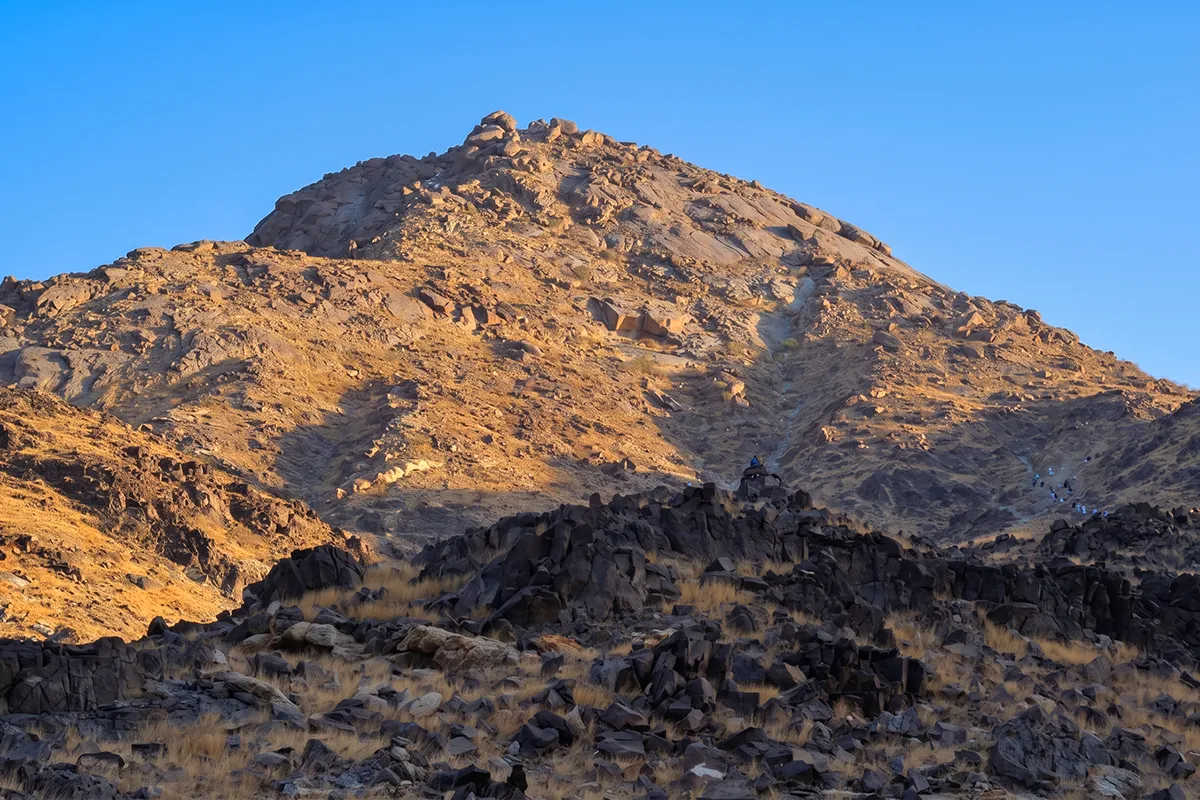
Jabal Thawr is a mountain about four kilometres south of the Grand Mosque in Makkah, rising 760 metres above sea level. Near its summit is Ghar Thawr, the cave where the Prophet Muhammad and Abu Bakr sheltered for three nights during the Hijrah. The climb is harder than Jabal al-Noor and takes most people two to three hours up and down. Climbing is not part of Hajj or Umrah.
Key takeaways
- ✓Jabal Thawr is 760 m high and sits about 4 km south of the Grand Mosque, away from the road to Madinah.
- ✓The Prophet and Abu Bakr went south deliberately, so the Quraysh would search the northern roads.
- ✓Sahih al-Bukhari records the three nights, the hired guide, and the two men who kept them supplied.
- ✓The climb is harder than Jabal al-Noor: two to three hours up and down, steep and exposed at the top.
- ✓Most Ziyarat groups view the mountain from the road, and that is a complete visit.
- ✓Climbing it is not part of Hajj or Umrah, and no reward for the climb is established.
- ✓The Jabal Thawr Cultural District at the base covers over 127,000 sq m and includes a Hijrah Exhibition.
Quick facts
- City
- Makkah, Saudi Arabia
- Height
- 760 m above sea level
- Distance from the Haram
- About 4 km south
- Also called
- Jabal Athal
- Car access
- To the base only. No road to the cave.
- Climb time
- 2-3 hours up and down for most people
- Difficulty
- Hard. Steeper than Jabal al-Noor.
- Part of Umrah?
- No. Not a rite of Hajj or Umrah.
- At the base
- Jabal Thawr Cultural District and Hijrah Exhibition
- Best time to climb
- Before sunrise
A mountain on the wrong side of the city
Jabal Thawr stands about four kilometres south of the Grand Mosque, on the opposite side of Makkah from the road to Madinah. It rises 760 metres above sea level. Older books also call it Jabal Athal.
Wadi al-Mufajr and the ring road that links Taif, the holy sites and Jeddah cut it off from the rest of Makkah's mountains, so it reads as a separate block of rock rather than part of a range. The nearest built-up area is the Al-Hijrah neighbourhood. That name is not a coincidence.
Saudipedia describes the mountain as easy at its base and rugged at its summit, with difficult paths. Anyone who has walked it will tell you that is a fair description. The first stretch is a walk. The last stretch is a scramble over bare rock.
Near the top, just below the peak, is a hollow in the stone. That hollow is Ghar Thawr, and it is the reason anyone knows the mountain's name.
Why the Prophet went south
Madinah is north of Makkah. Thawr is south.
When the Prophet Muhammad and Abu Bakr left Makkah on the Hijrah, the Quraysh were hunting them, and the obvious thing to do was to head north and travel fast. They did the opposite. They walked away from Madinah, climbed a mountain on the southern edge of the city, and stayed there for three nights while the search parties spread out along the northern roads.
Sahih al-Bukhari records the arrangement in detail. A guide from Banu al-Dil was hired in advance and told to bring the two camels to the mouth of the cave on the morning of the fourth day. Abdullah, the son of Abu Bakr, spent each night with them and slipped back into Makkah before dawn so that the Quraysh would think he had never left. Amir ibn Fuhayra grazed Abu Bakr's sheep past the cave after dark, both for milk and to wipe out the footprints.
It was a plan, and a careful one. The direction was the first move in it.
The climb, honestly
This is a harder climb than Jabal al-Noor. If you have read about the 600-odd steps up to Ghar Hira and thought that sounded manageable, adjust your expectations before you come here.
Our own Makkah Ziyarat route page, reviewed in August 2026, puts Jabal Thawr at two to three hours up and down for most people, and notes plainly that most Ziyarat groups look at it from the road and do not attempt it. A half-day round does not have room for both climbs.
The path is uneven rock with very little shade. The final section near the summit involves using your hands. In Makkah's heat, that combination is what causes trouble, not the height.
You will see step counts of 1,400 or 1,500 repeated on travel sites. We are not going to print one as a fact, because those figures do not trace back to any official source we can check. What we can say is that people who climb it consistently describe it as long, exposed and steep at the end.
Some plain advice if you decide to go up:
- Start before sunrise. Not at sunrise, before it.
- Carry more water than feels sensible. There is nowhere to buy any on the mountain.
- Wear real shoes with grip. Sandals are not enough on the upper section.
- Do not climb on the same day you have done a long tawaf and sa'i.
- If you have a heart condition, a breathing condition, or you are unsteady on your feet, look at it from the base instead. Nobody is keeping score.
Most pilgrims who visit Jabal Thawr never leave the road, and their visit is not worth less for it. Standing at the foot of it and understanding what the direction meant is the point of coming.
Is climbing Jabal Thawr part of Hajj or Umrah?
No. It is not one of the rites, and no reward for climbing it is established in authentic evidence. Your Umrah is complete whether you go up, stop at the base, or skip it altogether.
Islamweb states the position clearly: there is nothing in the Sharia that encourages visiting the cave of Thawr, and going there in the belief that the act itself carries religious virtue is an innovation. The same reasoning that Saudi scholars apply to Ghar Hira applies here.
That does not make the mountain uninteresting. It makes it history rather than worship, which is a different thing, and an honest one.
What is being built at the base
Jabal Thawr is in the middle of a large official project. The Jabal Thawr Cultural District, supervised by the Royal Commission for Makkah City and Holy Sites, covers more than 127,000 square metres at the foot of the mountain.
Its main components are a visitor reception centre and a Hijrah Exhibition, which tells the story of the migration through museum displays and modern technology rather than through a climb. Saudipedia also records orientation centres already established at the base to help visitors going up and coming down.
This matters for anyone travelling with elderly parents or young children. The pattern here is the same one that worked at Jabal al-Noor, where the Hira Cultural District gave people who cannot climb somewhere real to go. If part of your group wants the mountain and part of it does not, the base is no longer just a car park.
Because the district is still being developed, access arrangements at the mountain can change. Check on the day rather than relying on what you read months earlier, including here.
Getting there
There is no public transport to the foot of Jabal Thawr and no reason to expect a taxi to be waiting for you when you come back down. The ring road passes close by, and the drive from the central hotel district is short, but the mountain is not somewhere you want to be stranded at eight in the morning.
Almost everyone arrives by car as part of a wider round. On our fixed Makkah Ziyarat fare, one vehicle covers the whole circuit and waits at every stop:
| Vehicle | Seats | Makkah Ziyarat round |
|---|---|---|
| Standard sedan | 4 | SAR 200 |
| SUV | 6 | SAR 230 |
| Van | 11 | SAR 280 |
| Minibus | 20 | SAR 380 |
The fare is per vehicle, not per person, and waiting time is included. Fares reviewed August 2026.
If you intend to climb, say so when you book. It changes the shape of the day. A driver who knows he is waiting two or three hours at Thawr will plan the rest of the route around it instead of trying to fit eight stops into a morning.
Where it fits in a Makkah round
Thawr is usually the southern point of a Ziyarat circuit that otherwise runs north and east.
| Place | What it is |
|---|---|
| Ghar Thawr | The cave near the summit, and the three nights of the Hijrah. |
| Jabal al-Noor | North-east of the Haram. The other mountain, and the easier climb. |
| Jannat al-Mu'alla | Makkah's historic cemetery, about a kilometre north of the Haram. |
| Masjid Aisha at Taneem | The miqat used for a second Umrah from inside Makkah. |
Our Makkah Ziyarat guide puts these in a workable order for one morning, and the Makkah Ziyarat tour covers the standard route with a driver who already knows where to park at each stop.
If you are still putting the whole trip together, the first-time Umrah guide covers the rites in order, and a private Ziyarat car is the single booking that saves the most time on the ground.
Accuracy note
The mountain's height of 760 metres, its position roughly four kilometres south of the Grand Mosque, the alternative name Jabal Athal, the description of the terrain, and the details of the Jabal Thawr Cultural District all come from Saudipedia, which cites the Royal Commission for Makkah City and Holy Sites and the Saudi Press Agency.
The events of the Hijrah, including the hired guide, the role of Abdullah ibn Abi Bakr and Amir ibn Fuhayra, and the three nights on the mountain, are recorded in Sahih al-Bukhari. This is established evidence.
Climb times are what visitors and our own drivers report, and they vary with fitness and heat. They are not an official figure. We have deliberately not printed a step count, because the numbers repeated online do not trace back to a source we can verify. Fares are our own published Makkah Ziyarat rates, reviewed August 2026. Verified August 2026.
Frequently asked questions
Planning a Saudi trip?
Pre-book a private car, find a stay, or ask us anything on WhatsApp.
Last updated: 2 September 2026·Sources reviewed by the Wadana Go editorial team.