Ghar Thawr: The Cave Where the Hijrah Began
Short answer
Ghar Thawr is a small cave near the summit of Jabal Thawr, about four kilometres south of the Grand Mosque in Makkah. It is roughly 1.25 metres high with two openings, east and west. The Qur'an, in Surah at-Tawbah 9:40, records that the Prophet Muhammad and Abu Bakr sheltered there during the Hijrah. They stayed three nights. Visiting is not part of Umrah.
Key takeaways
- ✓Ghar Thawr is a hollow rock just below the summit of Jabal Thawr, with two openings facing east and west.
- ✓It is about 1.25 metres high. A grown man cannot stand up inside it.
- ✓The Qur'an names the event in Surah at-Tawbah 9:40, which makes this the strongest evidence for any cave in Islam.
- ✓Sahih al-Bukhari records the three nights, the hired guide, and the four people who kept the two men supplied.
- ✓The spider and pigeon story is disputed. Ibn Hajar and Ibn Kathir accepted a version; al-Albani and Ibn 'Uthaymeen rejected it.
- ✓Visiting the cave is not a rite of Hajj or Umrah and no prayer is prescribed there.
- ✓The climb takes two to three hours up and down. Most Ziyarat groups view the mountain from the road.
Quick facts
- City
- Makkah, Saudi Arabia
- Location
- Near the summit of Jabal Thawr, about 4 km south of the Haram
- Cave height
- About 1.25 m
- Openings
- Two: one east, one west
- Named in the Qur'an
- Yes, Surah at-Tawbah 9:40
- Nights spent there
- Three
- Car access
- To the base of the mountain only
- Climb
- 2-3 hours up and down. Steep and exposed.
- Part of Umrah?
- No. No prescribed prayer or reward.
- Best time
- Before sunrise, if you climb
A hollow in the rock, and how small it is
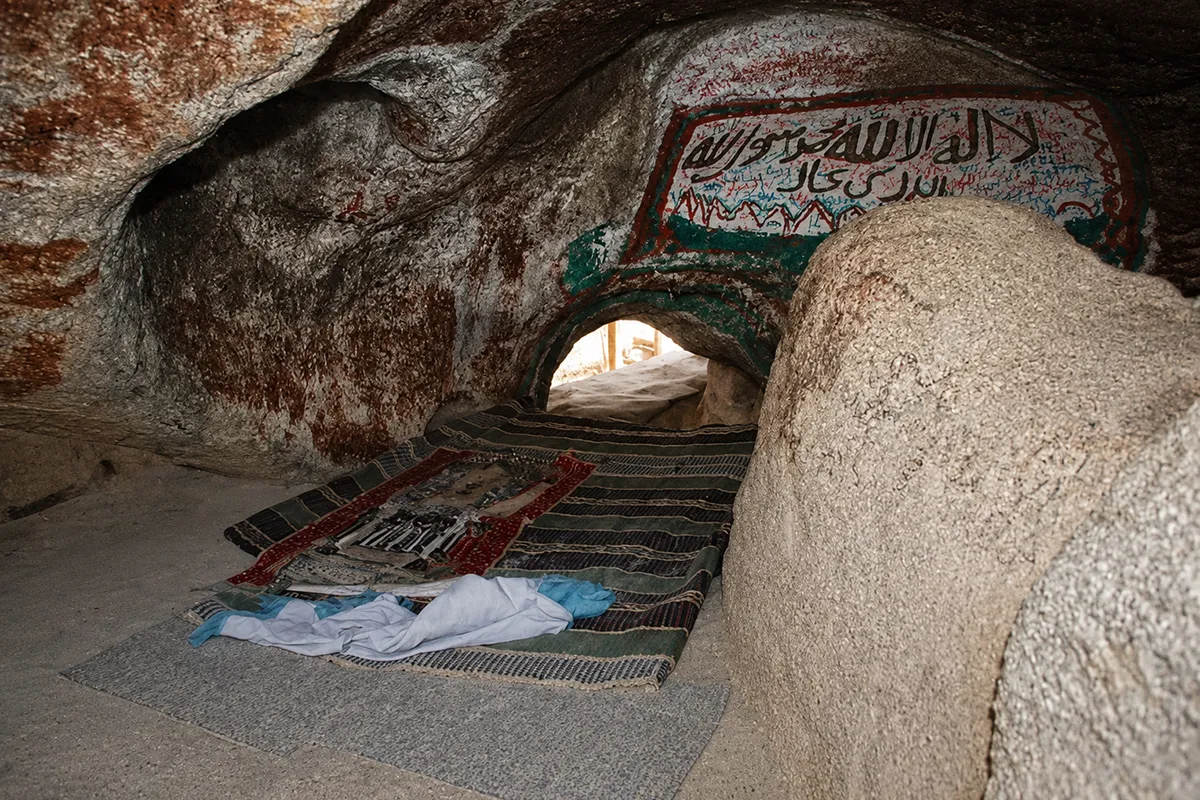
Ghar Thawr is not a cavern. Saudipedia describes it as a hollow rock at the top of Jabal Thawr, sitting just below the peak, with two openings: one facing east and one facing west. Islamweb gives its height as about 1.25 metres.
Read that figure again. A grown man cannot stand up inside it. Two men spending three nights in that space were lying down, sitting, and taking turns at the mouth. There was no room to do anything else.
The western opening is the one the Prophet Muhammad and Abu Bakr are recorded as having entered through. The eastern one is smaller.
People arrive expecting somewhere dramatic. What they find is a gap in a boulder field near the summit of a hot mountain, and most say afterwards that the smallness was the part that stayed with them.
What the Qur'an says about it
This is the strongest evidence attached to any cave in Islam. The Qur'an names the event directly, in Surah at-Tawbah, verse 40. In translation of the meaning:
If you do not aid the Prophet, Allah has already aided him when those who disbelieved had driven him out as one of two, when they were in the cave and he said to his companion, "Do not grieve; indeed Allah is with us." And Allah sent down his tranquillity upon him and supported him with angels you did not see.
Two things in that verse are worth sitting with. The companion is not named, and every commentator understands him to be Abu Bakr. And the reassurance is not that they would not be found. It is that Allah was with them.
The three nights, as Bukhari records them
Sahih al-Bukhari carries a long account of the migration that sets out how the three nights worked. It reads less like a miracle story and more like a well-run operation.
- The guide. A man of Banu al-Dil, an expert in the desert roads, was hired before they left. His instructions were to bring their two camels to the cave on the morning after the third night.
- The news. Abdullah ibn Abi Bakr, described in the narration as an intelligent and sharp young man, spent each night with them in the cave. He left before daybreak and was back among the Quraysh by morning as if he had slept in Makkah, listening for any plan against them and carrying it up the mountain after dark.
- The food, and the footprints. Amir ibn Fuhayra, Abu Bakr's freed slave, brought the milk sheep past the cave a while after nightfall, so they had fresh milk every night. He drove the flock away again before dawn. He did this on each of the three nights.
Asma bint Abi Bakr carried provisions up to them and, having nothing to tie the bundle with, tore her waist belt in two and used one half. She is known afterwards as Dhat al-Nitaqayn, the woman of the two belts.
Four people, each doing one job, for three nights. That is what the cave held.
What Abu Bakr said inside
The best-known moment from those nights is short. Abu Bakr, in Sahih al-Bukhari, said that he told the Prophet while they were in the cave: if any of them were to look down at his feet, he would see us.
He was right. There was no depth to hide in and no back to the cave. The searchers were standing at the mouth.
The Prophet's answer, recorded in the same collection and echoed in the Qur'an, was to ask what he thought of two men whose third is Allah.
The spider and the pigeons
You will hear this story at almost every Ziyarat stop: a spider spun a web across the entrance, two pigeons nested there, and the searchers turned away because no one could have gone in without breaking the web.
Here is where it actually stands, and it is worth knowing before you repeat it.
The story is not in Sahih al-Bukhari or Sahih Muslim. It appears in some history books, including Ibn Kathir's al-Bidaya wa'l-Nihaya. Scholars have not agreed on it. Ibn Hajar and Ibn Kathir graded a version of it as hasan, meaning acceptable. Al-Albani classed it as weak, and Shaykh Ibn 'Uthaymeen said plainly that the story of the spider's web is not authentic.
So: not a fabrication anyone invented yesterday, and not something you can quote as established either. Tell it, if you tell it, as a report that scholars differ over.
There is a second point that several scholars make, and it is the more useful one. What kept the Quraysh from finding two men lying in an open hollow was not a web. They were standing at the entrance and did not see. The Qur'an's own explanation is tranquillity sent down, and support they could not see.
Is visiting the cave part of Umrah?
No, and this deserves a straight answer because so many itineraries imply otherwise.
Ghar Thawr is not a station of Hajj or Umrah. No prayer is prescribed there. No reward for entering it, touching it or praying inside it is established in authentic evidence. Islamweb puts it directly: there is nothing in the Sharia encouraging a visit to the cave of Thawr, and visiting it in the belief that the act carries religious virtue is an innovation.
What is established is the history, and the history is in the Qur'an. You can stand at the foot of the mountain, understand what happened up there, and have taken nothing away from your Umrah.
What it is like to get to it today
The cave sits near the summit, and the only way to it is on foot. The mountain is gentle at the base and rugged at the top, and most people need two to three hours up and down. The last stretch needs hands as well as feet.
At the top, the entrance is low and narrow, and only a couple of people fit inside at once. If it is busy, you will wait. The space is dark, tight and hot. Anyone uneasy in confined spaces should decide that at the bottom of the mountain rather than at the top of it.
Most Ziyarat groups do not climb. Our Makkah Ziyarat route page, reviewed August 2026, notes that the mountain is normally viewed from the road, and that a half-day round has no time for both this climb and Jabal al-Noor. If the climb matters to you, build the day around it and tell your driver when you book.
At the base, the Jabal Thawr Cultural District is being developed by the Royal Commission for Makkah City and Holy Sites. It covers more than 127,000 square metres and includes a visitor reception centre and a Hijrah Exhibition telling the story of the migration through museum displays. For anyone who cannot make the climb, that is a real visit rather than a consolation.
Ghar Thawr and Ghar Hira are not the same story
Pilgrims mix these two up constantly, and the confusion is understandable. Two caves, two mountains, two names that sound alike in English.
| Ghar Hira | Ghar Thawr | |
|---|---|---|
| Mountain | Jabal al-Noor | Jabal Thawr |
| Where | About 4 km north-east of the Haram | About 4 km south of the Haram |
| What happened | The first revelation, before the Hijrah | Three nights of shelter during the Hijrah |
| Who was there | The Prophet alone | The Prophet and Abu Bakr |
| The climb | Steep, roughly 45 minutes to 1.5 hours up | Harder. 2 to 3 hours up and down |
If you only have the energy for one climb, most pilgrims choose Ghar Hira, and the shorter path is the reason.
Fitting it into a Makkah round
Thawr is the southern point of most Ziyarat circuits. A driver usually takes it either first, while the air is still cool, or last on the way back in.
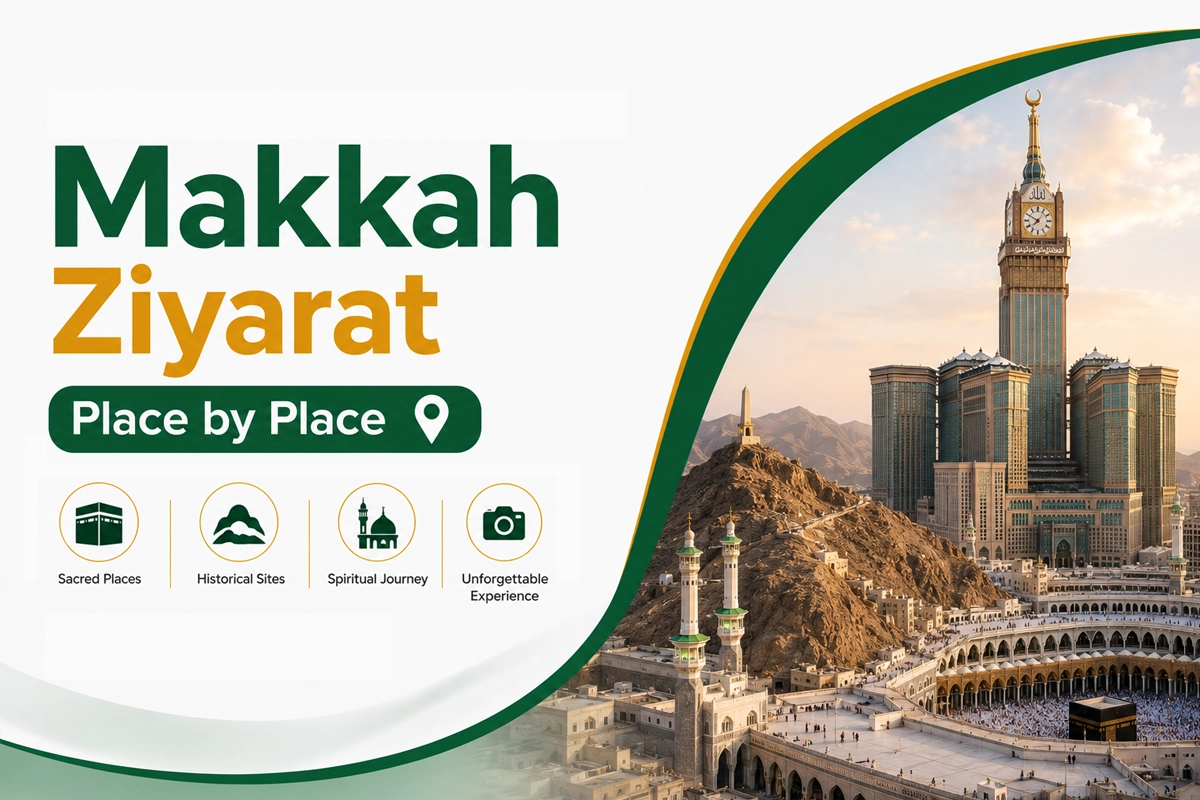
Our Makkah Ziyarat guide sets the stops in a workable order for a single morning, and the Makkah Ziyarat tour runs the standard route. The other stops usually paired with it are Jabal al-Noor, Jannat al-Mu'alla, and Masjid Aisha at Taneem for anyone intending a second Umrah.
Book a private Ziyarat car if you plan to climb. SAR 200 covers a sedan for the whole round, waiting included, so nobody is watching a meter while you are on the mountain. Fares reviewed August 2026.
Accuracy note
The verse quoted is Surah at-Tawbah 9:40, in translation of the meaning. The three nights in the cave, the hired guide from Banu al-Dil, the roles of Abdullah ibn Abi Bakr and Amir ibn Fuhayra, and Abu Bakr's words about the searchers' feet are all recorded in Sahih al-Bukhari. This is established evidence.
The cave's position just below the summit, its two openings facing east and west, and the description of the mountain come from Saudipedia. The interior height of about 1.25 metres is given by Islamweb, which is also the source for the ruling on visiting.
The spider and the pigeons are reported in some history works, not in the two Sahih collections. Scholars differ: Ibn Hajar and Ibn Kathir accepted a version as hasan, while al-Albani classed it weak and Ibn 'Uthaymeen said it is not authentic. We have set it out as a disputed report rather than as fact.
Climb times are what visitors and our own drivers report and vary with fitness and heat. Access at the mountain can change while the Cultural District is being built, so check on the day. Verified August 2026.
Frequently asked questions
Planning a Saudi trip?
Pre-book a private car, find a stay, or ask us anything on WhatsApp.
Last updated: 2 September 2026·Sources reviewed by the Wadana Go editorial team.