The Kaaba's Kiswah: How It Is Made and Why It Changes on 1 Muharram
Short answer
The Kiswah is the black silk cover of the Kaaba. It was last replaced on 16 June 2026, the first day of Muharram 1448, with cloth made at the King Abdulaziz Complex in Makkah. Since 2022 the change has been made at the start of the Hijri year instead of on the days of Hajj.
Key takeaways
- ✓The Kiswah was last replaced on 16 June 2026, the first day of Muharram 1448.
- ✓Since 30 July 2022 it has been replaced on 1 Muharram, not on 9 or 10 Dhul Hijjah.
- ✓The new cloth is made at the King Abdulaziz Complex in Umm al-Joud, Makkah.
- ✓Reports give a weight of about 1,410 kg and 47 silk panels, with about 150 artisans over nearly 11 months.
- ✓Published figures differ, for example about 825 kg of silk against about 1,000 kg.
- ✓Reports say the old cloth stays in place until the new panels are fixed, so the walls are never bare.
- ✓We found no source that makes touching or taking a piece of the Kiswah a rite of Umrah.
Quick facts
- Last replaced
- 16 June 2026 (1 Muharram 1448)
- Made at
- King Abdulaziz Complex, Umm al-Joud, Makkah
- Timing since
- 1 Muharram, first on 30 July 2022
- Before 2022
- 9 or 10 Dhul Hijjah
- Reported weight
- About 1,410 kg
- Silk
- About 825 kg per the Complex, about 1,000 kg per APP
- Silk panels
- 47
- Belt
- 95 cm wide, 47 m long, 16 panels (Siasat)
- Artisans
- About 150 over nearly 11 months
- Estimated cost
- Around SAR 20 million (APP)
- Next change
- About 5 to 7 June 2027, our estimate
The black cloth around the Kaaba is called the Kiswah. It is replaced once a year, and since 2022 the change has taken place at the start of the Hijri year, not on the days of Hajj. Last June it was replaced for the new year 1448 AH.
This page sets out what was reported about that replacement, what the Kiswah is made of, how the practice has changed, and where the published figures disagree, so you know which numbers to trust.
The replacement for 1448 AH
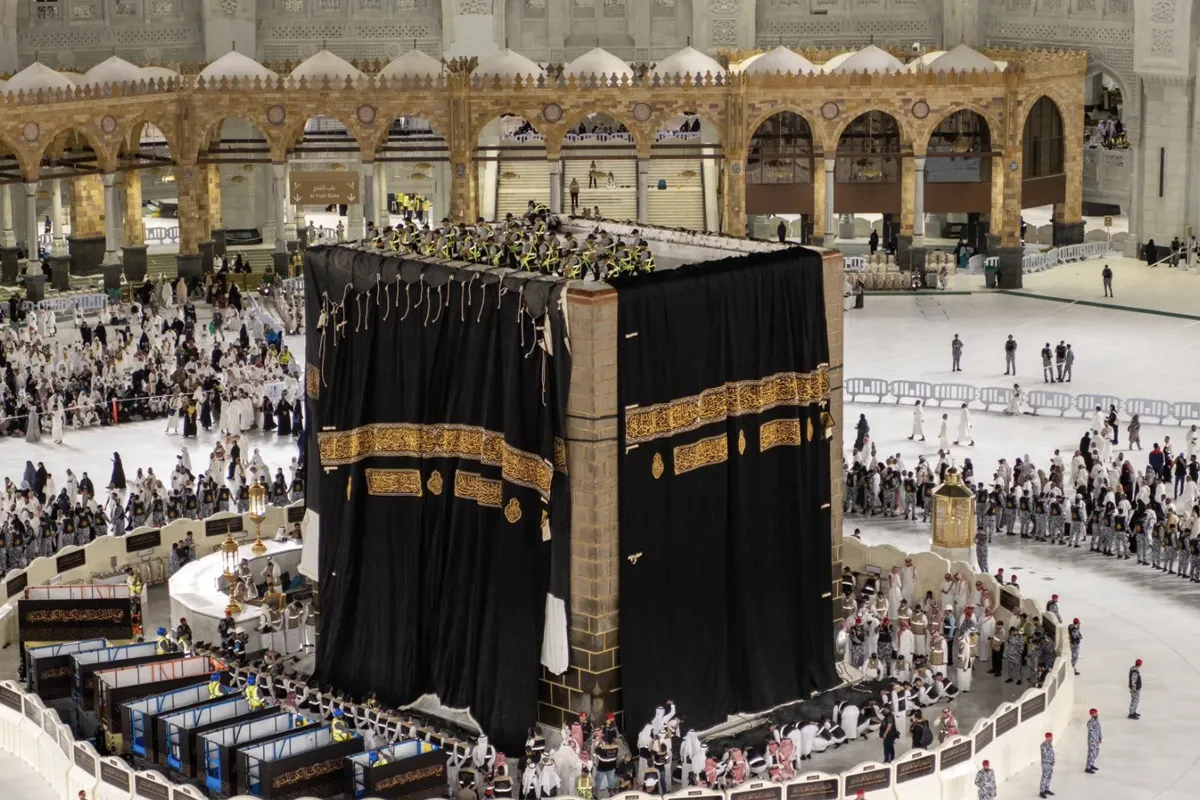
Gulf News reported that the new Kiswah was installed on Tuesday 16 June 2026, the first day of Muharram 1448, and that removal of the old covering began the evening before. Siasat reported on 15 June that the cloth, made at the King Abdulaziz Complex for the Holy Kaaba Kiswa, was handed to the Kaaba's caretakers by Prince Saud bin Mishaal, Deputy Governor of Makkah Region, on behalf of King Salman.
The Associated Press of Pakistan (APP) described how the work was done:
- The crew began on the Hateem side and lifted the new panels to the roof of the Kaaba.
- They fixed the new panels at the top before loosening the ropes of the old Kiswah.
- The old cloth was slid down beneath the new one, so the Kaaba's walls stayed covered throughout.
- The panels were then aligned and stitched at all four corners, and the belt (hizam) and the door curtain (burqa) were installed.
- The old Kiswah is to be chemically preserved in Makkah, and its segments are to be presented as state gifts to foreign dignitaries.
APP gives no named official for these details and says the operation lasted several hours, so treat the sequence as reported, not as an official procedure.
What it is made of, and where the figures differ
Several outlets published specifications for the 1448 Kiswah. They do not agree on everything, so we show them side by side.
| Item | What is reported | Source |
|---|---|---|
| Total weight | About 1,410 kg | Gulf News and Khaleej Times |
| Natural silk | About 825 kg (per the Complex), against about 1,000 kg of black silk | Siasat and Gulf News, against APP |
| Gold-plated silver thread | About 120 kg | Siasat and APP |
| Pure silver thread | About 60 kg, against about 100 kg | Siasat, against APP |
| Cotton | About 410 kg | Siasat, citing the Complex |
| Silk panels | 47 | Gulf News and Khaleej Times |
| Belt | 95 cm wide and 47 m long, with 16 embroidered panels | Siasat |
| Artisans | About 150, over nearly 11 months | Khaleej Times and Gulf News |
| Cost | Around SAR 20 million (estimate) | APP |
The weights Siasat attributes to the Complex (825 kg of silk, 120 kg of gold-plated silver, 60 kg of silver and 410 kg of cotton) add up to about 1,415 kg, close to the 1,410 kg that Gulf News and Khaleej Times report. APP's silk and silver figures do not fit that total, so we lean on the Complex's figures and flag APP's as different. None of the reports we read names an official statement for the 2026 specifications, so we could not confirm them against a primary source.
One more difference concerns the gold. The 2026 reports say the silver threads are plated with 24-carat gold. Arab News, in July 2022, said 21-karat gold-coated silver thread. We cannot say which is right, so we have not stated a carat in our own words.
Khaleej Times adds that production runs in seven stages, from water desalination and silk washing to weaving, printing, embroidery, assembly and final inspection, and that the Kiswah carries 30 Quranic verses on different panels. The script is Thuluth, according to Siasat.
Why it now changes on 1 Muharram
Arab News and The National both say the Kiswah used to be replaced on the 9th or 10th of Dhul Hijjah, around Hajj. The covering was changed on the first of Muharram for the first time on 30 July 2022. According to The National, Sheikh Abdulrahman Al Sudais, General President of the Affairs of the Grand Mosque and the Prophet's Mosque, announced the change the previous month and said it was based on a royal decision. The National gives no other reason, and we did not find one.
A short history of the covering
Saudipedia and Arab News describe the following. We give them as reported, and where sources differ we say so.
| Period | What is reported | Source |
|---|---|---|
| Before Islam | Tubba al-Himyari, a king of Yemen, is credited as the first to cover the Kaaba. Adnan, the Prophet's ancestor, is also named. | Saudipedia |
| After the conquest of Makkah | The Prophet ﷺ covered the Kaaba with striped white and red Yemeni cloth. | Saudipedia |
| Umayyad era | Two coverings a year, one for Ashura and one at the end of Ramadan. | Saudipedia |
| Abbasid era | Woven in Egypt, black, with gold inscriptions and silver embroidery. | Saudipedia |
| 1806 | Imam Saud bin Abdulaziz covered it in red silk, then in black silk the following year. | Saudipedia |
| 1345 to 1346 AH | King Abdulaziz directed a covering to be made, and a dedicated workshop opened in Ajyad, Makkah. | Khaleej Times |
| 1927 or 1928 | The Kiswah factory was established in Ajyad. Saudipedia says 1927 and Arab News says 1928. The two are consistent with 1346 AH. | Saudipedia, Arab News |
| 2017 or 2018 | The factory was renamed the King Abdulaziz Complex for the Holy Kaaba Kiswa. Arab News says 2017 and Saudipedia says 29 April 2018. | Arab News, Saudipedia |
Saudipedia states that the Kiswah is now sewn at the Complex in Umm al-Joud, Makkah, which is affiliated with the General Presidency of the Two Holy Mosques, and lists 220 artisans and technicians across its departments. That figure covers the whole Complex, so it does not conflict with the 150 reported for this year's Kiswah.
The parts you can see
- The black silk body. This is the large covering over the walls.
- The belt. A band embroidered with Quranic verses and motifs, reported by Siasat as 95 cm wide and 47 m long.
- The door curtain. Saudipedia calls it the Sitarah Bab al-Kaaba and describes it as the last step in installation. We found no 2026 figures for its size.
- The white cotton lining. Saudipedia says the Kiswah is raised about three metres above the marble base in a stage it calls the "Ihram of al-Kaaba". Arab News says this happens during the Hajj season.
- The corners. Saudipedia says the Kiswah rises in two parts at two of the corners, one of which is the Yamani Corner. Our post on Rukn al-Yamani covers what to do there.
Is touching the Kiswah part of Umrah?
We found no source that makes touching or taking a piece of the Kiswah a rite. IslamQA, quoting scholars, says the Prophet ﷺ is not reported to have touched any part of the Kaaba except the Black Stone and the Yamani Corner, and treats touching other parts as not reported. If you have a specific question, ask a qualified scholar.
When is the next change?
If the pattern holds, the next replacement will be on 1 Muharram 1449. The UAE Astronomy Centre, as reported by Khaleej Times, expects Dhul Hijjah 1448 to begin on 7 or 8 May 2027. Adding 29 or 30 days gives a first of Muharram around 5 to 7 June 2027. That is our own arithmetic, not an announcement, and the date depends on moon sighting. For the Hajj dates and what has been announced, see our Hajj 2027 post.
What it means for your visit
- If you want to be in Makkah for the change, note that last year the work began on the evening before 1 Muharram. We found no public viewing arrangement for it, so do not plan a trip around watching it.
- Stay close enough to walk back for a rest. See Where to Stay in Makkah, or browse stays in Makkah.
- For what to expect when you arrive, read our Masjid al-Haram visitor guide.
Related
| Page | What it covers |
|---|---|
| Rukn al-Yamani | The southwest corner, and what to do when you reach it. |
| Masjid al-Haram: Visitor Guide | What to expect when you arrive at the Haram. |
| Hajj 2027: what is confirmed | Dates and announcements for the coming Hajj. |
| Where to stay in Makkah | The five hotel areas around the Haram. |
| King Salman Gate and Masar | What is being built around the Grand Mosque. |
Accuracy note
The date of the 1448 replacement (16 June 2026, with removal starting the evening before), the 825 kg of silk, the 47 silk panels, the weight of about 1,410 kg and the production by 150 artisans are from Gulf News and Khaleej Times, both published around 16 June 2026. The handover by Prince Saud bin Mishaal, the weights attributed to the King Abdulaziz Complex, the belt size and the carat of gold are from Siasat, 15 June 2026. The sequence of installation, the preservation and gifting of the old Kiswah, the figures of about 1,000 kg of silk and 100 kg of silver, and the cost estimate of around SAR 20 million are from APP, 16 June 2026. None of these reports names an official statement for the specifications, and the figures disagree as shown in the table. The change of date to 1 Muharram, first made on 30 July 2022, is from The National, and the 21-karat figure and the 2017 renaming are from Arab News, July 2022. The historical entries, the 2018 renaming, the 220 artisans at the Complex and the description of the Ihram stage are from Saudipedia, and the Ajyad workshop dates are from Khaleej Times. The ruling on touching other parts of the Kaaba is from IslamQA, and the expected date of Dhul Hijjah 1448 is from Khaleej Times, quoting the UAE Astronomy Centre. The date of the next change is our own calculation. We could not open the Haramain Presidency's or the Complex's own pages, so check them for official figures. Verified November 2026. Out of date? Tell us.
Frequently asked questions
Planning a Saudi trip?
Pre-book a private car, find a stay, or ask us anything on WhatsApp.
Last updated: 20 November 2026·Sources reviewed by the Wadana Go editorial team.