Rukn al-Yamani: The Yemeni Corner of the Kaaba Explained
Short answer
Rukn al-Yamani is the Kaaba's southwest corner, the one you pass just before the Black Stone. It is recommended to touch it with your hand on each round if you can reach it, without kissing it. If you cannot reach it, keep walking and do not point toward it.
Key takeaways
- ✓Rukn al-Yamani is the southwest corner of the Kaaba, just before the Black Stone.
- ✓Touch it with your hand if you can reach it. Do not kiss it.
- ✓If you cannot reach it, keep walking. Scholars cited by IslamQA say not to point toward it.
- ✓Ibn Umar reported in Bukhari and Muslim that the Prophet ﷺ touched only the two Yemeni corners.
- ✓The Yemeni Corner is said to stand on the foundations of Ibrahim, which is why it is touched and the north corners are not.
- ✓The Ministry asks pilgrims not to stop at the Black Stone. Do not block the flow to reach any corner.
- ✓Touching the corner is recommended, not a condition of tawaf.
Quick facts
- Name
- Rukn al-Yamani, the Yemeni Corner
- Location
- Southwest corner of the Kaaba
- Next to
- The Black Stone corner, to the southeast
- Named for
- Facing Yemen
- What to do
- Touch with the hand if possible
- Kissing
- Not done
- If you cannot reach it
- Keep walking, do not point
- Key hadith
- Bukhari 1606, Muslim 1268, Abu Dawud 1876
- Du'a between the corners
- Surah al-Baqarah 2:201, commonly recited
- Required for tawaf
- Presented as recommended
- Crowd advice
- Do not stop or push, per the Ministry on the Black Stone
The Yemeni Corner, Rukn al-Yamani, is the corner of the Kaaba you pass just before the Black Stone on every round of tawaf. Many pilgrims are not sure what, if anything, they should do there.
The short answer is that it is recommended to touch it with your hand if you can reach it, without kissing it, and that if you cannot reach it you simply keep walking. This page explains where it is, what the hadith say, and what the Ministry has said about crowds, with each point labelled by its source.
Where is Rukn al-Yamani?
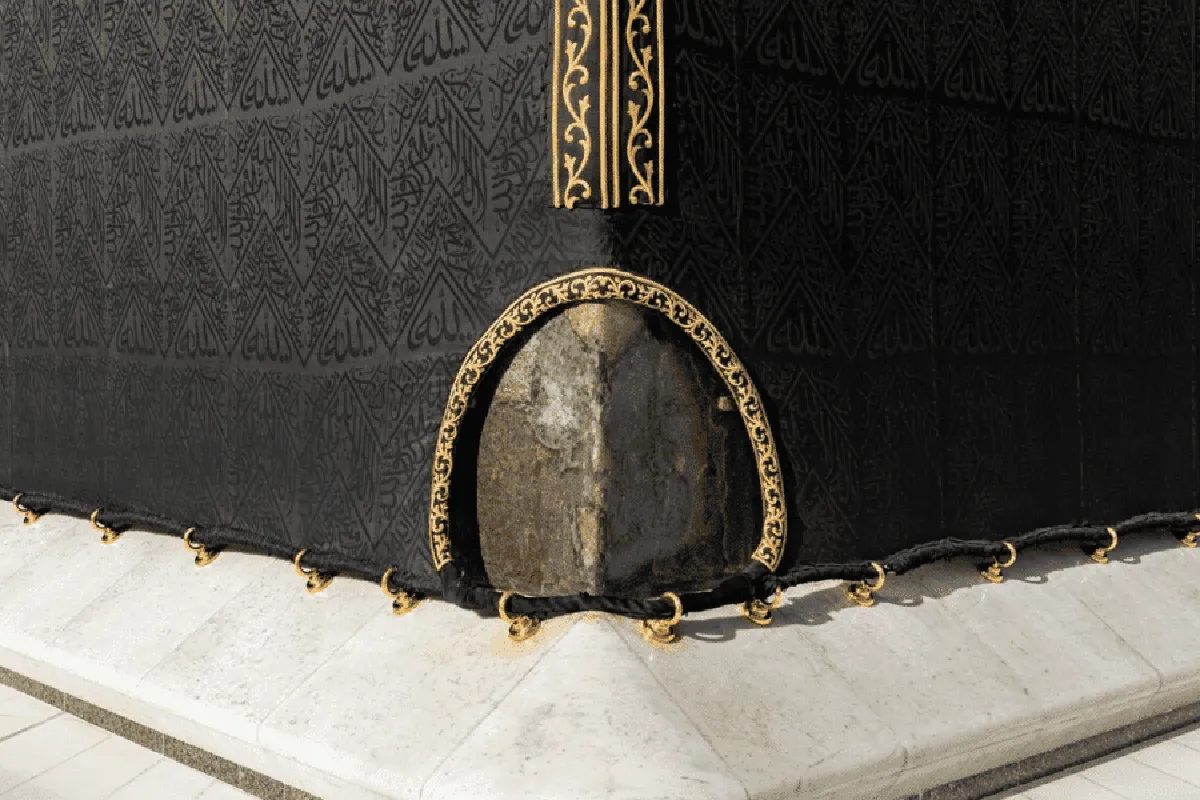
The Kaaba has four corners. According to Saudipedia, the Yamani Corner is in the southwest of the Kaaba, with the Black Stone on its southeast side. It is named after its direction, facing Yemen. Saudipedia also says it is one of two corners from which the kiswa, the Kaaba's cover, rises in two parts.
Tawaf is counterclockwise, with the Kaaba on your left. The Ministry of Hajj and Umrah's tawaf page says the corner before the Black Stone is the Yemeni Corner, so you reach it shortly before you reach the Stone each time.
| Corner | Direction | Touched in tawaf? |
|---|---|---|
| Black Stone corner | Southeast (eastern) | Yes, touch and kiss if possible |
| Yamani Corner | Southwest | Yes, touch only |
| The other two corners (Shami and Iraqi) | North side | No. Not reported from the Prophet ﷺ. |
What the hadith say
These are the narrations behind the practice. Each is attributed to Ibn Umar (may Allah be pleased with him) and named by collection.
- Sahih al-Bukhari, no. 1606. Ibn Umar said he never stopped touching the two corners, the Black Stone and the Yemeni Corner, whether it was crowded or not, since he saw the Prophet ﷺ do so. Nafi reported that Ibn Umar would walk between the two corners to reach them more easily.
- Sahih Muslim, no. 1268. Ibn Umar said he had not abandoned touching the Yamani corners and the Stone since he saw the Messenger of Allah ﷺ, in hardship and in ease.
- Sunan Abi Dawud, no. 1876. Reports that the Prophet ﷺ did not give up touching the Yamani corner. Al-Albani graded it hasan, according to sunnah.com.
- Bukhari and Muslim. Ibn Umar also said he saw the Prophet ﷺ touch no part of the Kaaba except the two Yemeni corners. The Hadeeth Encyclopedia grades this authentic.
IslamQA, quoting al-Albani, also cites a hadith in Ahmad in which touching the Black Stone and the Yemeni Corner "erases sins", graded sahih by al-Albani in Sahih al-Jami. We have not opened Ahmad's own text, so we give it as reported by IslamQA.
What to do when you reach it
Scholars cited by IslamQA and the Hadeeth Encyclopedia say the following. These are rulings from named scholars, not from us.
| Question | Answer | Source |
|---|---|---|
| Should I touch it? | Yes, with the hand, if possible, on each round. | Ministry of Hajj and Umrah, IslamQA quoting al-Albani |
| Should I kiss it? | No. Touch only. | Saudipedia, IslamQA, Hadeeth Encyclopedia |
| Should I say "Allahu akbar" when I touch it? | Not as a Sunnah. Ibn Uthaymeen says the Prophet ﷺ touched it without saying it. | IslamQA, quoting Ibn Uthaymeen |
| What if I cannot reach it? | Do not point toward it. Keep walking. | IslamQA, Saudipedia |
| Is it required for tawaf? | The sources we read present it as recommended, not as a condition of tawaf. | Ministry of Hajj and Umrah, "if possible" |
This differs from the Black Stone. The Ministry's page says that you point toward the Black Stone when you say takbeer at the start of each round, and that if kissing it is not possible, "especially in seasons and during crowds", the pilgrim is not at fault. Pointing at the Yamani Corner is a different matter, as the table shows. If you are unsure about your own case, ask a qualified scholar.
The du'a between the two corners
Between the Yemeni Corner and the Black Stone, many pilgrims recite the verse from Surah al-Baqarah, 2:201: Rabbana atina fid-dunya hasanatan wa fil-akhirati hasanatan wa qina adhaban-nar. It means: our Lord, give us good in this world and good in the Hereafter, and protect us from the punishment of the Fire.
The muslimandquran.com page lists it with references to Hisn al-Muslim no. 235, Abu Dawud and Ahmad, and Saudipedia says pilgrims ask Allah for good in this world and the next as they walk between the two. The Ministry's tawaf page says to pray and call on Allah often during tawaf and does not name a specific du'a for this stretch, so you may use any du'a you choose.
Why it is touched and the other two corners are not
The Hadeeth Encyclopedia explains that the Yamani Corner has one distinction: it stands on the foundations laid by Ibrahim (peace be upon him). The Black Stone corner has two, because it also holds the Stone. It adds that the other two corners have neither, so touching or kissing them is not permissible.
IslamQA describes a report in which Ibn Abbas told Muawiyah to stop touching the two northern corners, and Muawiyah replied that no part of the House should be neglected. Ibn Abbas answered that he had seen the Prophet ﷺ touch only the two Yemeni-side corners, and Muawiyah accepted this. IslamQA's ruling is that touching other parts of the Kaaba is not reported from the Prophet ﷺ.
What is known of its history
We give these as reported, not as established.
- Muhammad Tahir al-Kurdi's al-Tarikh al-Qadim li Makkah, quoted by IslamQA, says the stone at this corner dates to when Ibn al-Zubayr rebuilt the Kaaba, and every later rebuilder kept it. It says the pieces were joined with adhesive and nails in the Fatimid era, and that in 1040 AH, under Sultan Murad IV, the edge was broken off and molten lead was poured in its place.
- Saudipedia, citing Ibn al-Athir's al-Kamil, says that in 1016 the corner was "scattered", and that an earthquake in 1121 caused part of it to collapse. We did not verify these entries against the original.
- Saudipedia says the corner is now surrounded by handmade embroidery with gold-plated silver wire, added in 2016, measuring about 115 by 92 cm. Saudipedia also dates a restoration to the reign of King Fahd in 1957, which cannot be right because King Fahd's reign began in 1982, so we have not used that date.
Crowds at the Mataf
The Ministry of Hajj and Umrah has asked pilgrims not to stop beside the Black Stone, because lingering slows the flow and creates safety risks. It says tawaf does not require touching or kissing the Stone and that pilgrims may point toward it while they keep moving. Gulf News reported this advice in 2025. It is advice, not a rule, and it does not mention the Yemeni Corner. The same logic applies to any corner. Do not block the path to reach it.
A Ministry notice reported on 10 March 2026 says the ground floor of the Mataf is designated for Umrah performers, with tawaf on the upper floors subject to capacity limits, and recommends checking crowd density on the official Haramain site before choosing a floor. It also asks visitors to stay on the designated tawaf pathways, move at a gentle pace, and not walk against the flow. Our practical advice, not an official statement: if you cannot get to the corner without pushing, skip it. Nothing in the sources we read makes it a condition of tawaf.
What it means for your Umrah
- Start tawaf from the Black Stone line, and keep the Kaaba on your left.
- If your hand can reach the Yemeni Corner without leaving the flow, touch it and move on. Do not kiss it.
- If it is too crowded, do not stop and do not point. Continue to the Stone line, where you may point.
- Use the time between the corners for du'a.
- Keep your hotel close enough for a rest between rounds in busy periods. See Where to Stay in Makkah, or browse stays in Makkah.
For the wider picture of the Haram, see our Masjid al-Haram visitor guide and the guide to the 2026–27 Nusuk rules. If you travel in Ramadan, read Umrah in Ramadan 2027 for the crowd and permit picture.
Related
| Page | What it covers |
|---|---|
| Masjid al-Haram: Visitor Guide | What to expect when you arrive at the Haram. |
| Umrah in Ramadan 2027 | Dates, permits and crowd rules. |
| New Umrah and Nusuk rules, 2026–27 | Visa, permit and booking requirements. |
| Where to stay in Makkah | The five hotel areas around the Haram. |
| Jabal al-Kaaba | Another Makkah name, and what is actually recorded. |
Accuracy note
The location of the Yamani Corner in the southwest, its naming, the kiswa detail, the embroidery of 2016, and the historical entries from al-Kamil are from Saudipedia, which also contains a date for a restoration under King Fahd that we did not use. The rulings on touching, not kissing, not pointing and not saying takbeer, the hadith of Ahmad on touching erasing sins, and the account of the stone's repairs are from IslamQA, quoting al-Albani, Ibn Uthaymeen and al-Kurdi. The hadith of Ibn Umar are from Sahih al-Bukhari no. 1606, Sahih Muslim no. 1268 and Sunan Abi Dawud no. 1876, as shown on sunnah.com, with the Bukhari and Muslim wording on the two Yemeni corners and the explanation of Ibrahim's foundations from the Hadeeth Encyclopedia. The exchange between Ibn Abbas and Muawiyah is from IslamQA. The du'a of Surah al-Baqarah 2:201 and its references are from muslimandquran.com. The tawaf instructions, including pointing at the Black Stone and the corner before it, are from the Ministry of Hajj and Umrah's tawaf page. The advice not to stop at the Black Stone is from the Ministry of Hajj and Umrah as reported by Gulf News, last updated 9 April 2025 and 20 August 2025. The Mataf notice is from the Ministry of Hajj and Umrah as republished by Hajj Reporters on 10 March 2026. These are religious rulings and practical guidance, not a substitute for a scholar, so ask one if your case is unusual. Verified November 2026. Out of date? Tell us.
Step by step
- 1
Start at the Black Stone line
Begin tawaf with the Kaaba on your left.
- 2
Walk the round
Keep to the flow and make du'a as you go.
- 3
Reach the Yemeni Corner
Touch it with your hand if you can do so without leaving the flow.
- 4
Do not kiss or point
Touch only. If it is too crowded, keep walking.
- 5
Make du'a between the corners
Many pilgrims recite Surah al-Baqarah 2:201 here.
- 6
Reach the Black Stone line
Point toward the Stone and continue, without stopping.
Frequently asked questions
Planning a Saudi trip?
Pre-book a private car, find a stay, or ask us anything on WhatsApp.
Last updated: 19 November 2026·Sources reviewed by the Wadana Go editorial team.