The Jamarat: What the Stoning Is, and What It Is Not
Short answer
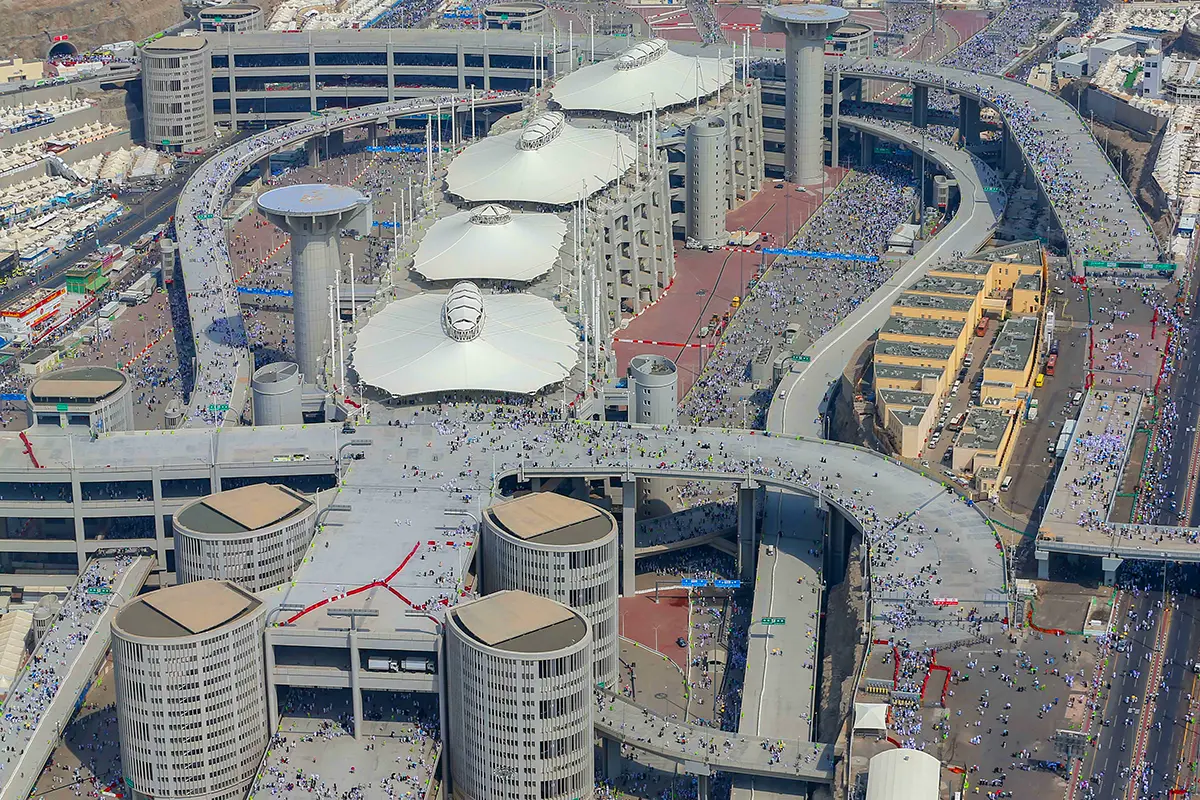
The Jamarat are three stone pillars in Mina: al-Jamrah al-Sughra, al-Jamrah al-Wusta and Jamrat al-Aqabah. Pilgrims throw seven small pebbles at each on the days of Tashreeq, and at Jamrat al-Aqabah alone on the tenth of Dhul Hijjah. They stand inside a five-floor complex that can handle more than 300,000 pilgrims an hour.
Key takeaways
- ✓There are three Jamarat in Mina: the small, the middle and al-Aqabah, the largest.
- ✓On 10 Dhul Hijjah only Jamrat al-Aqabah is stoned, with seven pebbles.
- ✓On the days of Tashreeq all three are stoned, in order from the smallest.
- ✓The Prophet said to take the rites from him, which is where the method comes from.
- ✓An authentic hadith states that the stoning was ordained to establish the remembrance of Allah.
- ✓No authentic evidence says a devil is present at the pillars. The popular name is misleading.
- ✓The Jamarat complex has five floors, is 950 m long and handles over 300,000 pilgrims an hour.
Quick facts
- Where
- Mina, about 7 km from the Grand Mosque
- Number of pillars
- Three
- Pebbles per pillar
- Seven
- On 10 Dhul Hijjah
- Jamrat al-Aqabah only
- On the Tashreeq days
- All three, smallest first
- Complex floors
- Five, designed to extend to twelve
- Complex size
- 950 m long, 80 m wide
- Capacity
- Over 300,000 pilgrims per hour
- Part of Umrah?
- No. The stoning belongs to Hajj.
Three pillars, in order
The Jamarat are three stone pillars standing in a line along the valley of Mina. From the Muzdalifah end towards Makkah they are:
- Al-Jamrah al-Sughra, the small one, furthest from Makkah.
- Al-Jamrah al-Wusta, the middle one.
- Jamrat al-Aqabah, the largest, at the Makkah end. It has its own page because it behaves differently from the other two.
The order matters, and it is the direction of travel that fixes it. On the days of Tashreeq you start at the small one and work towards Makkah.
What you actually do
Seven small pebbles at each pillar, thrown one at a time, saying Allahu akbar with each.
The pebbles are small. About the size of a chickpea is the description usually given, and that is the size intended. There is no benefit in a larger stone and there is real risk to the people around you, which is why the authorities remove large stones and sandals from the basin.
| Day | Which pillars | Pebbles |
|---|---|---|
| 10 Dhul Hijjah | Jamrat al-Aqabah only | 7 |
| 11 Dhul Hijjah | All three, smallest first | 21 |
| 12 Dhul Hijjah | All three, smallest first | 21 |
| 13 Dhul Hijjah | All three, if you stay | 21 |
On the Tashreeq days, after the small and the middle pillars, the sunnah is to move aside, face the qibla and make a long du'a. After Jamrat al-Aqabah you do not stop. You throw and you leave.
Where the method comes from
Two pieces of evidence do most of the work here, and both are worth knowing by name.
The method. At the Farewell Pilgrimage the Prophet performed the rites and said to take the rites from them, since he did not know whether he would perform Hajj after that year. That is in Sahih Muslim. Everything about how the stoning is done traces back to that instruction, which is why the details are followed closely rather than improvised.
The purpose. Aisha reported that the Prophet said the tawaf around the House, going between Safa and Marwah, and the stoning of the Jamarat were only ordained to establish the remembrance of Allah. That is narrated by Abu Dawud and al-Tirmidhi and is accepted as authentic.
Read that second one carefully, because it answers the question people are usually too shy to ask.
The part that gets misunderstood
In English the ritual is almost always called "stoning the devil". That name has done a lot of damage to how people understand what they are doing.
There is no authentic evidence that a devil is present at those pillars. You are not throwing stones at a being who is standing there. The pillars are not Shaytan and they do not contain him.
The reports connecting the three places with Iblis appearing to Ibrahim and being driven off are found in the historical and exegetical literature, and they do not carry authentic chains of the kind hadith scholars require. Scholars discuss them as background rather than as proof.
What is established is the hadith above: the stoning was ordained for the remembrance of Allah. Al-Ghazali's explanation is the one usually given, and it is a good one: the purpose is to follow the command and to show submission, in imitation of Ibrahim.
So the honest description is this. You are obeying an instruction whose full wisdom you are not required to know, and saying Allahu akbar seven times while you do it. That is a calmer and more accurate picture than a man throwing rocks at an invisible enemy, and it removes the anxiety some pilgrims carry about whether they threw hard enough or hit the pillar squarely.
The bridge, and why it exists
The Jamarat now sit inside an enormous engineered complex, and it was built because of what used to happen here.
Crowd disasters at the Jamarat killed large numbers of pilgrims on several occasions. The current structure is the response to that, and it is worth understanding as a piece of safety engineering rather than as architecture.
- Five floors, each twelve metres high, in a structure 950 metres long and 80 metres wide.
- Capacity of more than 300,000 pilgrims per hour.
- Designed to be extended to twelve floors and around five million pilgrims in future.
- 340 escalators and 682 surveillance cameras monitoring crowd density.
- Each floor is fed from a different direction, so groups do not cross. The first and second serve pilgrims from the east of Mina, the third from Makkah, al-Adl and al-Sheshah, the fourth from the north, and the fifth from al-Azizeyah and the camps south of Mina.
The pillars themselves were replaced with long oval walls rather than narrow columns, so that many people can throw at once and fewer stones come back.
Doing it safely
Most of the practical advice here comes down to timing and to not fighting the crowd.
- Use the floor you are told to use. The routing is what keeps the flows separated. Going up to a different level to avoid a queue puts you against the traffic.
- Avoid the peak. Mid-morning on the tenth is the heaviest period. Later in the day is permitted and far safer.
- Do not stop in the throwing area. Throw and move forward. Stopping to take a photograph or to make du'a at the basin is where crushes start.
- Weak, elderly and ill pilgrims may appoint someone to throw on their behalf. This is a recognised allowance and not a shortcut.
- Carry your pebbles in a small bag and count them before you set off. Counting in the crowd is difficult.
- Wear sandals you can keep on. The floor gets hot and losing footwear in the crush is common.
Our Hajj step by step guide sets the stoning in the order of the days, and the Nusuk app guide covers the permit side.
Seeing the Jamarat outside Hajj
Outside the season Mina is quiet and the complex is visible from the road. Most Ziyarat drivers stop at a point where you can see the structure and the length of the valley.
You cannot perform any rite there outside Hajj, and there is none to perform. There is no prayer, no reward and no ritual for a visitor. It is worth seeing for the same reason the empty valley is: it makes the scale real.
Mina, Muzdalifah and Arafat come one after another on the same road, so all three fit into one leg of a Makkah Ziyarat round, from SAR 200 per vehicle with waiting included. Fares reviewed August 2026.
Accuracy note
The three Jamarat and their names and order come from Saudipedia, as do the details of the Jamarat complex: five floors each twelve metres high, 950 metres long and 80 metres wide, capacity of more than 300,000 pilgrims per hour, design allowing extension to twelve floors and around five million pilgrims, 340 escalators, 682 surveillance cameras, and the allocation of each floor to pilgrims arriving from a particular direction.
The Prophet's instruction to take the rites from him is recorded in Sahih Muslim. The hadith of Aisha that the tawaf, the going between Safa and Marwah and the stoning of the Jamarat were ordained to establish the remembrance of Allah is narrated by Abu Dawud and al-Tirmidhi and is accepted as authentic.
We have stated plainly that no authentic evidence establishes the presence of a devil at the pillars. The reports of Iblis appearing to Ibrahim at the three places are found in the historical and exegetical literature without authentic chains, and we have described them as such. Al-Ghazali's explanation of the purpose is quoted as an explanation, not as evidence.
Capacity figures and floor allocations are as published and are adjusted between seasons by the authorities. Fares are our own published rates, reviewed August 2026. Verified August 2026.
Frequently asked questions
Planning a Saudi trip?
Pre-book a private car, find a stay, or ask us anything on WhatsApp.
Last updated: 12 October 2026·Sources reviewed by the Wadana Go editorial team.