Al-Abwa: The Village Where the Prophet's Mother Was Buried
Short answer
Al-Abwa is a place on the road between Makkah and Madinah where the early sources record that Aminah bint Wahb, the Prophet's mother, died and was buried when he was about six years old. Sahih Muslim records that he later visited his mother's grave and wept. Al-Abwa also appears in the hadith of ihram.
Key takeaways
- ✓Al-Abwa lies on the old road between Makkah and Madinah.
- ✓The early sources place the death and burial of Aminah bint Wahb there.
- ✓Sahih Muslim records the Prophet visiting his mother's grave and weeping.
- ✓That is why lists placing her grave at Jannat al-Mu'alla in Makkah are wrong.
- ✓Sahih al-Bukhari records a gift of game refused at al-Abwa because he was in ihram.
- ✓No specific grave at al-Abwa is marked or identified today.
- ✓It is a stage on the Hijrah route and on the pilgrim road between the cities.
Quick facts
- Where
- On the road between Makkah and Madinah
- Known for
- The grave of Aminah bint Wahb
- Recorded in
- Sahih Muslim and the early biographies
- Is the grave marked?
- No
- Also appears in
- The hadith on ihram and game
- Car access
- Yes, near the modern highway
- Anything built there?
- No preserved site
- Part of Umrah?
- No. Not a rite of Hajj or Umrah.
Where it is
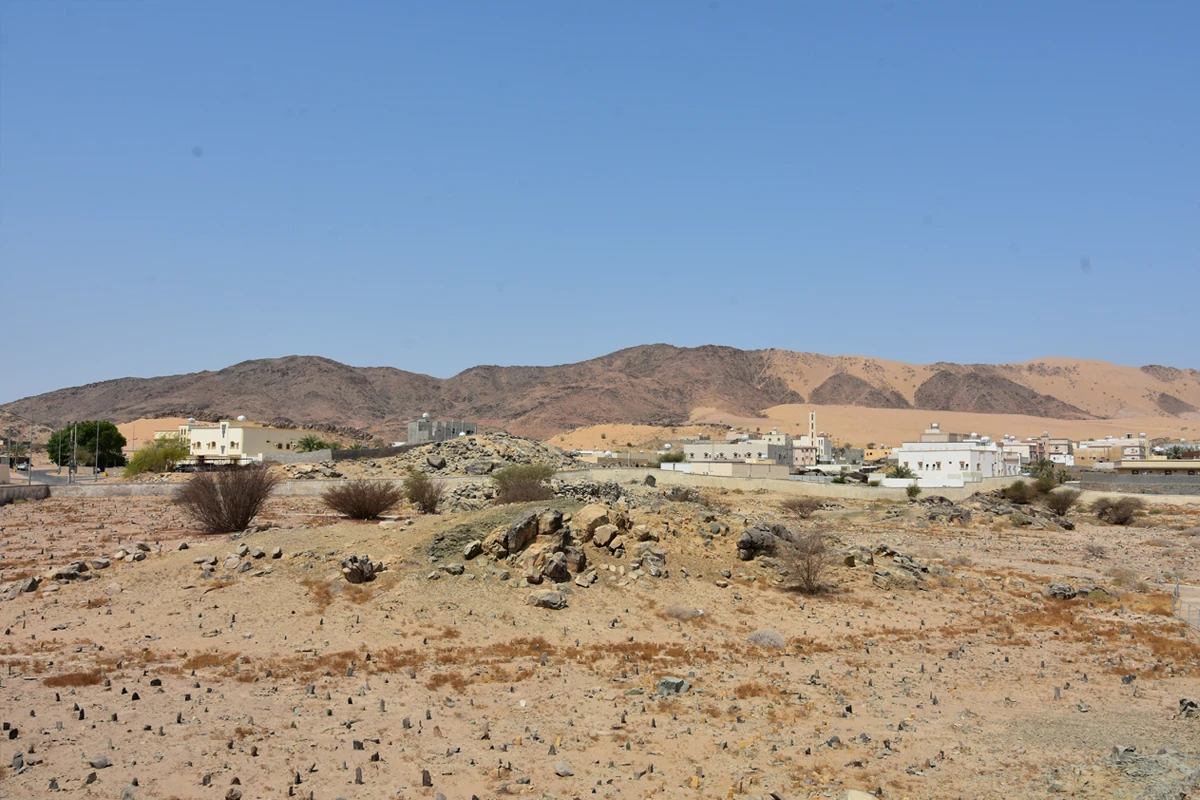
Al-Abwa is a place on the old road between Makkah and Madinah, in the country of low volcanic hills and dry plain that the pilgrim route has always crossed.
It is a stage on the Hijrah route, and it appears repeatedly in the accounts of journeys between the two cities. It is not a town of any size and there is no preserved site there.
The grave
The early sources record that Aminah bint Wahb, the Prophet's mother, died at al-Abwa and was buried there.
The circumstances are these. She took her son, then about six years old, to Madinah to visit his mother's relatives, accompanied by his grandfather Abd al-Muttalib and by Umm Ayman. On the way back she died at al-Abwa.
He had already lost his father before he was born. At six he lost his mother on a roadside, and was taken on to Makkah by a servant.
Sahih Muslim records that he later visited his mother's grave and wept, and made those with him weep.
Why this page matters for another one
Because of an error that is repeated almost everywhere.
A very large number of Ziyarat lists, travel pages and itineraries place Aminah's grave at Jannat al-Mu'alla, the historic cemetery in Makkah. Pilgrims stand at that wall and make dua for her.
The early sources place her grave at al-Abwa. Saudipedia's own entry on the al-Ma'la cemetery does not name her among those buried there, and neither does the standard burial list. The claim appears to have spread by copying rather than by anyone checking.
We are not saying this to score a point. We are saying it because a person who travels to a wall in Makkah believing their dua is being made beside a particular grave deserves to know the sources place that grave two hundred kilometres up the road.
The other reason al-Abwa is in the books
There is a second, quite different reason the name appears in the collections, and it is a matter of law rather than history.
Sahih al-Bukhari records that al-Sa'b ibn Jaththama presented the Prophet with the meat of a wild donkey at al-Abwa, and that he refused it. Al-Sa'b's face showed what he felt at the refusal, and the Prophet explained that he had only returned it because he was in the state of ihram.
The point being that a person in ihram does not hunt and does not accept game hunted for him. The narration is one of the main texts on that rule, and it is why students of fiqh meet the name al-Abwa in a completely different context from students of seerah.
The human detail in it is the part worth keeping: the Prophet noticed that the man's feelings were hurt by the refusal, and explained himself rather than leaving it.
What is there to visit
Very little, and we would rather be plain about it.
No grave at al-Abwa is marked or identified. There is no tomb, no enclosure, no signage and no established spot. The sources record that she was buried in that place. They do not fix a point on the ground, and nothing has been built to fix one.
That is not an accident of neglect. Marked graves attached to figures of that standing are exactly what Saudi policy has removed elsewhere, for reasons covered on our al-Mu'alla page.
So if you stop at al-Abwa, you are stopping at a stretch of country, not at a shrine. Anyone offering to show you the grave is offering something the sources do not support.
Is visiting prescribed?
No. Al-Abwa is not a rite of Hajj or Umrah, no prayer is prescribed there and no reward for visiting is established.
Visiting graves generally is a sunnah, for the reason given in Sahih Muslim: to remember the Hereafter. That applies to cemeteries you can actually visit rather than to a general area where a grave is known to be somewhere.
On making dua for the Prophet's parents specifically, there is a discussion among scholars that we are not going to summarise on a travel page, because it turns on hadiths that need careful handling. Ask a scholar you trust rather than taking a position from a website.
Getting there
Al-Abwa sits near the modern Makkah to Madinah highway, so it is a possible stop on a road transfer between the two cities.
- It only makes sense by car. The Haramain train does not stop anywhere useful for this.
- Ten to fifteen minutes is all there is to spend.
- Combine it with the other road stops: Usfan, al-Juhfah near Rabigh.
- Take water and expect nothing in the way of facilities.
Our Makkah to Madinah private car runs that road and can stop, and the transport guide compares the road against the train. Fares reviewed August 2026.
On the same road
| Place | What it is |
|---|---|
| Usfan | A stage on the road, with a historic fortress. |
| Al-Juhfah | The old miqat, now an archaeological site. |
| Rabigh | The modern miqat that replaced al-Juhfah. |
| The Hijrah route | The whole journey and which stops are firm. |
Accuracy note
That Aminah bint Wahb died at al-Abwa and was buried there, on the return from a journey to Madinah when her son was about six, is recorded in the early biographies of the Prophet. That he later visited his mother's grave and wept, and made those with him weep, is recorded in Sahih Muslim.
Saudipedia's entry on the al-Ma'la cemetery in Makkah does not name Aminah among those buried there, and the standard burial list does not either. We have therefore stated that the widespread claim placing her grave in Makkah is not supported by the sources.
The narration of al-Sa'b ibn Jaththama presenting the meat of a wild donkey at al-Abwa, the Prophet's refusal, and his explanation that it was because he was in ihram, is recorded in Sahih al-Bukhari. This is established evidence.
No grave at al-Abwa is marked or identified today, and no specific spot is established. We have not pointed at one. No prayer or reward is established there and visiting is not part of Hajj or Umrah. The scholarly discussion about supplicating for the Prophet's parents is outside the scope of this page. Fares are our own published rates, reviewed August 2026. Verified August 2026.
Frequently asked questions
Planning a Saudi trip?
Pre-book a private car, find a stay, or ask us anything on WhatsApp.
Last updated: 9 October 2026·Sources reviewed by the Wadana Go editorial team.