Usfan: A Fortress on the Pilgrim Road, and the Prayer of Fear
Short answer
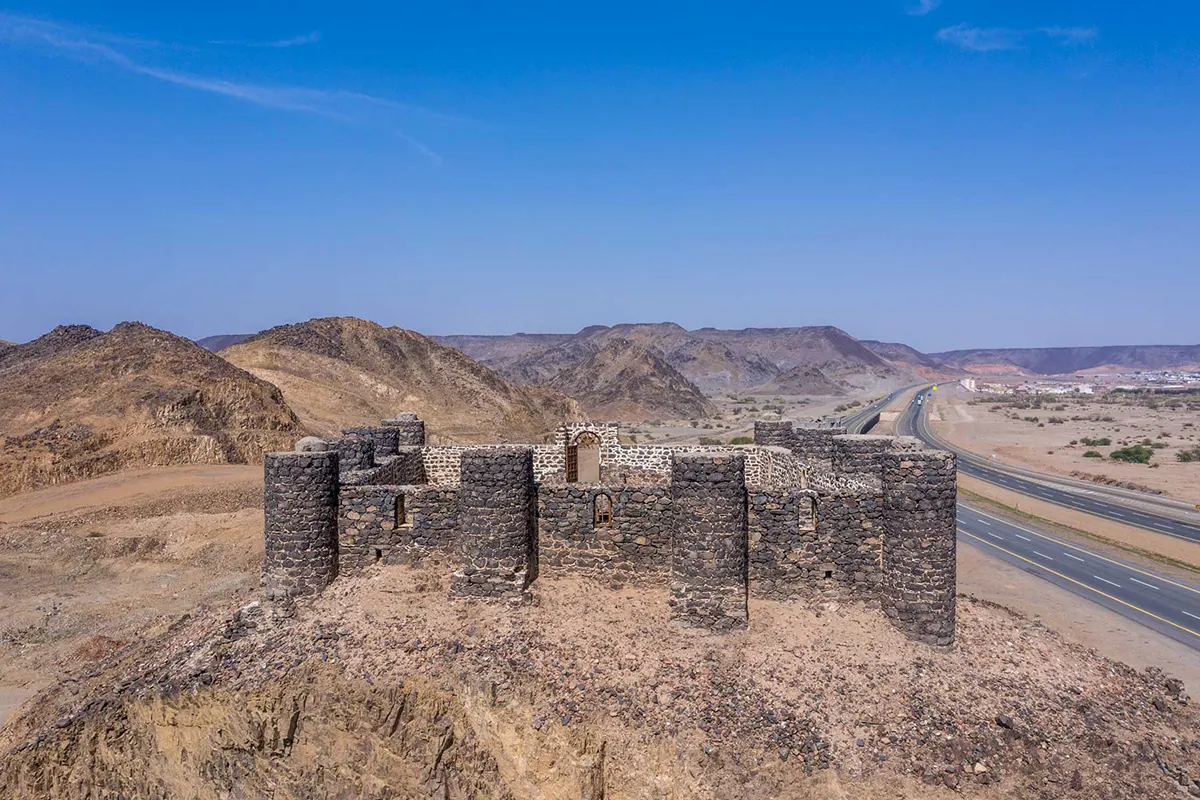
Usfan, also written Asfan, is a place in al-Jumum Governorate on the road north of Makkah, with a historic fortress that formed part of a chain of small forts protecting pilgrims between Makkah and Madinah. The authentic collections record that the Prophet led salat al-khawf, the prayer of fear, at Usfan.
Key takeaways
- ✓Usfan is in al-Jumum Governorate, on the road between Makkah and Madinah.
- ✓Asfan Fortress was one of a chain of small forts protecting pilgrims on that road.
- ✓The standing fortress dates from 1887, built of basalt and granite with lime mortar.
- ✓It is square with four corner towers and two more on each wall, under 200 sq m.
- ✓Ibn Jubayr, who came for Hajj in 1182, described an older fort already there.
- ✓Jabir's narration records the Prophet leading the prayer of fear at Usfan.
- ✓Khalid ibn al-Walid was leading the opposing side at the time, before he accepted Islam.
Quick facts
- Where
- Al-Jumum Governorate, north of Makkah
- Also written
- Asfan
- Fortress built
- 1887, early 14th century AH
- Materials
- Basalt and granite with lime mortar
- Size
- No more than 200 sq m
- Set on
- A rise no more than 20 m high
- Mentioned by
- Ibn Jubayr, who came for Hajj in 1182
- Part of Umrah?
- No. Not a rite of Hajj or Umrah.
Where it is and what stands there
Usfan, which you will also see written Asfan, is a place in al-Jumum Governorate on the road running north from Makkah towards Madinah. It has been a named stage on that road for as long as the road has existed.
What survives is a fortress. Saudipedia describes Asfan Fortress as built of basalt brought from the neighbouring mountains, with granite as the main building material and lime mortar as the adhesive. It is square, with four towers at the corners and two more on each of its walls.
It is small: no more than 200 square metres, standing on top of a rise no more than twenty metres above the ground.
The standing structure is not ancient. It dates from the beginning of the fourteenth century of the Islamic calendar, in 1887, and belongs to a series of small fortresses built along the road between Makkah and Madinah to protect pilgrims.
There was a fort here long before that
The 1887 date is for the building you see, not for the site, and there is a good witness to that.
Ibn Jubayr, the Andalusian traveller who came for Hajj in 1182 and left one of the best travel accounts of the medieval Muslim world, mentioned Asfan Fortress. He described it as an ancient fort with towers, already weakened by age and heading for ruin.
So a fort stood here, and was old, seven hundred years before the present one was built. The site has been fortified, abandoned and refortified, which is what happens to a strategic point on a road that people keep needing to use.
Why the road had forts on it
This is the part worth understanding, because it explains a whole category of Saudi heritage site.
The pilgrim road between Makkah and Madinah carried enormous numbers of people, on foot and on animals, in caravans, with money and goods, through empty country. That is a target.
Successive states responded the way states do: forts at intervals, garrisons, water points and wells. The chain of small fortresses that Asfan belongs to is infrastructure for pilgrimage, in the same way the wells and cisterns along the routes are.
You see the same logic at al-Juhfah, where archaeological work has revealed a walled city with a fortress and a water system, built to keep pilgrims and residents secure and supplied.
Read together, these sites make the point that pilgrimage was never only a religious matter. It was also a logistical operation, on a continental scale, sustained for over a thousand years.
The prayer of fear at Usfan
The name Usfan appears in the authentic collections for a specific reason, and it is one of the more striking scenes in the hadith literature.
Jabir ibn Abdullah reported that they were with the Messenger of Allah at Usfan when the enemy was between them and the qibla, and the Prophet led them in salat al-khawf, the prayer of fear. He arranged them in two rows behind him.
The prayer of fear is a modified form of congregational prayer for a situation where a force cannot safely all prostrate at once. Different forms are recorded from different occasions, and the one at Usfan is among the described versions in the books of law.
The detail that gives the scene its edge: the commander on the other side was Khalid ibn al-Walid, then still fighting against the Muslims. He accepted Islam some years later and became one of the most effective commanders in Islamic history.
Both of those facts are worth holding at once. The man opposite the Prophet at Usfan later prayed behind him.
Usfan and the Hijrah road
Usfan is one of the named places on the general line of the Hijrah route, and it recurs in accounts of movements between the two cities throughout the Prophet's life.
It is worth being careful about the level of claim here. Usfan being a known stage on the road, and being named in the authentic collections, is established. That does not mean any specific building or spot at Usfan today is connected with a specific event. The fortress you can see was built in 1887.
Visiting it
- It is on the Makkah to Madinah road, so it works as a stop on a transfer between the cities.
- Fifteen to twenty minutes covers it. It is a small fort on a small hill.
- The fort is an archaeological site, so treat it accordingly and do not climb on the structure.
- Combine it with the other road stops: al-Abwa and al-Juhfah near Rabigh.
- Take water. There are no facilities to rely on.
Our Makkah to Madinah private car runs that road and can stop where the train cannot, and the transport guide compares the two. Fares reviewed August 2026.
Is visiting prescribed?
No. Usfan is not a rite of Hajj or Umrah, no prayer is prescribed there and no reward for visiting is established in authentic evidence.
It is a historical site on a historical road, which is reason enough to stop for a quarter of an hour if you are driving past.
On the same road
| Place | What it is |
|---|---|
| Al-Abwa | Where the sources place Aminah's grave. |
| Al-Juhfah | The old miqat and its archaeological remains. |
| Rabigh | The modern miqat that replaced it. |
| Umm Ma'bad's tent site | Another stop associated with the Hijrah. |
Accuracy note
The description of Asfan Fortress as built of basalt brought from adjacent mountains with granite as the main material and lime mortar as adhesive, square with four corner towers and two additional towers on each wall, no more than 200 square metres in area, standing on a rise no more than twenty metres high, and built in the beginning of the fourteenth century AH in 1887 as part of a series of small fortresses between Makkah and Madinah to protect pilgrims, comes from Saudipedia. So does the record that Ibn Jubayr, who came for Hajj in 1182, mentioned it as an ancient fort with towers already weakened by age.
That the Prophet led salat al-khawf at Usfan, with the enemy between the Muslims and the qibla and the congregation arranged in two rows, is recorded in the authentic collections on the authority of Jabir ibn Abdullah, and the reports name Khalid ibn al-Walid as leading the opposing side at that time. This is established evidence.
Usfan is a known stage on the road between Makkah and Madinah and appears in accounts of movements between the cities. No specific building or spot at Usfan today is established as connected with a specific event, and the standing fortress dates from 1887.
No prayer or reward is established at the site and visiting is not part of Hajj or Umrah. Fares are our own published rates, reviewed August 2026. Verified August 2026.
Frequently asked questions
Planning a Saudi trip?
Pre-book a private car, find a stay, or ask us anything on WhatsApp.
Last updated: 9 October 2026·Sources reviewed by the Wadana Go editorial team.