Umm Ma'bad's Tent: The Best Description We Have, and How Firm It Is
Short answer
Umm Ma'bad was a woman of Khuza'ah whose tent the Prophet passed during the Hijrah from Makkah to Madinah. The report describes a goat that had given no milk producing milk, and her detailed description of him to her husband afterwards. It is recorded by al-Hakim, who graded it authentic, and al-Dhahabi agreed.
Key takeaways
- ✓Umm Ma'bad was Atika bint Khalid of the tribe of Khuza'ah.
- ✓The Prophet and his companions passed her tent on the Hijrah road.
- ✓The report describes a barren goat giving milk after he touched it.
- ✓Her description of him to her husband is the fullest physical portrait that survives.
- ✓The report is recorded by al-Hakim, who graded it authentic, and al-Dhahabi agreed.
- ✓It is not in Sahih al-Bukhari or Sahih Muslim, and some scholars are less certain.
- ✓No site is established as the location of her tent, and nothing is marked.
Quick facts
- Who
- Atika bint Khalid, of Khuza'ah
- When
- During the Hijrah to Madinah
- Where
- On the road north of Makkah, not fixed
- Recorded by
- Al-Hakim, graded authentic
- Agreed by
- Al-Dhahabi
- In Bukhari or Muslim?
- No
- Site marked?
- No
- Part of Umrah?
- No. Not a rite of Hajj or Umrah.
What the report says
During the Hijrah, the Prophet, Abu Bakr, their guide and Amir ibn Fuhayra passed a tent on the road north.
Outside it sat a woman of the tribe of Khuza'ah, Atika bint Khalid, known as Umm Ma'bad. Travellers stopped at her tent as a matter of course, and she fed and watered them.
They asked whether she had anything to sell, meat or dates. She had nothing. It was a year of drought, the men and the flocks were away seeking pasture, and the tent was empty.
The Prophet noticed a goat at the side of the tent. He asked about it. She said it was too weak to go with the flock and had no milk in it.
He asked her permission to milk it. She said that if he could find milk in it, he was welcome to it.
The report describes him wiping its udder, mentioning the name of Allah and praying for her. The goat's udder filled. He called for a large vessel and milked it until the vessel was full, gave her to drink until she was satisfied, gave his companions to drink, drank last himself, and filled the vessel a second time before they went on.
What she told her husband
Abu Ma'bad came back to find milk in the tent, and asked where it had come from.
She said a blessed man had passed. He asked her to describe him. And what she said is the reason this report is treasured: it is the fullest physical description of the Prophet that survives, given by someone who had seen him once, for an hour, from a few feet away.
She described a man of striking cleanliness and a bright face. Not thin, not heavy. Fine featured, with a long neck and a full beard, dark eyes with a natural line to them, and a softness in his voice. She said his speech was clear, neither too little to be understood nor too much to be tiresome, and that his words were like beads on a string.
She said that seen from a distance he was the most beautiful of men, and close up the sweetest and most handsome. She said he had companions who surrounded him, and that when he spoke they listened, and when he ordered something they hurried to it.
Then she said the line that people remember: he is obeyed, not commanded, neither austere nor argumentative.
Abu Ma'bad said that this was the man of Quraysh they had been talking about, and that had he been there he would have gone with him.
How firm is this?
Now the part that most retellings skip, and the reason we wrote this page.
This report is not in Sahih al-Bukhari or Sahih Muslim.
It is recorded by al-Hakim in his collection, and he graded it authentic. Al-Dhahabi, whose commentary on al-Hakim is famously more critical than al-Hakim himself, agreed with that grading.
That is a serious endorsement. Al-Dhahabi corrected al-Hakim frequently, and his agreement carries real weight.
At the same time, other scholars have been less certain about it, and it does not sit in the class of material that the two Sahih collections contain.
So the accurate way to speak about it is: a well-known report, graded authentic by al-Hakim and al-Dhahabi, not found in the two Sahih collections, and treated with some caution by others.
That is not a reason to discard it. It is a reason to describe it correctly. There is a difference between "this is reported and respected scholars accepted it" and "this is in Bukhari", and pilgrims are owed the difference.
The site is not established
Separate question, and the answer is shorter.
No location is established as the site of Umm Ma'bad's tent.
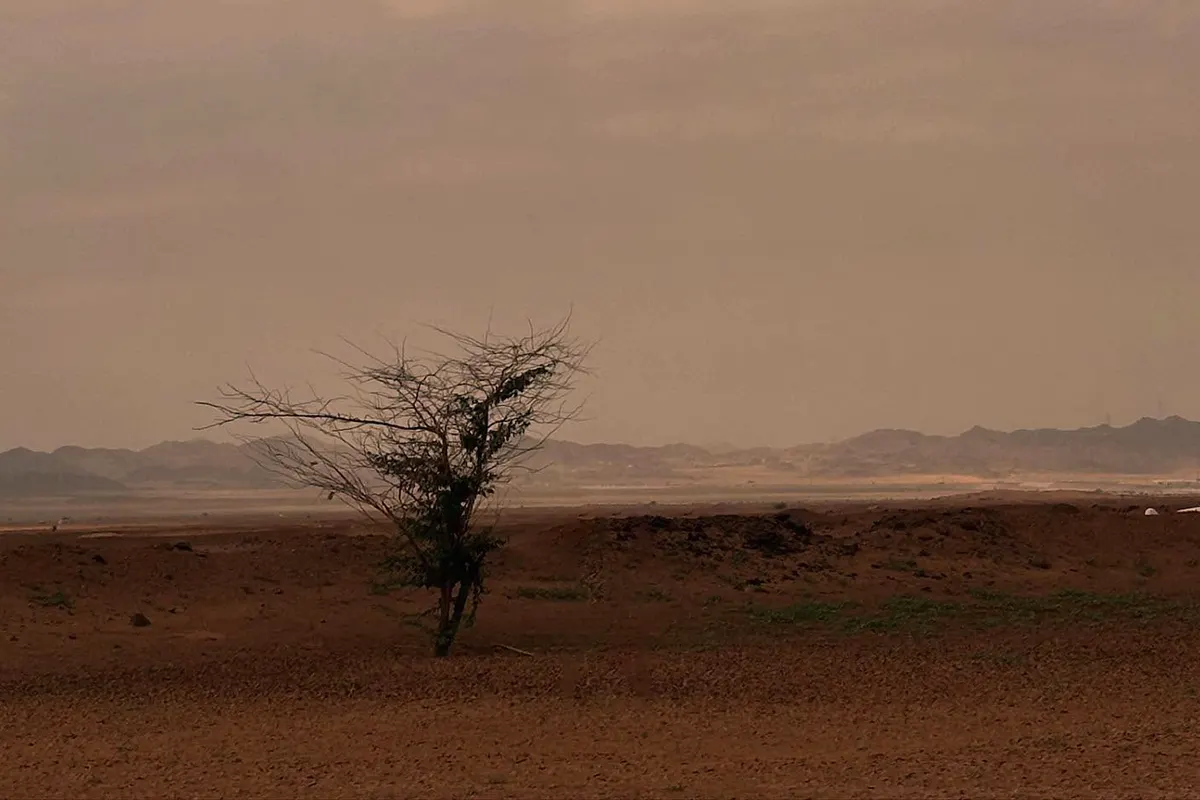
The report describes a tent on the road during a journey. A tent leaves nothing. Accounts place the meeting somewhere on the route north of Makkah, with figures given for the distance that vary between sources, and no early source fixes a point.
There is no ruin, no marker and no accepted spot. If an itinerary offers you the site of Umm Ma'bad's tent, ask what it is based on, because as far as we can establish there is nothing to base it on.
The schedule this article belongs to rates the topic as traditional and uncertain, and that rating is correct.
Why the story is worth telling anyway
Because of what it captures that the great set-piece narratives do not.
Every dramatic account of the Hijrah is about pursuit, hiding and escape. This one is about four tired men stopping at a tent, an empty larder, a goat nobody expected anything from, and a woman who is given the drink first.
And the description she gave was not composed by a devoted companion after decades of familiarity. It came from a stranger, in one sitting, describing someone she had never met before and might never see again. Whatever else it is, it is an outsider's account.
Umm Ma'bad and her husband later accepted Islam.
Is there anything to visit?
No, and we would rather say so than send you into the desert.
What you can do is drive the road between the two cities and stop at the places that are identified: Usfan, al-Juhfah near Rabigh, and al-Abwa. Those are real locations with something to see or at least something documented.
The Hijrah is best understood on that road as a whole rather than at any single point along it.
Our Makkah to Madinah private car runs the route and can stop, and the transport guide compares the road with the Haramain train. Fares reviewed August 2026.
Is anything prescribed?
No. There is no site, so there is nothing to visit, no prayer prescribed and no reward established.
Reading the description she gave is worth doing. It requires no journey.
Accuracy note
The account of the Prophet and his companions stopping at the tent of Umm Ma'bad during the Hijrah, the goat that had no milk, and her description of him to her husband afterwards is recorded by al-Hakim, who graded it authentic, and al-Dhahabi agreed with that grading. It is not found in Sahih al-Bukhari or Sahih Muslim, and other scholars have treated it with more caution. We have set out that position rather than presenting the report as being of the same class as the material in the two Sahih collections.
Umm Ma'bad is identified in the sources as Atika bint Khalid, of the tribe of Khuza'ah. The summary of her description given here follows the wording of the report and is a paraphrase rather than a translation.
No location is established as the site of her tent. Distances given for the meeting vary between sources and no early source fixes a point, and there is no ruin, marker or accepted spot. We have not pointed at one.
No prayer or reward is established, and there is no rite of Hajj or Umrah connected with this. Fares are our own published rates, reviewed August 2026. Verified August 2026.
Frequently asked questions
Planning a Saudi trip?
Pre-book a private car, find a stay, or ask us anything on WhatsApp.
Last updated: 9 October 2026·Sources reviewed by the Wadana Go editorial team.