Arafat: The One Day Without Which There Is No Hajj
Short answer
Arafat is a plain about 22 kilometres east of Makkah, covering roughly 33 square kilometres and ringed by a semicircle of mountains. Pilgrims stand there on the ninth of Dhul Hijjah from midday until sunset. The Prophet said that Hajj is Arafah. It is the only one of the holy sites lying outside the boundaries of the Haram.
Key takeaways
- ✓Arafat lies about 22 km east of Makkah and covers roughly 33 sq km.
- ✓It is the only one of the holy sites outside the boundaries of the Haram.
- ✓The Prophet said that Hajj is Arafah. Missing the standing means there is no Hajj.
- ✓The whole plain is valid for standing. Only Wadi Uranah is excluded.
- ✓Dhuhr and Asr are combined and shortened at Masjid Namirah on the ninth.
- ✓The standing runs until sunset, and pilgrims leave for Muzdalifah after it.
- ✓Climbing Jabal al-Rahmah is not required and carries no established reward.
Quick facts
- Where
- About 22 km east of Makkah
- Area
- About 33 sq km
- Capacity
- More than two million pilgrims
- Inside the Haram?
- No. The only holy site outside it.
- The day
- 9 Dhul Hijjah, midday to sunset
- Excluded ground
- Wadi Uranah
- Car access
- Yes, outside the Hajj season
- Part of Umrah?
- No. Arafat belongs to Hajj.
The shape of the place
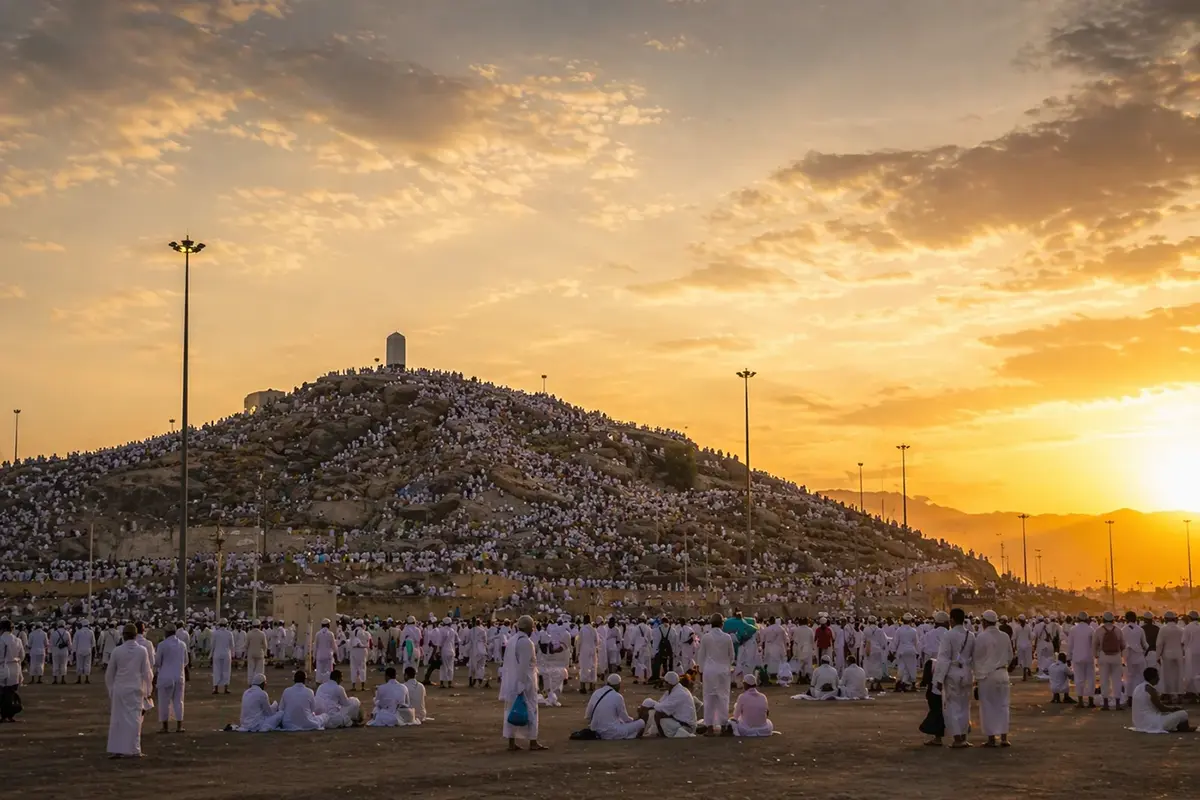
Arafat is a plain about 22 kilometres east of Makkah, on the road that runs towards Taif. Saudipedia gives its area as roughly 33 square kilometres, with capacity for more than two million pilgrims.
It is flat, ringed by a semicircle of low mountains, with Wadi Uranah running along part of its edge. Out of the middle of the flat ground rises one modest rocky hill, Jabal al-Rahmah, with a marker on top.
The first thing people say when they see it empty is that it is bigger and plainer than they expected. There is very little there. That is the point.
The one holy site outside the Haram
Here is a fact that gets missed and that explains several other things.
Arafat is the only one of the holy sites that lies outside the boundaries of the Haram. Mina and Muzdalifah are inside the sacred precinct. Arafat is not.
That is why the miqat rules treat it the way they do, and why someone inside Makkah can enter ihram at Arafat for a fresh Umrah, as at Taneem and al-Ji'ranah.
It is also part of why the boundary markers matter so much on the ninth. If you are not inside Arafat between the required times, you have not done the standing.
Hajj is Arafah
The Prophet said: Hajj is Arafah. The statement is recorded in the collections of al-Tirmidhi, Abu Dawud and al-Nasa'i and is accepted as authentic.
What it means practically is severe and simple. A pilgrim who misses every optional thing but stands at Arafat in time has a Hajj. A pilgrim who does everything else perfectly and misses the standing does not, and cannot make it up that year.
Every other worry people carry into Hajj sits below that line. Whether you got close to the Kaaba, whether you managed the climb up a hill, whether your tent was near or far: none of it is the thing that decides whether you have performed Hajj.
There is a second hadith worth knowing, in Sahih Muslim, that there is no day on which Allah frees more people from the Fire than the Day of Arafah.
All of Arafah is a place of standing
In Jabir's long account of the Farewell Pilgrimage in Sahih Muslim, the Prophet said that he had stood there and that all of Arafah is a place of standing.
That sentence has saved a great many lives, and it is the single most useful thing on this page.
You do not need to be at the hill. You do not need to be near where the Prophet stood. Anywhere inside the boundary counts, including a tent at the far edge with the air conditioning running.
The one exception is Wadi Uranah, which is outside the boundary. Masjid Namirah is built so that part of it falls outside, which is why the boundary lines are marked and why the mosque's layout has that quirk.
Every year people exhaust themselves in forty-degree heat walking towards Jabal al-Rahmah because they believe the standing is better there. It is not, and no evidence says it is.
How the ninth runs
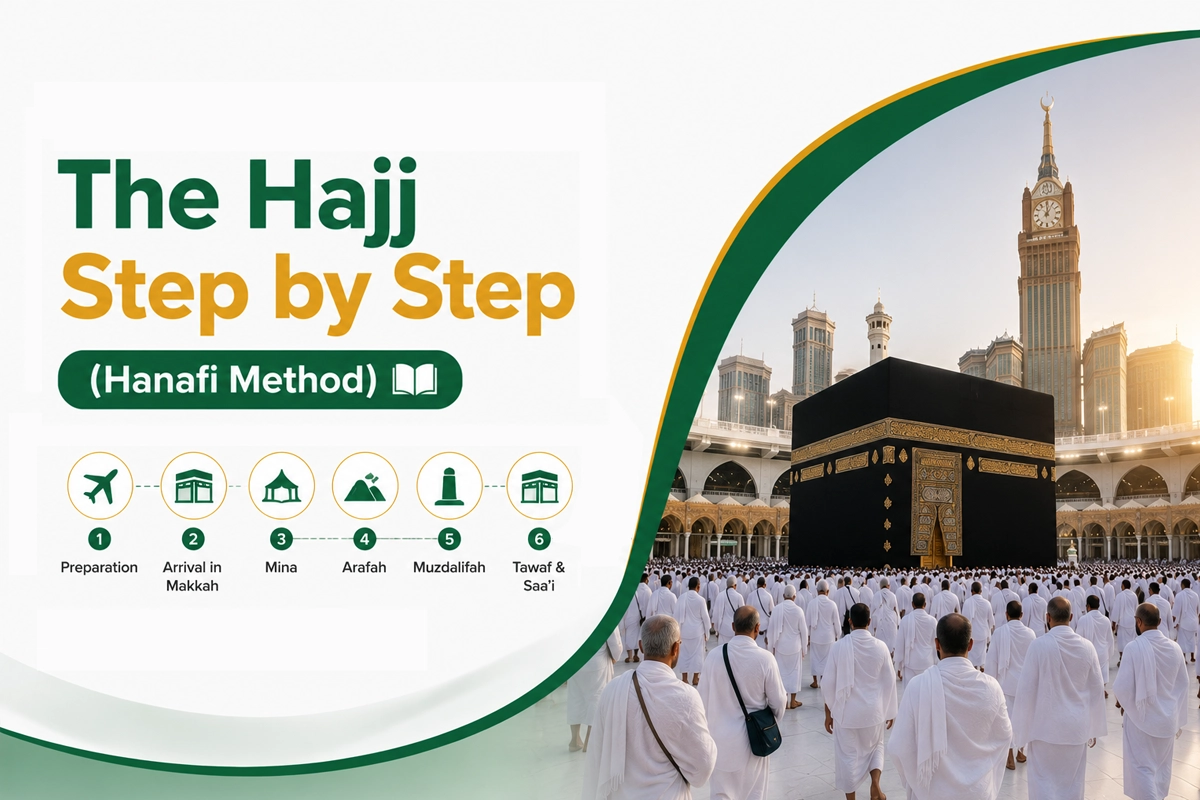
- Morning. Pilgrims move from Mina to Arafat after sunrise.
- Midday. Dhuhr and Asr are prayed at Masjid Namirah, combined and shortened, two units each, at the time of Dhuhr. A sermon precedes them.
- Afternoon. The standing. Facing the qibla, making du'a, until sunset. This is the whole of it, and there is no prescribed formula or number.
- Sunset. Pilgrims leave for Muzdalifah without praying Maghrib at Arafat. Maghrib and Isha are combined at Muzdalifah.
The point about not praying Maghrib before leaving catches people out every year. It is what the Prophet did, and it is the practice followed.
Our Hajj step by step guide sets out the surrounding days.
What was revealed there
Umar ibn al-Khattab was told by a Jewish man that a certain verse, had it been revealed to the Jews, would have been taken as a festival day. Umar answered that he knew when and where it was revealed: it came down to the Prophet on the Day of Arafah, on a Friday, while he was standing at Arafat.
The verse is in Surah al-Ma'idah: this day I have perfected for you your religion and completed my favour upon you, and have approved for you Islam as religion.
That exchange is in Sahih al-Bukhari.
Arafat is also named in Surah al-Baqarah, in the instruction that when you depart from Arafat you should remember Allah at al-Mash'ar al-Haram.
Practical realities of the day
- Heat is the main hazard. Arafat has almost no natural shade and the standing runs through the hottest part of the afternoon.
- Stay in your tent if that is where your group is. It is valid, it is safer, and it is what most pilgrims do.
- Drink steadily from the morning rather than trying to catch up in the afternoon.
- You do not have to stand. Sitting is fine. The word is standing but the requirement is presence.
- Keep the du'a simple. There is no set formula, and people who plan an elaborate programme often find they cannot use it. Ask for what you actually want.
- Know the boundary. If your camp is at the edge, check which side of the line it falls on. The markers are there for this.
Arafat outside Hajj
It is open, empty and worth seeing. Most Umrah pilgrims who go say it changes how they picture the day.
You can walk out onto the plain and up Jabal al-Rahmah, which takes a few minutes. There is no rite to perform, no prescribed prayer, and no reward established for visiting outside the season.
- Allow 30 to 40 minutes within a wider round.
- Go early. No shade, and the ground reflects heat.
- It is the furthest of the three sites, so it comes last on the way out and first on the way back.
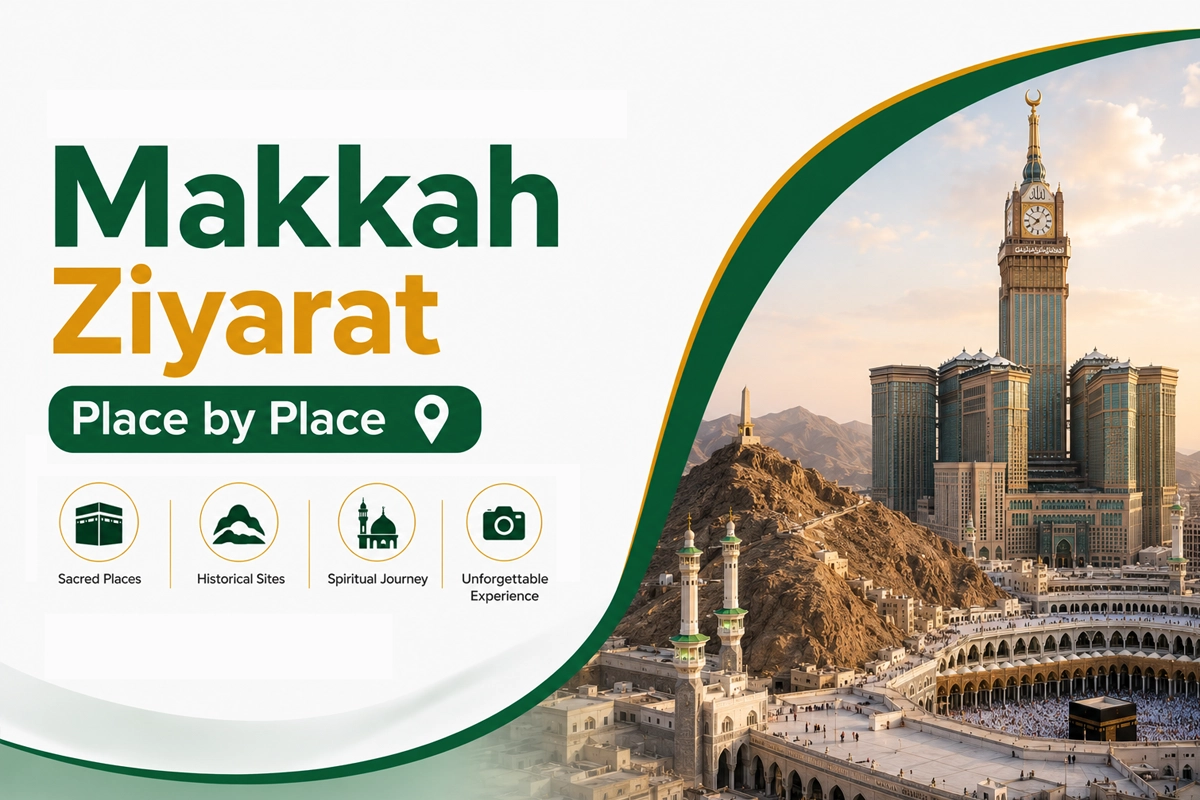
Mina, Muzdalifah and Arafat sit one after another on the same road, so all three fit into one leg of a Makkah Ziyarat round, from SAR 200 per vehicle with waiting at each stop. Fares reviewed August 2026.
On the same road
| Place | Distance from Makkah | What it is |
|---|---|---|
| Mina | About 7 km | The tent valley, first of the three. |
| Muzdalifah | About 12 km | The night after Arafat, in the open. |
| Arafat | About 22 km | The standing on the ninth. |
| Jabal al-Rahmah | Within Arafat | The hill with the pillar on top. |
Accuracy note
Arafat's area of about 33 square kilometres, its position roughly 22 kilometres east of Makkah on the road towards Taif, its situation as a plain ringed by a semicircle of mountains and bounded by Wadi Uranah, its capacity of more than two million pilgrims, and the fact that it is the only holy site outside the boundaries of the Haram all come from Saudipedia.
The statement that Hajj is Arafah is recorded in the collections of al-Tirmidhi, Abu Dawud and al-Nasa'i and is accepted as authentic. That all of Arafah is a place of standing is recorded in Sahih Muslim within Jabir's account of the Farewell Pilgrimage, as is the exclusion of Wadi Uranah. The hadith that there is no day on which Allah frees more people from the Fire than the Day of Arafah is in Sahih Muslim.
Umar ibn al-Khattab's account of the verse of Surah al-Ma'idah being revealed on the Day of Arafah, on a Friday, while the Prophet stood at Arafat, is recorded in Sahih al-Bukhari. Arafat is named in Surah al-Baqarah in the instruction to remember Allah at al-Mash'ar al-Haram after departing from it.
The sequence of the day, including combining and shortening Dhuhr and Asr at Namirah and leaving for Muzdalifah at sunset without praying Maghrib at Arafat, follows the Prophet's practice at the Farewell Pilgrimage as recorded in the authentic collections. No reward for standing at any particular point within Arafat is established. Fares are our own published rates, reviewed August 2026. Verified August 2026.
Frequently asked questions
Planning a Saudi trip?
Pre-book a private car, find a stay, or ask us anything on WhatsApp.
Last updated: 11 October 2026·Sources reviewed by the Wadana Go editorial team.