Magha'ir Shu'ayb: The Caves, the Name, and the Arithmetic
Short answer
Magha'ir Shu'ayb is a group of Nabataean rock-cut tombs about two kilometres from al-Bad' in Tabuk Province, dated to around the first century AD. Inscriptions inside carry Nabataean names. The traditional identification with the dwellings of Prophet Shu'ayb is level C and is not supported by the dating.
Key takeaways
- ✓Magha'ir Shu'ayb means the caves of Shu'ayb: rock-cut tombs about two kilometres from al-Bad'.
- ✓They are Nabataean, dated to around the first century AD. Same people, same century, as Hegra and Petra.
- ✓A published study of the two necropolises here deals with 35 tombs. Saudi sources give around eighty across the wider site.
- ✓The burial chambers average about 4.4 m by 4.4 m by 1.7 m, some with pillars, columns or carved niches.
- ✓Inscriptions above the pit graves carry Nabataean names, written by the people who did the burying.
- ✓Shu'ayb belongs to a period long before the first century AD, so these cannot be his dwellings. That is level C tradition.
- ✓None of this touches the Qur'anic account, and it does not by itself move Madyan. It changes what a guide should be allowed to tell you.
Quick facts
- Where
- About 2 km from al-Bad', Tabuk Province
- What
- Nabataean monumental rock-cut tombs
- Date
- Around the first century AD
- Tomb count
- 35 in the published study; about 80 in Saudi sources
- Chamber size
- Roughly 4.4 m by 4.4 m by 1.7 m
- Inscriptions
- Nabataean names, above pit graves
- Facade detail
- Pillars topped with Nabataean crowns
- The Shu'ayb tradition
- Level C. Not supported by the dating
- Part of Umrah or Hajj
- No
Magha'ir Shu'ayb means the caves of Shu'ayb. It is a set of rock-cut tombs about two kilometres from the town of al-Bad', in the far north-west of Saudi Arabia, and it is the best-known thing in the Madyan area.
The name is old and the site is real. The connection between the two is where the care is needed.
What they are
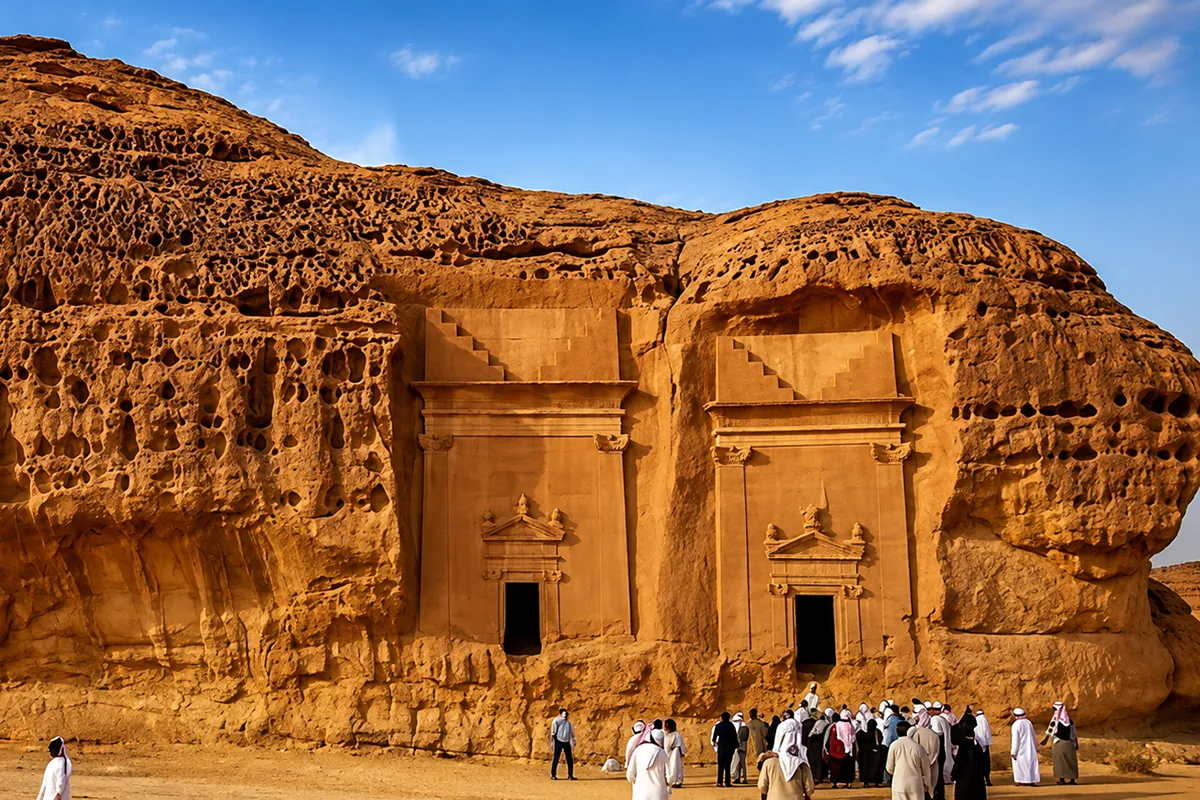
They are Nabataean monumental rock-cut tombs, dated to around the first century AD.
Same people who built Petra. Same people who carved Hegra. Same century, roughly.
A published architectural study covering the two necropolises here, Magha'ir Shu'ayb and al-Asifir, deals with 35 tombs in total. Saudi heritage sources give a higher figure of around eighty across the wider site, and the difference is a matter of what counts as a tomb rather than a disagreement about the ground.
So do not repeat a single number as though it were settled. We have not.
What is inside them
This is the interesting part, and it is not what most visitors expect.
The main burial chambers average roughly 4.4 metres long, 4.4 wide and 1.7 high. Low enough that you would stoop.
Some have pillars, columns or carved niches. Some carry inscriptions, painted or engraved, cut above pit graves in the floor.
And those inscriptions carry Nabataean names.
That is about as direct as archaeological evidence gets. Not a dating estimate or a stylistic argument, but the names of the people buried there, written on the wall by the people who buried them.
What they look like
Saudi heritage descriptions record square-cut chambers with single entrances, some facades finished with terraces and horizontal mouldings, and some entrances flanked by two pillars topped with Nabataean crowns.
That crown detail is a Nabataean signature. If you have seen Hegra you will recognise it immediately.
They are smaller and plainer than Hegra's, and there are fewer of them. Which, honestly, is part of the appeal. Almost nobody is there.
Where the name comes from
Local tradition identifies this as the dwelling place of the prophet Shu'ayb, and the caves are named for him. The tradition is old and it is why anyone knows the place.
The problem is arithmetic.
Shu'ayb belongs to a period long before the first century AD. The tombs are first century AD. They cannot be his dwellings, or his people's, and no archaeologist has argued that they are.
This is level C: a traditional association, respected and long-standing, and not supported by the dating.
What that does and does not change
It does not touch the Qur'an. Madyan, Shu'ayb and the account of Musa arriving at the water are level A and are not affected by what century a set of tombs was carved in.
It does not even necessarily move Madyan. The identification of the general area with Madyan rests on the Arab and Islamic geographical tradition, not on these tombs. An oasis can be the right place while a monument in it is the wrong monument.
What it changes is what you should let a guide tell you. If someone points at a carved doorway and says this was Shu'ayb's house, that claim is wrong, and you now know why.
If you go
- Do not enter the chambers. They are burial chambers, they are fragile, and there is nothing to see inside that a photograph from the doorway will not show.
- Do not climb the rock face.
- Do not seek blessing here. There is no basis for it, and these are graves of people who were not Muslims.
- Bring water and fuel. It is remote country.
- Confirm access before travelling. Arrangements at Saudi heritage sites change.
Is visiting part of Hajj or Umrah?
No. Not a rite of either.
Getting there, honestly
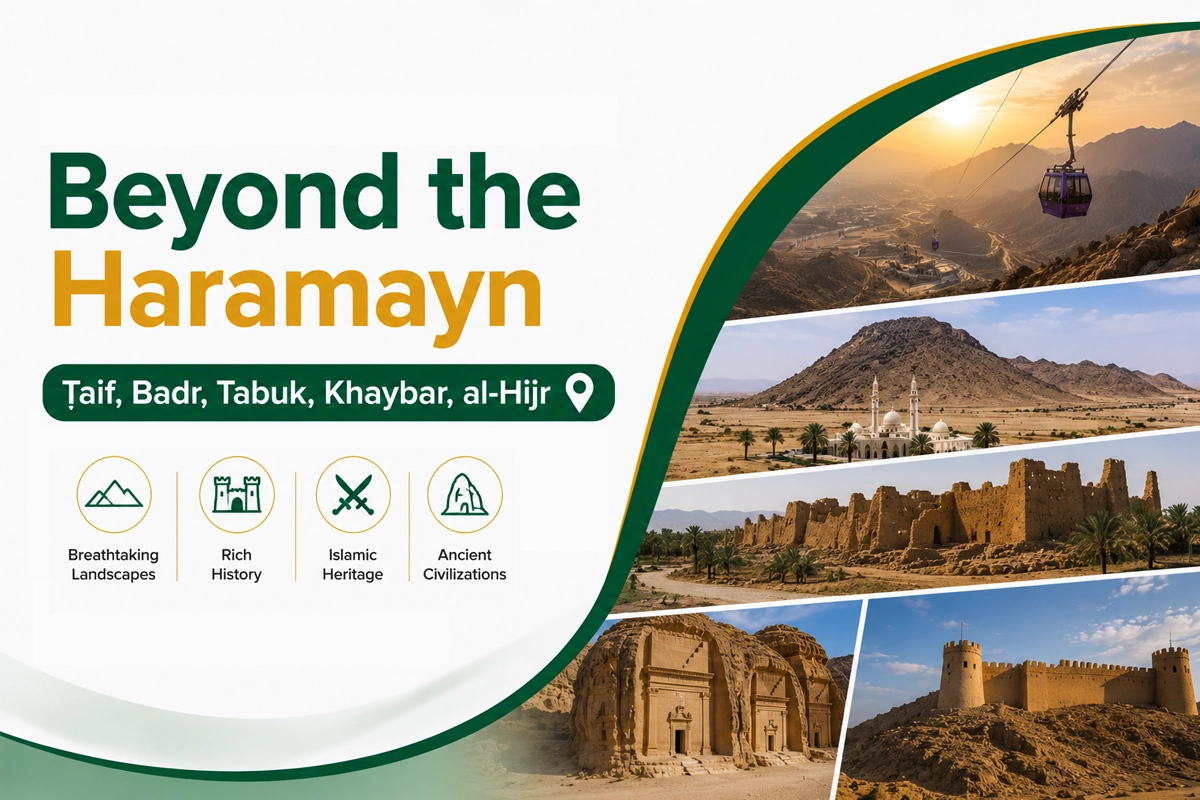
We do not run a scheduled service this far north and there is no published Wadana Go fare for it. Al-Bad' is about 225 km from Tabuk city, so flying to Tabuk and hiring a car, or arranging a private car in advance, are the practical options. See driving yourself versus a private driver and renting a car in Saudi Arabia. Our Beyond the Haramayn guide puts this region alongside Badr, Khaybar, AlUla and Taif.
Related reading
- Madyan and Prophet Shu'ayb — the Qur'an, the ground and the join.
- Al-Bad' archaeological site — the wider oasis.
- The well associated with Musa — the other tradition here.
- Hegra — the same problem, on a larger scale.
Accuracy note
Magha'ir Shu'ayb is a group of Nabataean monumental rock-cut tombs about two kilometres from al-Bad' in Tabuk Province, dated by archaeologists to around the first century AD. A published architectural study of the two necropolises of Magha'ir Shu'ayb and al-Asifir deals with 35 tombs; Saudi heritage sources give a figure of around eighty across the wider site, and we have given both rather than presenting either as settled. The average interior dimensions of the main burial chambers of roughly 4.4 m by 4.4 m by 1.7 m, the presence of pillars, columns and niches, and the painted or engraved inscriptions carved above pit graves bearing Nabataean names, follow that published study. The descriptions of square-cut chambers with single entrances, facades with terraces and horizontal mouldings, and entrances flanked by two pillars topped with Nabataean crowns, follow Saudi heritage sources including Saudipedia. The identification of the site as the dwelling place of the prophet Shu'ayb is a long-standing local tradition and is level C; it is not supported by the dating of the tombs, and we have said so plainly rather than leaving it ambiguous. That conclusion does not affect the Qur'anic account of Madyan, Shu'ayb or Musa, which is level A, nor does it by itself move the identification of the wider area with Madyan, which rests on the Arab and Islamic geographical tradition rather than on these tombs. These are burial chambers of people who were not Muslims; no blessing attaches to the site and none should be sought. Arrangements at Saudi heritage sites change; confirm access before travelling. Visiting is not a rite of Hajj or Umrah. We do not run a scheduled service to al-Bad' and have not quoted a fare. Content verified August 2026. Correction? Tell us.
Frequently asked questions
Planning a Saudi trip?
Pre-book a private car, find a stay, or ask us anything on WhatsApp.
Last updated: 31 August 2026·Sources reviewed by the Wadana Go editorial team.