Maqam Ibrahim: What It Is, What the Quran Says, and What You Do There
Short answer
Maqam Ibrahim is the stone Prophet Ibrahim stood on while building the Kaaba. It sits a few metres east of the Kaaba in a crystal case, marked with two footprint hollows. The Quran says to take it as a place of prayer (2:125), and the Prophet prayed two rak'ahs there after tawaf. You do not visit it separately, and if the area is full you may pray those two rak'ahs anywhere in the mosque.
Key takeaways
- ✓Maqam Ibrahim is a stone, not a grave. Maqam means standing place.
- ✓The Quran names it twice, in 2:125 and 3:97, and tells believers to take it as a place of prayer.
- ✓Sahih Muslim records that the Prophet prayed two rak'ahs at it after tawaf, reciting al-Kafirun and al-Ikhlas.
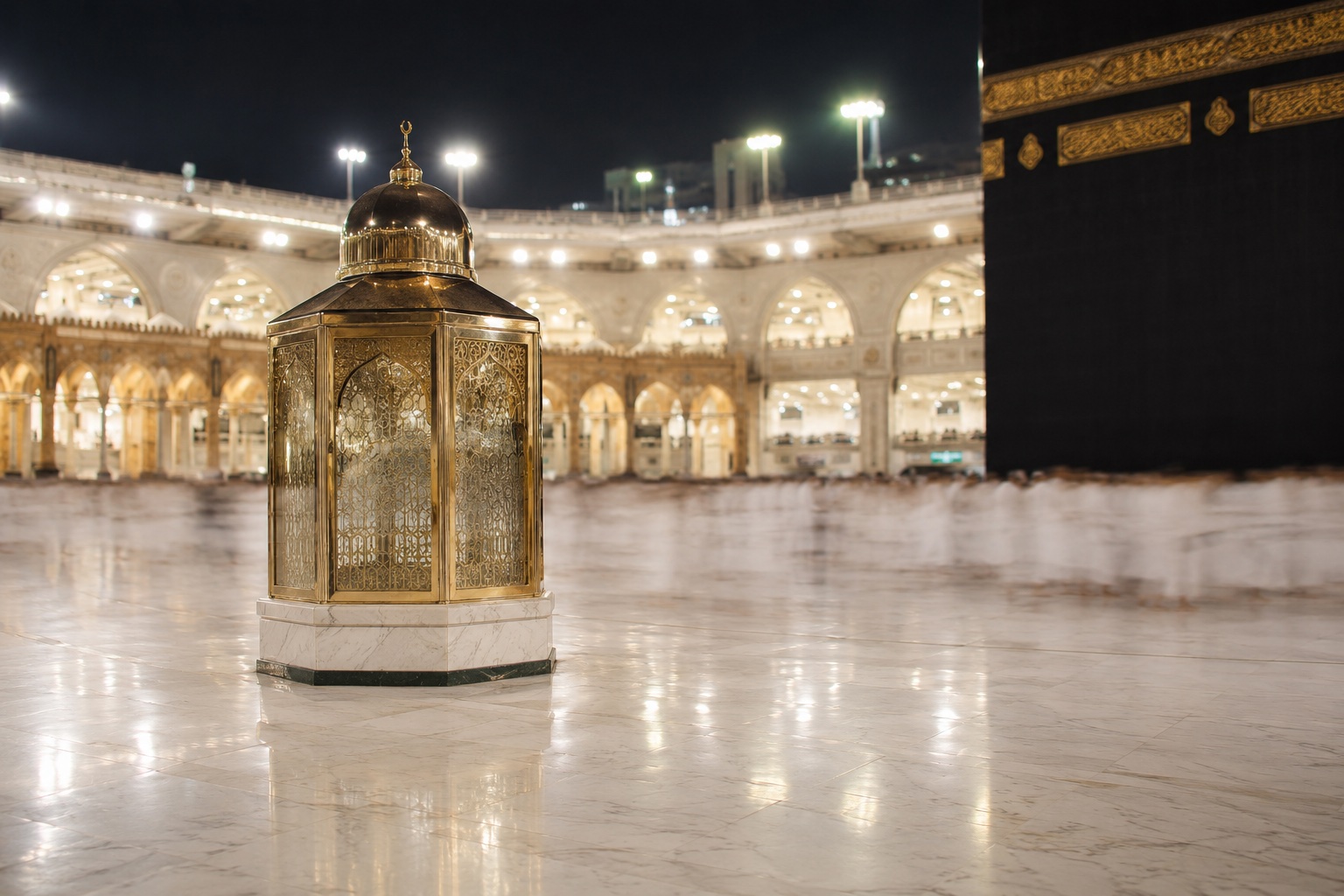
- ✓You cannot touch or reach it. It is enclosed in glass and crystal on a marble base.
- ✓If the mataf is crowded, the two rak'ahs may be prayed anywhere inside Masjid al-Haram.
- ✓Touching or wiping the case is not established from the Prophet.
- ✓There is no separate Ziyarat to it. It is part of tawaf.
Quick facts
- City
- Makkah, Saudi Arabia
- Where
- Inside Masjid al-Haram, in the mataf, a few metres east of the Kaaba
- What it is
- A stone with two footprint-shaped hollows, in a crystal case
- In the Quran
- Surah al-Baqarah 2:125 and Surah Aal Imran 3:97
- Part of Umrah
- Yes, as the two rak'ahs prayed after tawaf
- Can you touch it
- No, it is fully enclosed
- Can a car reach it
- No, it is inside the mosque and reached on foot
- Quietest hours
- Roughly midnight to 3am, outside Ramadan
- Current casing
- Crystal cover from 1967, gold-plated mesh and marble base from 1996
- Non-Muslim access
- No, Makkah is closed to non-Muslims
What Maqam Ibrahim is
Maqam Ibrahim is a stone. It stands a few metres east of the Kaaba, roughly in line with the Kaaba's raised door, inside a clear case of glass and crystal. On the top surface of the stone are two hollow marks shaped like the soles of two feet.
The name means "the standing place of Ibrahim". Muslims understand it as the stone that Prophet Ibrahim, peace be upon him, stood on while he and his son Isma'il raised the walls of the Kaaba. Saudipedia, the Saudi national reference, describes it in those words.
One thing to be clear about at the start: it is not a grave, and nobody is buried there. The Arabic word maqam here simply means a place where somebody stood. It is not a shrine and it is not prayed to.
What the Quran says about it
Two verses name it directly.
The first is in Surah al-Baqarah: "And take from the standing place of Ibrahim a place of prayer" (Quran 2:125). This verse is not background history. It is the instruction a pilgrim acts on the moment tawaf ends.
The second is in Surah Aal Imran, describing the Sacred House: "In it are clear signs, the standing place of Ibrahim" (Quran 3:97).
Because both verses are in the Quran, everything in this section is established beyond doubt. Some of the later history further down this page is not on the same level, and we say so where that is the case.
The two rak'ahs after tawaf
Sahih Muslim records the long account of the Prophet's Hajj narrated by Jabir ibn Abdullah, may Allah be pleased with him. After completing seven rounds of the Kaaba, the Prophet, peace and blessings be upon him, went to Maqam Ibrahim and recited the verse "And take from the standing place of Ibrahim a place of prayer". He placed the Maqam between himself and the House, and prayed two rak'ahs. In them he recited Surah al-Kafirun and Surah al-Ikhlas.
That is the connection between you and this stone. You do not make a separate visit to it. You pray two short rak'ahs near it, facing the Kaaba, with the Maqam in front of you.
The schools of law differ on whether those two rak'ahs are obligatory or a strong sunnah. In practice the difference does not change what you do. Every school tells you to pray them, so pray them.
When the mataf is full, and it usually is
Standing directly behind the Maqam is close to impossible at busy hours. The tawaf stream runs right past it. Scholars are agreed that the two rak'ahs may be prayed anywhere inside Masjid al-Haram if the space behind the Maqam is crowded. Walk out of the circling stream, find a clear patch of marble, and pray there.
Nobody is rewarded for blocking tawaf. Pushing back against a moving crowd to reach one spot puts elderly pilgrims at real risk, and the sunnah is available to you twenty metres away.
What you actually see today
You will not see bare rock. The stone sits inside a small domed enclosure of glass and crystal, set on a base of white Carrara marble with green granite. A gold-coloured metal frame surrounds it, and there is a gold-plated mesh inside.
Saudipedia describes the stone itself as a cube measuring about fifty centimetres in length, width and height, with two oval hollows in the middle of its upper face. Other references give slightly different measurements, so treat any exact figure as approximate.
What this means for you as a visitor is simple. You cannot touch it, you cannot reach it, and you will see it while you are already moving in tawaf. It is a glimpse, not a stop. Look, keep walking, and do your looking properly on a quieter circuit rather than slowing the line.
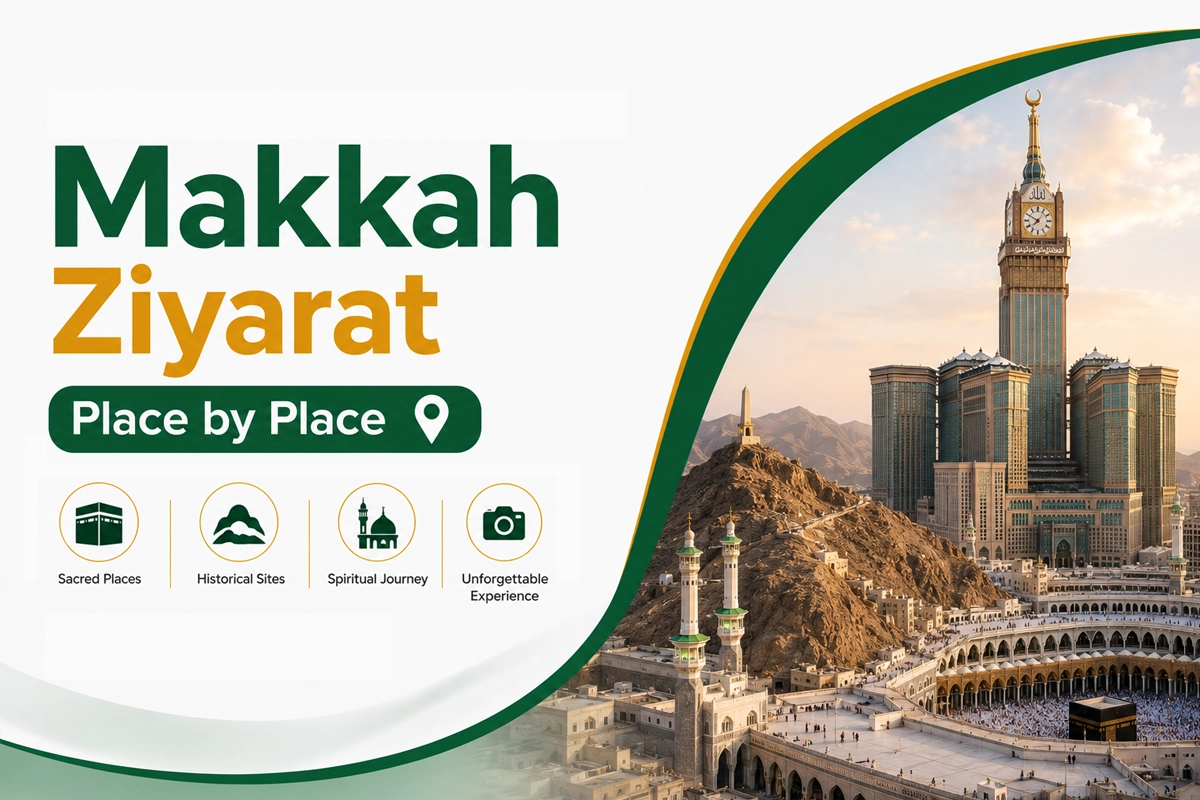
If the wider set of Makkah sites is on your list for this trip, our Makkah Ziyarat guide covers what is outside the Haram and what a half-day round normally includes.
How it reached its present position
This part is history rather than scripture, so the wording is more careful.
Historical sources record that the stone once stood against the wall of the Kaaba, and that Umar ibn al-Khattab, may Allah be pleased with him, moved it back to give the people performing tawaf room to circle. Saudipedia records the same. This is well documented in early Islamic history, but it is not a Quranic statement, so it belongs one level down.
After that, the changes are mostly about protection and decoration. Saudipedia's timeline records gold work by the Abbasid caliph al-Mahdi in 777 and again under al-Mutawakkil in 851, and a dome that was renewed repeatedly between 1495 and 1721.
The modern casing is Saudi work. During the expansion in the reign of King Faisal, in 1967, the old enclosure was removed and replaced with a crystal cover. In 1996, under King Fahd, an inner gold-plated mesh was added, the metal structure was replaced with high-grade copper, and the concrete base was changed to white Carrara marble with green granite. That is broadly what you see today.
What is not established
A few practices circulate around the Maqam that have no authentic basis. None of them is required, and none of them is recorded from the Prophet, peace and blessings be upon him.
- Touching, kissing or rubbing the glass case. There is no authentic report of the Prophet doing this, and the case is modern in any event.
- Wiping your hands on it and then over your face. Not established.
- A special dua fixed for the Maqam. What is transmitted is the recitation of the verse on approaching it, and the two surahs inside the two rak'ahs. Beyond that, make dua in your own words, in your own language.
- Facing the Maqam in prayer. You face the Kaaba. The Maqam is between you and the House, not your qiblah.
Two footprint-shaped hollows in a stone naturally attract stories. Be content with what is confirmed: the Quran names this place, and the Prophet prayed two rak'ahs at it. That is a great deal already.
Is visiting it part of Umrah or Hajj?
Yes, but not as a separate act. There is no independent Ziyarat to Maqam Ibrahim. It is built into tawaf: seven rounds, then two rak'ahs at the Maqam, then Zamzam, then out to Safa for sa'i.
So you do not need to plan for it, book anything, or set aside time. If you are performing tawaf correctly you will pass it seven times and pray at it once.
The full order of the rites, with the duas placed where you will need them, is in our first-time Umrah guide. The transmitted duas on their own are collected in the Umrah duas guide.
Practical notes for a first visit
- The mataf is ground level. The Maqam is only visible from the courtyard around the Kaaba. From the upper floors you are far above it.
- Late night is calmest. Roughly midnight to three in the morning, outside Ramadan, the mataf thins out. After Fajr and after Isha are the hardest hours.
- Do not stop to photograph it. Standing still in the mataf with a phone up is how people get knocked over. If you want to look properly, step out to the edge first.
- Wheelchair users. There is a dedicated wheelchair route for tawaf, and free manual wheelchairs are available at several Grand Mosque gates. Plan the two rak'ahs away from the crowd. Our Haram accessibility guide has the current arrangements.
- Ramadan and the last ten nights. Assume you will not get near the Maqam at all. Pray the two rak'ahs wherever you can stand.
What sits around it
Everything in this part of the mosque is within a short walk of everything else. The Kaaba is in front of you. The Black Stone is at its eastern corner, where each round of tawaf begins and ends. The Zamzam taps line the edges of the mataf, and the Safa gate leads through to the sa'i gallery.
If you want the wider picture of the building itself, the gates, the floors and how to find your way back to your group, read our Masjid al-Haram visitor guide. For the House at the centre of it all, see the Holy Kaaba.
Getting to Makkah
You do not take a car to Maqam Ibrahim. It is inside the Grand Mosque, and the only way to it is on foot from your hotel or from one of the gates. What a car does help with is the part before that: getting into Makkah with your luggage, and getting to your hotel without a two-hour wait at the airport.
Most pilgrims arrive through Jeddah. Our fixed fare for Jeddah Airport to Makkah is SAR 260 in a standard sedan, SAR 280 in an SUV and SAR 330 in a Hiace van, plus parking, as reviewed in August 2026. The driver meets you inside the terminal and takes you to your hotel door, which matters at two in the morning with three suitcases and a family in ihram.
For the sites outside the Haram, such as Jabal al-Noor, Jabal Thawr, Mina and Arafat, the Makkah Ziyarat round by private car is a half day with the car waiting at each stop. Hotel choice makes a bigger difference than most people expect, so it is worth reading how far from the Haram to stay before you book.
Accuracy note
The Quranic verses quoted here are 2:125 and 3:97. The account of the Prophet's two rak'ahs at the Maqam is from the hadith of Jabir ibn Abdullah in Sahih Muslim. The description of the stone, its casing and its timeline follows Saudipedia, the Saudi national encyclopaedia. The move by Umar ibn al-Khattab is recorded in early Islamic history and by Saudipedia, and is presented here as historical documentation rather than as a Quranic or hadith text.
Measurements of the stone differ between sources, so the figure given is approximate. Transport fares are our own fixed prices, reviewed August 2026. Facts on this page were verified in August 2026. Crowd conditions and access arrangements inside Masjid al-Haram change, so check with the mosque staff on the day.
Frequently asked questions
Planning a Saudi trip?
Pre-book a private car, find a stay, or ask us anything on WhatsApp.
Last updated: 23 August 2026·Sources reviewed by the Wadana Go editorial team.