Masjid al-Bay'ah: The Abbasid Mosque Where the Pledges Were Given
Short answer
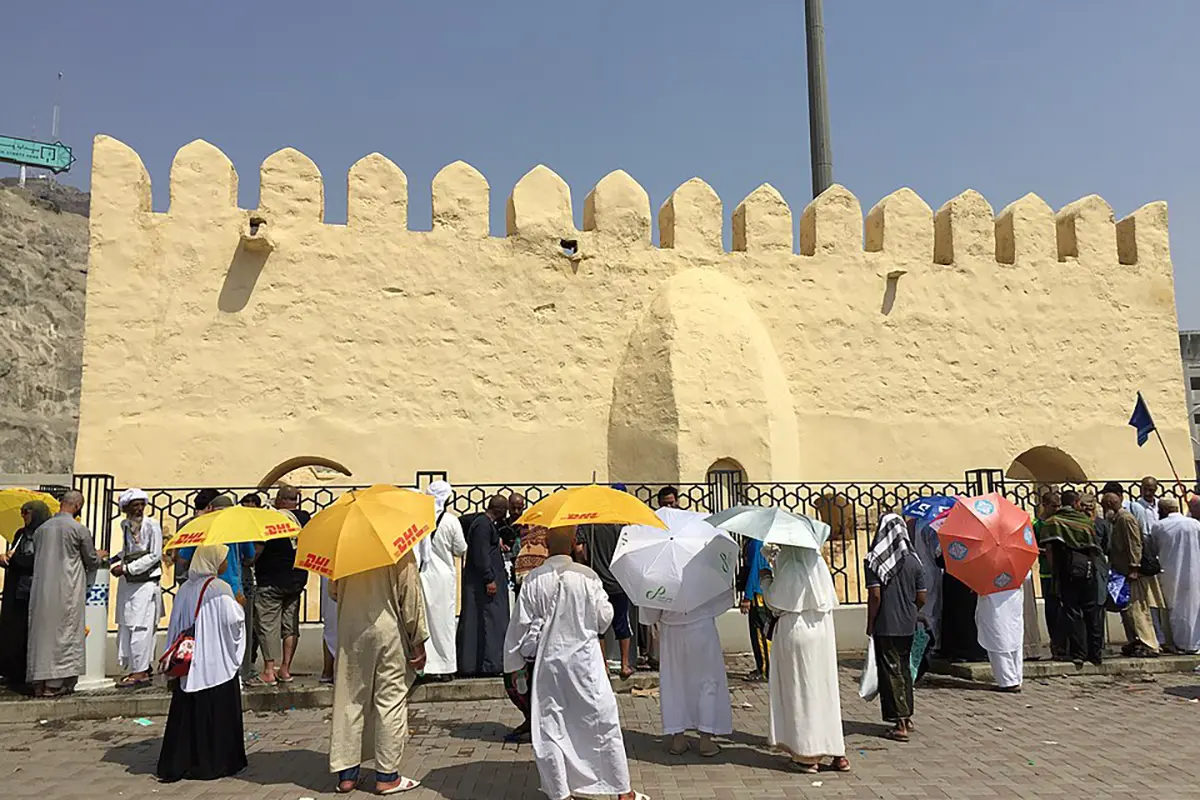
Masjid al-Bay'ah is a small historic mosque in Mina, near Jamrat al-Aqabah, built by the Abbasid caliph Abu Ja'far al-Mansur in 761. It marks the site connected with the Pledges of Aqaba, given to the Prophet Muhammad by men of Madinah during the pilgrimage seasons before the Hijrah. It is not used for congregational prayer today.
Key takeaways
- ✓Masjid al-Bay'ah stands in Mina, near Jamrat al-Aqabah at the Makkah end of the valley.
- ✓Saudipedia records that it was built by the Abbasid caliph Abu Ja'far al-Mansur in 761.
- ✓It marks the site connected with the Pledges of Aqaba, given before the Hijrah.
- ✓The pledges themselves are established. The exact spot rests on a very old tradition.
- ✓Being built barely a century and a half after the events gives that tradition unusual weight.
- ✓It is a small plain structure, not a working congregational mosque.
- ✓It is easy to miss, standing beside the enormous Jamarat complex.
Quick facts
- Where
- Mina, near Jamrat al-Aqabah
- Built by
- Abbasid caliph Abu Ja'far al-Mansur
- Year built
- 761
- What it marks
- The site of the Pledges of Aqaba
- Also called
- Masjid al-Aqaba
- In regular use?
- No
- Car access
- Yes, outside the Hajj season
- Part of Umrah?
- No. Not a rite of Hajj or Umrah.
A small building beside a very large one
Masjid al-Bay'ah stands in Mina, close to Jamrat al-Aqabah at the Makkah end of the valley. It is also called Masjid al-Aqaba.
It is small, plain and old, and it sits in the shadow of the enormous multi-level Jamarat complex. Millions of people pass within a short distance of it every year and most never look at it.
It is not a working congregational mosque in the way Masjid al-Khayf is. It is a marked historical structure.
Built in 761
Saudipedia records that the mosque was built by the Abbasid caliph Abu Ja'far al-Mansur in 761.
That date is worth pausing on, because it is the strongest thing about this site.
The pledges were given in the years immediately before the Hijrah, so around 621 and 622. The mosque was built roughly a hundred and forty years later. In the terms of historical evidence, that is close. It was built while the topography of the pilgrimage was still well known and while the chain of people who knew where things had happened was still short.
Compare that with sites whose identification first appears in a book written five hundred years after the event, and the difference is real.
What it marks
During the pilgrimage seasons of the last years in Makkah, men from Yathrib, the city later called Madinah, met the Prophet secretly at Aqaba, on the edge of Mina.
The first pledge was given by a small group. They committed to worship Allah alone and to avoid theft, unlawful sexual relations, killing their children and slander, and to obey in what is right.
The second pledge, the following year, was given by a much larger group, and it went further. It included the commitment to protect the Prophet as they would protect their own families.
That second pledge is what made the Hijrah possible. Without a city that had agreed to receive and defend him, there was nowhere to go.
The full account of both pledges, including the terms recorded in Sahih al-Bukhari, is on our Pledges of Aqaba page.
How certain is the location?
Two levels again, and they are worth keeping separate.
The pledges are established. Their terms are recorded in the authentic collections, and the events are among the best documented of the late Makkan period.
That they happened at this exact spot rests on the tradition the mosque itself represents. Al-Mansur built here because this is where people in the middle of the eighth century understood it to have happened.
That is a strong tradition and not a proof. We would treat it as among the better-founded site identifications in the whole of the Hajj area, and still say plainly that it is an identification rather than a text.
Is there a prayer there?
No prescribed prayer and no established reward attach to Masjid al-Bay'ah. Visiting it is not part of Hajj or Umrah.
Nobody's pilgrimage is affected by whether they see it. It is history, and history in a place where you are surrounded by rites, which is a slightly unusual combination and worth being clear about so that nobody starts treating a historical marker as a station of Hajj.
Seeing it
Honestly, this is a stop of a few minutes, and the main difficulty is finding it.
- It is close to Jamrat al-Aqabah, at the Makkah end of the valley, and easy to walk past.
- Ask your driver by name. Masjid al-Bay'ah or Masjid al-Aqaba. Drivers who run the Ziyarat route know it; others may not.
- Do not expect to go inside. It is a preserved structure rather than an open mosque.
- Outside Hajj is the only realistic time. During the season the area around Jamrat al-Aqabah is the most crowded ground in the pilgrimage and nobody is stopping to look at a small old building.
Mina, Muzdalifah and Arafat come one after another on the road out of Makkah, so this fits into one leg of a Makkah Ziyarat round, from SAR 200 per vehicle with waiting at each stop. Fares reviewed August 2026.
Why it is worth the few minutes
Because of what it sits next to.
A few metres away, three million people a year perform a rite of Hajj at a complex that can move three hundred thousand of them an hour. And here is a small stone enclosure marking the place where, before any of that existed, a handful of men from another town promised to protect one man that his own city wanted dead.
Everything downstream of that promise, including the crowd on the bridge, followed from it.
Nearby
| Place | What it is |
|---|---|
| The Pledges of Aqaba | What was agreed, and what it led to. |
| Jamrat al-Aqaba | The largest pillar, a short distance away. |
| Masjid al-Khayf | The main mosque of Mina, at the other end. |
| Mina | The valley and its days. |
Accuracy note
That Masjid al-Bay'ah stands within the boundaries of Mina and was built by the Abbasid caliph Abu Ja'far al-Mansur in 761 comes from Saudipedia.
The Pledges of Aqaba are established history, and the terms of the pledge are recorded in Sahih al-Bukhari. The identification of this specific spot as the place where they were given rests on the tradition that the mosque itself represents, dating from roughly a hundred and forty years after the events. We have described that as a strong tradition rather than as textual evidence.
No prescribed prayer or established reward attaches to the mosque, and visiting it is not part of Hajj or Umrah. It is a preserved structure rather than a mosque in regular congregational use, and access may be restricted. Fares are our own published rates, reviewed August 2026. Verified August 2026.
Frequently asked questions
Planning a Saudi trip?
Pre-book a private car, find a stay, or ask us anything on WhatsApp.
Last updated: 12 October 2026·Sources reviewed by the Wadana Go editorial team.