Masjid al-Khayf: Mina's Great Mosque, and the Seventy Prophets Claim
Short answer
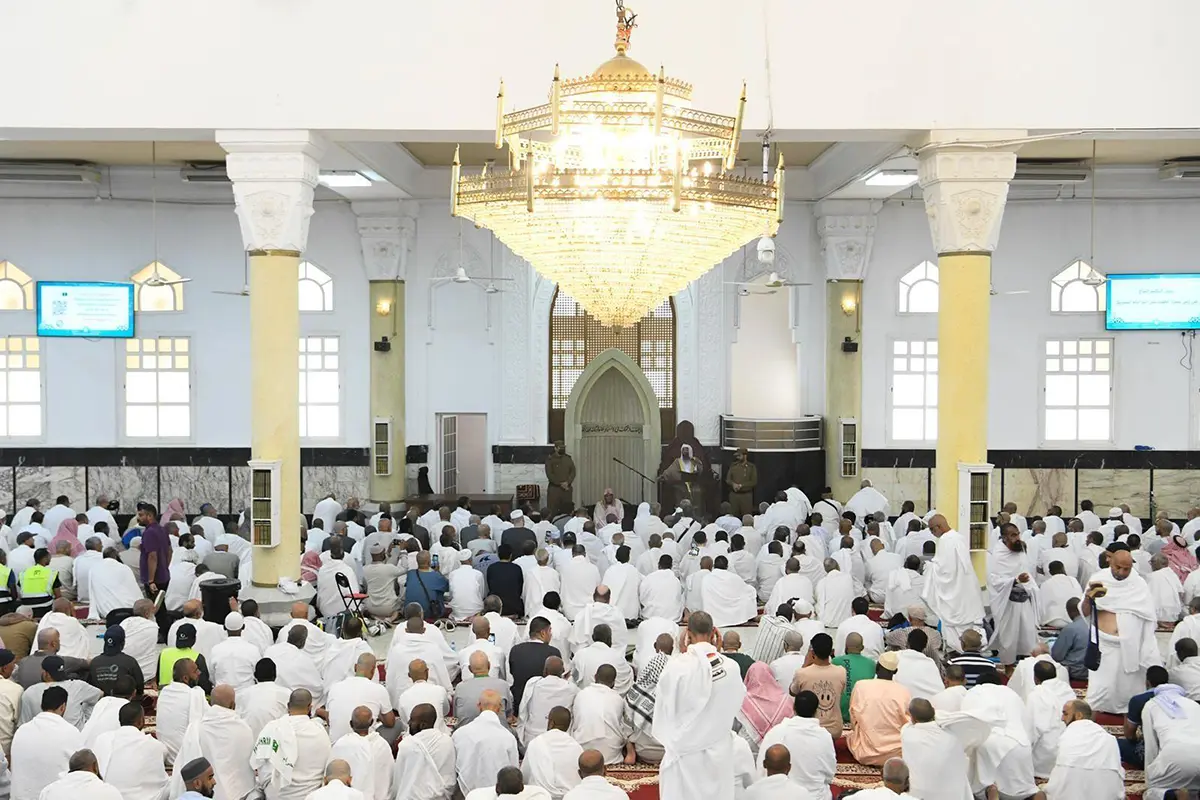
Masjid al-Khayf is the principal mosque of Mina, on the southern side of the valley near the smallest of the three Jamarat. It covers about 23,500 square metres and holds roughly 25,000 worshippers. The Prophet Muhammad prayed there during the Farewell Pilgrimage. It is used during Hajj and stands empty for most of the year.
Key takeaways
- ✓Masjid al-Khayf is the main mosque of Mina, on the southern side of the valley.
- ✓It covers about 23,500 sq m, holds around 25,000 worshippers and has four minarets.
- ✓It was expanded in 1987 and has 1,700 washrooms for men and women.
- ✓The Prophet prayed there during the Farewell Pilgrimage. That much is established.
- ✓A report that seventy prophets prayed there is graded acceptable by some scholars and disputed by others.
- ✓The claim that seventy prophets are buried there is not supported and has been refuted.
- ✓It is a working Hajj mosque, mostly closed and empty outside the season.
Quick facts
- Where
- Southern side of Mina, near the small Jamrah
- Area
- About 23,500 sq m
- Capacity
- About 25,000 worshippers
- Minarets
- Four
- Washrooms
- 1,700 for men and women
- Last major expansion
- 1987
- Used
- Mainly during the Hajj season
- Part of Umrah?
- No. Mina belongs to Hajj.
The mosque of the valley
Masjid al-Khayf sits on the southern side of Mina, against the foot of the mountain, near the smallest of the three Jamarat. The word khayf refers to ground that slopes down from a mountain towards a valley floor, which is exactly where it stands.
It is large. Saudipedia gives its area as about 23,500 square metres, with capacity for roughly 25,000 worshippers, four minarets, and 1,700 washrooms. Its most recent major expansion was in 1987.
During Hajj the Ministry of Islamic Affairs runs its educational programmes for pilgrims from here, teaching the rites and the rules to people who are about to perform them.
For the rest of the year it stands almost empty, like everything else in the valley.
What is established about it
The firm ground first.
The Prophet prayed at Masjid al-Khayf. He camped in Mina during the Farewell Pilgrimage and prayed in this place, and that is recorded in the authentic material. It is a mosque built on a spot where he prayed, which is the ordinary and honest reason a mosque of this name exists there.
A well-known sermon is also connected with Mina during that pilgrimage, in which the Prophet asked Allah to brighten the face of a man who hears his words, retains them and passes them on, and noted that many who carry knowledge are not themselves people of understanding. That address is reported in the collections of al-Tirmidhi and Ibn Majah among others.
The seventy prophets report
This is the claim you will hear at the door, and it needs three sentences rather than one.
There is a narration from Ibn Abbas, recorded by al-Tabarani in al-Mu'jam al-Kabir and by al-Bazzar, that seventy prophets prayed in Masjid al-Khayf, among them Musa.
Scholars have assessed it differently. Al-Albani graded it hasan, meaning acceptable, in Sahih al-Targhib. Al-Mundhiri also called it hasan, and al-Haythami said its narrators are trustworthy. Others have judged it weaker than that.
So the fair statement is: this report is not in Bukhari or Muslim, it is graded acceptable by several respected scholars, and it is not beyond dispute. It is reasonable to mention. It is not reasonable to present it as settled, and it is certainly not the basis for any particular act of worship.
The claim that should be rejected
A different claim circulates alongside it, and this one does not survive scrutiny at all: that seventy prophets are buried at Masjid al-Khayf.
That is not what the narration says. The narration is about prophets praying there, not being buried there. Islamweb has published a fatwa specifically refuting the burial claim as unsupported.
The distinction is not pedantic. A mosque where prophets are said to have prayed is a place with a history. A mosque said to hold seventy graves invites people to behave towards it in ways Islam does not permit, and the difference between those two ideas is exactly the sort of drift that turns a historical note into a problem.
If you hear the burial version in Mina, it is wrong.
Is there a special prayer there?
No prescribed prayer and no established reward attach to Masjid al-Khayf beyond what applies to praying in any mosque.
Praying there during Hajj is normal and sensible, because it is the mosque of the valley you are staying in and it holds twenty-five thousand people. That is a practical reason, not a devotional claim.
Nothing in Hajj requires you to pray in this particular mosque. Pilgrims in far camps who pray where they are have not missed anything.
Using it during Hajj
- Know where it is relative to your camp. Mina is confusing and the mosque is a useful landmark, being one of the few large permanent buildings in the valley.
- It fills. Twenty-five thousand sounds enormous until three million people are in the valley. Arrive early or expect to pray in the courtyards.
- The washrooms are worth knowing about. With 1,700 of them, this is often a better bet than the block nearest your tent.
- The teaching programmes are free and run in several languages during the season. If you are unsure about a rite, this is a better source than a group chat.
Our Hajj step by step guide covers the days in order, and the Nusuk app guide covers permits and bookings.
Seeing it outside Hajj
Outside the season the mosque is usually closed, though the building is easy to see from the road and Ziyarat drivers stop nearby.
Whether you can pray inside depends on the day and on what the authorities have opened. Some visitors find it open at prayer times, others find it shut. We would not promise you access either way.
Mina, Muzdalifah and Arafat sit one after another on the same road out of Makkah, so all three fit into one leg of a Makkah Ziyarat round, from SAR 200 per vehicle with waiting at each stop. Fares reviewed August 2026.
Nearby
| Place | What it is |
|---|---|
| Mina | The valley itself and its days. |
| The Jamarat | The three pillars, in the same valley. |
| Masjid al-Bay'ah | Near Jamrat al-Aqabah, at the Makkah end. |
| Jamrat al-Aqaba | The largest pillar, stoned on the day of Eid. |
Accuracy note
The mosque's area of about 23,500 square metres, capacity of around 25,000 worshippers, four minarets, 1,700 washrooms, the 1987 expansion, and its use by the Ministry of Islamic Affairs for pilgrim education during the season all come from Saudipedia.
That the Prophet prayed at Masjid al-Khayf during the Farewell Pilgrimage is established. The sermon delivered at Mina asking Allah to brighten the face of one who hears and conveys his words is reported in the collections of al-Tirmidhi and Ibn Majah among others.
The report that seventy prophets prayed in Masjid al-Khayf, including Musa, is narrated from Ibn Abbas by al-Tabarani in al-Mu'jam al-Kabir and by al-Bazzar. It is graded hasan by al-Albani in Sahih al-Targhib and by al-Mundhiri, and al-Haythami said its narrators are trustworthy, while other scholars have judged it weaker. It is not in Bukhari or Muslim, and we have presented it as an acceptable but disputed report rather than as settled.
The separate claim that seventy prophets are buried at the mosque is unsupported and has been refuted in published fatwa by Islamweb. We have rejected it plainly.
No prescribed prayer or established reward attaches to this mosque beyond what applies to any mosque. Access outside the Hajj season is not guaranteed. Fares are our own published rates, reviewed August 2026. Verified August 2026.
Frequently asked questions
Planning a Saudi trip?
Pre-book a private car, find a stay, or ask us anything on WhatsApp.
Last updated: 12 October 2026·Sources reviewed by the Wadana Go editorial team.