Qalat Fortress and al-Qamus: What a Khaybar Fort Actually Was
Short answer
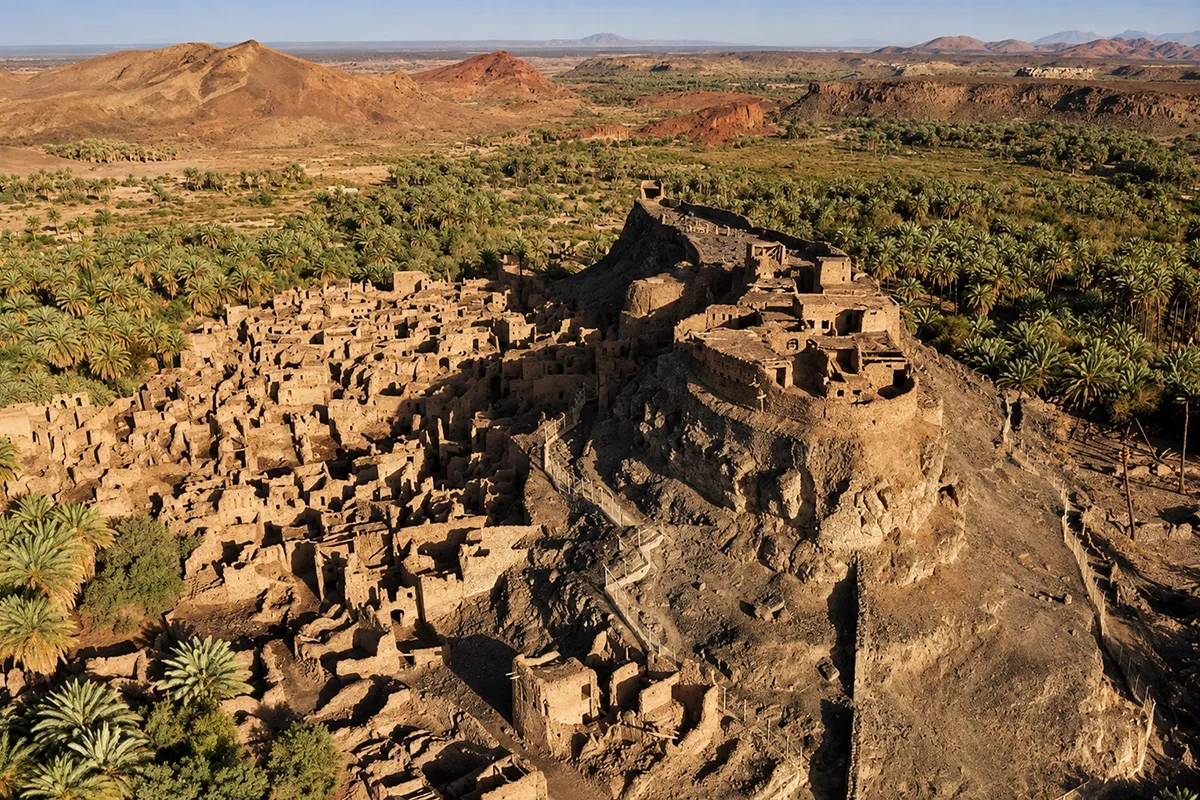
Qal'at simply means fortress in Arabic, and the listed Qalat Fortress points to the main standing castle at Khaybar, associated with al-Qamus. The classical sources describe al-Qamus as the strongest stronghold, belonging to the Abu'l-Huqayq clan and standing on a ridge above old Khaybar. The area around it is fenced off as unsafe.
Key takeaways
- ✓Qal'at is simply the Arabic word for a fortress, so the listed name has lost its second half somewhere.
- ✓It points to the main standing castle at Khaybar, associated with al-Qamus, the strongest of the strongholds.
- ✓Al-Qamus belonged to the Abu'l-Huqayq clan of the Banu Nadir, who held more date orchards than anyone in the oasis.
- ✓It stands on an elevated ridge overlooking old Khaybar, which is where you would put the strongest position.
- ✓A Khaybar fort was not a garrison. It was a fortified farm: homes, storehouses and stables, one family per fort, with its own fields and palm groves.
- ✓That explains why there were so many, why they were spread out, and why taking Khaybar meant working through walled farms one at a time.
- ✓Bukhari and Muslim record the poisoned sheep presented to the Prophet ﷺ after the campaign. He did not swallow the piece he took.
Quick facts
- Location
- Khaybar, on a ridge above the old town
- Qal'at means
- Fortress or castle, in Arabic
- Associated with
- Al-Qamus, the strongest stronghold
- Whose fort
- The Abu'l-Huqayq clan of the Banu Nadir
- What the forts contained
- Homes, storehouses and stables, one family each
- Around each fort
- Its own cultivated fields and palm groves
- Access
- Fenced off. Unsafe and under archaeological study
- Part of Umrah or Hajj
- No
- Evidence level
- A for the poisoning; B for the fort descriptions
Qal'at is simply the Arabic word for a fortress or castle. "Qalat Fortress" is therefore a name that has lost its second half somewhere along the way, and it usually points to the main castle at Khaybar: the standing structure the town is known for, associated with al-Qamus.
That is the fort worth understanding, because it was the strongest one.
Al-Qamus
The classical sources describe al-Qamus as the strongest and most critical of the Khaybar strongholds. It belonged to the Abu'l-Huqayq clan, of the Banu Nadir, who held more date orchards than anyone else in the oasis.
It stands on an elevated ridge overlooking the old town of Khaybar, which is exactly where you would put the strongest position.
What a Khaybar fort actually was
This is the detail that changes the picture, and it is worth reading twice.
The sources describe these strongholds as containing homes, storehouses and stables. Each fortress was occupied by a separate family, and each was surrounded by its own cultivated fields and palm groves.
So a "fort" at Khaybar was not a garrison building. It was a fortified farm: a family, their house, their animals, their grain store and their orchard, behind a wall.
That explains a great deal. It explains why there were so many of them. It explains why they were spread across the oasis rather than clustered. And it explains why the campaign took the shape it did: taking Khaybar meant working through a landscape of walled farms, one at a time.
The incident after
One episode connected with Khaybar and the Abu'l-Huqayq family is recorded in Sahih al-Bukhari and Sahih Muslim.
After the campaign, a woman of Khaybar presented the Prophet ﷺ with a roasted sheep that had been poisoned. He took a piece, and the narrations record that he did not swallow it, and that a Companion who ate died.
The reports differ on what was done afterwards, and we are not going to adjudicate that here. What is level A is that the poisoning happened and that he was aware of it.
The site today
The main castle at Khaybar is the visible landmark of the town and it is what most photographs show.
The area immediately around it is fenced off, both because the structure is considered unsafe and because it is under archaeological study. You will be looking from outside, and you should be.
Do not climb on it. Do not try to get past a fence. Old rubble masonry standing for centuries without maintenance is genuinely dangerous, and there is nothing inside worth a broken leg two hours from a hospital.
Two different lists of forts
This confuses people at Khaybar, so it is worth setting out once.
The classical seerah list names seven strongholds involved in the campaign: Na'im, al-Qamus, al-Katibah, al-Natat, al-Shiqq, al-Watih and al-Sulalim, across three regions.
The modern heritage listing of archaeological sites at Khaybar uses a different set of names, including the castle of al-Sa'b ibn Mu'adh, the castle of al-Zubayr near Na'im fort, al-Bazah, al-Watih, Sallam, Qalat and al-Bara.
The two overlap but are not the same. One is a record of a campaign; the other is an inventory of standing remains. A name on one is not automatically a name on the other, and that is the source of most of the confusion you will meet on the ground.
The evidence, plainly
- Al-Qamus as the strongest stronghold, belonging to the Abu'l-Huqayq clan, on a ridge above old Khaybar: the classical sources and published descriptions.
- The forts as family compounds with homes, storehouses and stables, each with its own fields and palm groves: published descriptions of the oasis.
- The poisoned sheep incident: level A, Sahih al-Bukhari and Sahih Muslim.
- The identification of "Qalat Fortress" specifically with the main castle: our reading, since Qal'at simply means fortress. Treat it as such.
Is visiting part of Hajj or Umrah?
No. Not a rite of either.
Related
- The Khaybar guide — the oasis and how to plan a day.
- The Battle of Khaybar — the campaign and the standard.
- Sallam Fortress — and the defence plan.
- Al-Watih — how it ended.
Getting there, honestly
We do not run a scheduled service to Khaybar and there is no published Wadana Go fare for it. A private car arranged in advance from Madinah or a hire car are the practical options; see driving yourself versus a private driver and renting a car in Saudi Arabia. Ask before you travel, not on the morning. Our Beyond the Haramayn guide covers Khaybar alongside Badr, Taif, Tabuk and al-Hijr.
Accuracy note
Qal'at is the Arabic word for a fortress or castle; our identification of the listed "Qalat Fortress" with the main standing castle at Khaybar, associated with al-Qamus, is a reading of the name and is presented as such rather than as an established identification. Al-Qamus as the strongest and most critical of the Khaybar strongholds, its belonging to the Abu'l-Huqayq clan of the Banu Nadir who held extensive date orchards, and its position on an elevated ridge overlooking old Khaybar, follow the classical sources and published descriptions. The description of the Khaybar strongholds as containing homes, storehouses and stables, each occupied by a separate family and surrounded by its own cultivated fields and palm groves, follows published descriptions of the oasis. The incident of a woman of Khaybar presenting the Prophet ﷺ with a poisoned roasted sheep, his not swallowing the piece he took, and the death of a Companion who ate, is recorded in Sahih al-Bukhari and Sahih Muslim; the reports differ on what followed and we have not adjudicated that. The area immediately around the main castle is fenced off because the structure is deemed unsafe and is under archaeological study; do not climb on it or pass a fence. Visiting is not a rite of Hajj or Umrah. We do not run a scheduled service to Khaybar and have not quoted a fare. Content verified August 2026. Correction? Tell us.
Frequently asked questions
Planning a Saudi trip?
Pre-book a private car, find a stay, or ask us anything on WhatsApp.
Last updated: 3 September 2026·Sources reviewed by the Wadana Go editorial team.