Zamzam Well and Zamzam Water: The Full Story
Short answer
Zamzam is a well inside Masjid al-Haram, about 21 metres east of the Kaaba and roughly 30 metres deep. It appeared when Hajar searched for water for her infant son Ismail. Pilgrims cannot visit the well itself, since its basement entrances were closed in 2003. The water is piped to a plant at Kudai, treated, and served from coolers throughout the mosque.
Key takeaways
- ✓The Zamzam well is inside Masjid al-Haram, about 21 metres east of the Kaaba and roughly 30 metres deep.
- ✓You cannot see or visit the well. Its basement entrances were closed in 2003 to free up space in the tawaf area.
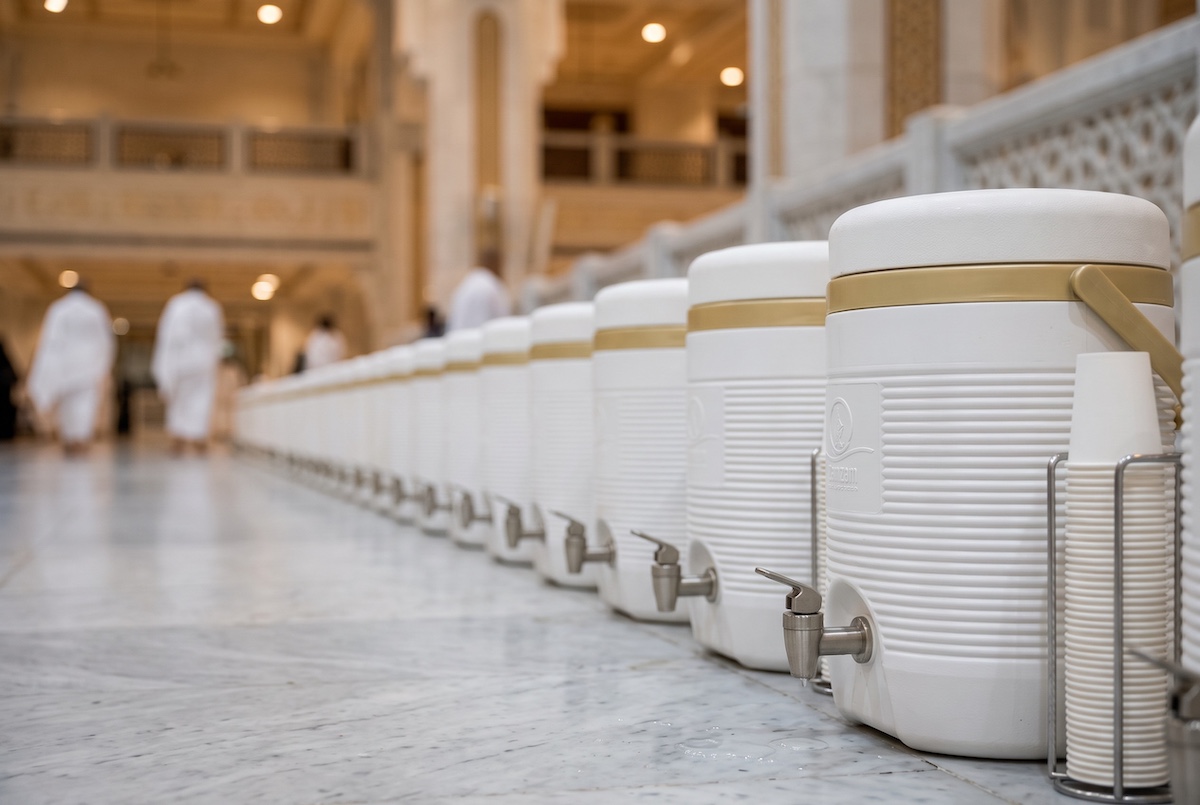
- ✓Zamzam is available free from coolers all over the mosque, chilled and at room temperature, including along the sa'i hall.
- ✓Sahih Muslim records the Prophet saying of Zamzam that it is blessed and is food that satisfies. The phrase 'a cure for sickness' comes from a different narration, not from Muslim.
- ✓Drinking Zamzam is a Sunnah, not a pillar of Umrah. Your Umrah is valid whether or not you drink it.
- ✓Water is pumped to the King Abdullah plant at Kudai, filtered and UV sterilised, then bottled and returned to the mosque.
- ✓Zamzam cannot go in hand luggage. Allowances for checked containers differ by airline, so check yours before buying one.
Quick facts
- City
- Makkah, Saudi Arabia
- Location
- Beneath the mataf inside Masjid al-Haram
- Distance from Kaaba
- About 21 metres, east side
- Depth
- About 30 metres
- Can you visit the well
- No, sealed to the public since 2003
- Where to drink it
- Free coolers throughout the mosque and the mas'a
- Part of Umrah
- Drinking it is a Sunnah, not a pillar
- Cost
- Free inside the Haram
- Can a car reach it
- No, it is inside the mosque
- Taking it home
- Checked baggage only, never hand luggage
Almost every pilgrim drinks Zamzam within an hour of arriving at the Haram. Far fewer know where the water actually comes from, or that you can no longer go down and look at the well.
Here is the honest version: what Zamzam is, what the authentic sources say about it, what happens to it before it reaches your cup, and what to do if you want to take some home.
What Zamzam is
Zamzam is a well inside Masjid al-Haram in Makkah. It sits about 21 metres east of the Kaaba, and it is roughly 30 metres deep. It has been giving water for a very long time, and it still supplies the whole mosque today.
The water is groundwater, drawn from the rock of the valley. Saudi figures put its normal yield at somewhere between about 11 and 18.5 litres every second. That is what makes it possible to hand out millions of cups during Ramadan without the mosque running dry.
One thing to be clear about from the start. You cannot visit the well. More on that below, because a lot of pilgrims arrive expecting to see it.
Where the water came from
The account is in the long narration of Ibn Abbas in Sahih al-Bukhari (hadith 3364), the same narration that explains sa'i.
Ibrahim left Hajar and their infant son Ismail in the valley of Makkah, where there was no water and no settlement. When their supply ran out, Hajar climbed Safa to look for anyone who could help, then crossed to Marwah, going back and forth seven times. On the last crossing she heard something at the place of Zamzam and found water coming from the ground.
The narration says she began heaping sand around the spring to hold the water in, and the Prophet ﷺ commented that had she left it alone, it would have become a flowing spring. Later, when the tribe of Jurhum passed through and saw birds circling the valley, they realised there was water and asked to settle there.
That is the origin of both the well and the walk between the two hills. If you want the walk itself explained step by step, see our guide to Safa, Marwah and sa'i.
What the hadith actually say
Zamzam has a lot of claims attached to it, and they are not all equal. Here is what is firm and what is not.
Established
Abu Dharr stayed near the Kaaba for a long period with nothing but Zamzam to live on, and reported that he did not grow thin. The Prophet ﷺ said of it, "It is blessed, it is food that satisfies." This is in Sahih Muslim (2473).
Worth noting carefully: the extra phrase you often see quoted alongside it, "and a cure for sickness", is not part of the wording in Sahih Muslim. It appears in a separate narration recorded by al-Tayalisi. It is often quoted as though the two are one sentence in Muslim. They are not.
Accepted by most scholars
The well-known statement "Zamzam water is for whatever it is drunk for" is recorded by Ibn Majah (3062). Many scholars graded it acceptable, and it is widely acted upon. Some scholars did question its chain. So drink it with a good intention, by all means, but do not describe it to others as a hadith beyond any question.
Sunnah, not obligation
Drinking Zamzam after tawaf is a Sunnah of the Prophet ﷺ, and it is a good and recommended act at any time. It is not a pillar of Umrah or Hajj. If you never drink it, your Umrah is still complete. Nobody should tell you otherwise.
There is also no fixed du'a that the Prophet ﷺ taught for the moment of drinking. Say what you need to say, in your own language.
Can you see the Zamzam well?
No, and this disappoints people every year, so it is better to know before you go.
The well used to be reachable. In 1962, under King Saud, the opening was lowered below the level of the mataf into a basement room about 2.7 metres deep, with separate sections for men and women. Pilgrims went down a staircase to drink at the source.
In 1424 AH, corresponding to 2003, those basement entrances were roofed over. The reason was crowd space: the staircases sat in the middle of the tawaf area and were a bottleneck at exactly the busiest point in the mosque. Closing them released that floor space for the people circling the Kaaba.
Since then the well itself has been sealed from public access, and the water is brought to you instead. So when you stand in the mataf, the well is beneath your feet, but there is nothing to see.
Where to get Zamzam inside the Haram
Everywhere, is the short answer. You do not need to hunt for it.
- Coolers around the mataf — rows of white and gold containers with taps, restocked constantly, with disposable cups beside them.
- Along the mas'a — the sa'i hall has coolers at intervals on every level, so you can drink mid-lap.
- Throughout the prayer halls and courtyards, on all floors, including the roof.
- Chilled and room temperature. Containers are usually labelled in Arabic and English. If your stomach is sensitive, take the non-chilled one.
Two small courtesies. Fill your bottle away from the drinking crowd rather than blocking a tap, and take a cup you will actually finish. The amount of water poured away in that mosque is enormous.
What happens before it reaches your cup
The water no longer goes straight from the well to the tap. Since the reign of King Abdullah it has passed through a dedicated plant.
The King Abdullah bin Abdulaziz Zamzam Water Project sits in the Kudai area, a few kilometres south of the Grand Mosque. Water is pumped from the well through stainless steel pipes to the plant, where it is filtered and sterilised with ultraviolet light, then bottled and sent back. Saudi sources describe an automated line capable of around 200,000 bottles a day, running around the clock.
| Detail | Figure |
|---|---|
| Well depth | About 30 metres |
| Distance from the Kaaba | About 21 metres, east side |
| Normal yield | Roughly 11 to 18.5 litres per second |
| Treatment plant | Kudai, south of the Haram |
| Treatment method | Filtration and ultraviolet sterilisation |
| Bottling capacity | Around 200,000 bottles a day |
| Sent to Madinah | Yes, by tanker |
Zamzam is also trucked to Madinah, which is why you will find the same coolers inside Masjid an-Nabawi. The water level and quality of the well are monitored by Saudi authorities, and pumping is managed rather than unlimited.
Flying into Jeddah with an early check-in and a long queue ahead of you? A pre-booked car from Jeddah Airport to Makkah is a fixed price and the driver waits if your flight is late.
Taking Zamzam home
You can, and most pilgrims do. A few practical points.
Sealed Zamzam containers are sold at Saudi airports and by authorised outlets. Buying a sealed one is simpler than filling your own, because unsealed water in your baggage causes problems at security.
Zamzam cannot go in your hand luggage. It is a liquid, and liquid limits at security apply to it exactly as they do to anything else. It travels in the hold.
Beyond that, allowances differ from airline to airline and they change. We are not going to invent a number here. What is allowed on a Saudia flight is not necessarily allowed on a budget carrier, and the rule this year may not be the rule next year. Read our guide to Zamzam water airline rules and then check your own airline's current page before you buy a container you cannot carry.
If you are moving between the two cities with a five-litre container plus your suitcases, a private car is a great deal easier than a bus or a train platform. Our Makkah to Madinah private car takes your luggage door to door.
Claims to be careful with
Zamzam attracts a lot of forwarded messages. Some common ones deserve a second look.
- Claims about a unique molecular or crystal structure. These circulate widely and trace back to studies that were never properly published or verified. Zamzam's standing in Islam does not rest on them.
- "It has never been treated." It is treated now. Filtration and UV sterilisation at the Kudai plant are documented Saudi practice, and that is a sensible thing to do with water served to millions of people.
- Very precise numbers about the well. Depth, yield and daily volume figures vary between sources and between seasons. Treat any single exact number, including ours, as an approximation.
None of this reduces Zamzam. The blessing is established in the authentic sources. It does not need help from a viral image.
Around the Haram
The well sits in the middle of everything else you will do that morning:
- Masjid al-Haram, a complete visitor guide — gates, floors and how not to get lost.
- The Holy Kaaba — the centre of the mosque and of tawaf.
- Maqam Ibrahim — where you pray after tawaf, and just before you drink Zamzam.
- Safa, Marwah and sa'i — the walk that began with Hajar's search for this water.
For everything outside the mosque, start with the Makkah Ziyarat guide, and if you are still packing, the Umrah packing checklist covers what actually gets used.
Getting to Makkah, and moving on
Zamzam is inside the Haram, so no car is involved in drinking it. Where a car helps is the parts of the trip that involve luggage and heat.
We run fixed-price private transfers from Jeddah Airport to Makkah, between Makkah and Madinah, and a Makkah Ziyarat round of the sites outside the city, which starts at SAR 200 for a sedan and SAR 280 for a Hiace van. Fares are per vehicle, so a family shares one price rather than paying per seat.
See Makkah Ziyarat by private car, or read how to book a private car for Umrah if you have not done this before.
How we checked this page
The origin of the well is from the narration of Ibn Abbas in Sahih al-Bukhari (3364). The statement "it is blessed, it is food that satisfies" is from Sahih Muslim (2473), and we have flagged that the commonly added phrase about curing sickness is from a different narration, not from Muslim's wording. "Zamzam water is for whatever it is drunk for" is from Ibn Majah (3062), graded acceptable by many scholars and questioned by some, and we have said so rather than presenting it as beyond dispute.
The depth, position, yield, the 1962 basement, the 2003 closure of its entrances and the details of the King Abdullah Zamzam Water Project come from Saudi official and reference sources. Figures vary a little between them and are given here as approximations.
We have deliberately not quoted airline liquid allowances, because they differ by carrier and change. Fares quoted are our own published rates, per vehicle, reviewed periodically. Verified August 2026.
Frequently asked questions
Planning a Saudi trip?
Pre-book a private car, find a stay, or ask us anything on WhatsApp.
Last updated: 25 August 2026·Sources reviewed by the Wadana Go editorial team.