Ayn Zubaydah: The Water Channel That Supplied Hajj for 1,200 Years
Short answer
Ayn Zubaydah is an underground water channel, a qanat, built at the order of Zubaydah bint Ja'far, wife of the caliph Harun al-Rashid, to bring water to Arafat and Makkah. It runs from the hills north of Taif through Wadi Numan and supplied the holy sites for close to 1,200 years. Visiting is not part of Hajj or Umrah.
Key takeaways
- ✓Ayn Zubaydah is a qanat, an underground gravity channel with vertical inspection shafts. No pumps, no power, just a very carefully cut slope.
- ✓Zubaydah bint Ja'far, wife of Harun al-Rashid, ordered and funded it after seeing how hard pilgrims struggled for water.
- ✓It ran from the hills north of Taif through Wadi Numan, east of Makkah, out to the plain of Arafat and on towards the city.
- ✓Sources give lengths of about 30 km with 132 inspection chambers, and about 38 km from Wadi Numan. Both are reasonable; the system was extended over centuries.
- ✓It supplied Makkah and the holy sites for roughly 1,200 years, ending in the twentieth century as the modern city grew and piped supply took over.
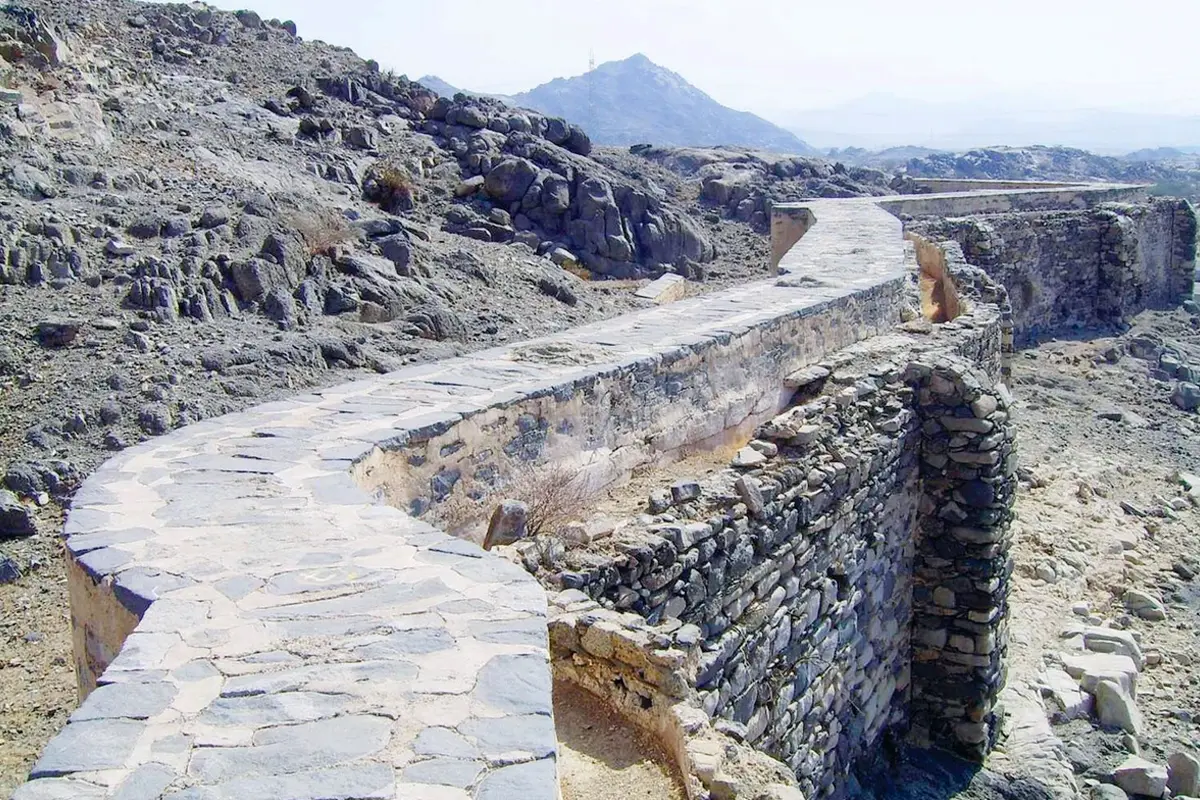
- ✓The clearest surviving piece is a stone bridge about 10 m high on the Dhab route between Arafat and Muzdalifah.
- ✓It is heritage, not a rite. No prayer is prescribed there and no reward for visiting is reported.
Quick facts
- City / region
- East of Makkah, towards Arafat and Muzdalifah
- Built by
- Zubaydah bint Ja'far, wife of Harun al-Rashid
- Date
- Late 2nd century AH; SPA dates the order to 174 AH / 791 CE
- Type
- Qanat, an underground gravity-fed water channel
- Length
- About 30 km (132 inspection chambers); some sources say about 38 km
- In service
- Roughly 1,200 years, ending in the twentieth century
- Part of Umrah or Hajj
- No. Heritage, not a rite
- Can a car reach it
- Yes, on the Arafat and Muzdalifah road. Access rules change, so check locally
- Best time
- Early morning, and never during the Hajj season
For most of Makkah's history the hardest thing about Hajj was not the walking. It was the water.
Zamzam supplied the Haram, but a city swollen by hundreds of thousands of pilgrims, out on the plain of Arafat in the heat, needed more than one well. Ayn Zubaydah is the answer somebody built to that problem more than twelve hundred years ago, and parts of it are still standing.
What Ayn Zubaydah is
Ayn Zubaydah is a qanat: an underground water channel, cut with a very slight downward slope, that moves water from a source in the hills to where people need it using gravity alone. No pumps. No power. Vertical shafts are sunk along the route so workers can get down to dig it and, afterwards, keep it clean.
The technology is ancient and it was used across Iran, Arabia and North Africa. What makes this one remarkable is where it goes and how long it kept working.
It brought water from the hills to the plain of Arafat and on towards Makkah, following a line north of Taif and through Wadi Numan to the east of the city.
Who built it
Zubaydah bint Ja'far, wife of the Abbasid caliph Harun al-Rashid, ordered the work. Accounts say she saw for herself how badly pilgrims struggled to get water, hauling it from distant sources near Jabal Kara, and paid for a permanent fix out of her own wealth.
The Saudi Press Agency's account dates the order to 174 AH, around 791 CE. Other accounts tie the decision to her own Hajj a little later. The exact year is debated in the sources; that she commissioned and funded it is not.
The name stuck to the project and never came off. Twelve centuries later people in Makkah still call it by her name, which is a fair measure of what it was worth.
How long, and how it was built
Sources give different lengths, and it is worth understanding why rather than picking a number.
One commonly cited figure is around 30 km, with about 132 inspection chambers along the route. Another measures roughly 38 km from Wadi Numan. The difference is not sloppiness. The system was extended and rebuilt many times over the centuries, and it had branches. Depending on which channel and which period you measure, you get a different answer.
What is consistent across the sources is the method:
- Underground channels, to stop the water evaporating in the heat and to keep it clean.
- Vertical shafts and inspection chambers at intervals, so the channel could be dug, checked and cleared out.
- Stone and plaster construction, with the channel bed carefully laid so the slope stayed gentle and even.
- Flood protection, because the wadis it crosses flood hard and fast when it does rain.
Get the slope wrong over 30 km and the whole thing either silts up or runs dry. They did not get it wrong.
What survives today
Most of the system is underground, which is exactly why so much of it is still there.
The most visible piece is a stone bridge or aqueduct on the Dhab route, on the stretch between Arafat and Muzdalifah. It stands about 10 metres high, built of stone and plaster, with a precisely laid stone water channel, drainage openings and structures to protect it against floods. If you have ever wondered what a twelve-hundred-year-old piece of Hajj infrastructure looks like, that is it.
In early 2024 the site was developed in partnership with Kidana Development Company, with a walking trail of about a kilometre, seating areas and multimedia displays.
Please treat access as a live question rather than a settled fact. Development around the holy sites moves quickly, arrangements during Hajj season are different from the rest of the year, and we cannot confirm current opening hours, permits or entry rules. Check locally before you build a morning around it.
When it stopped
Ayn Zubaydah supplied Makkah and the holy sites for close to 1,200 years. Think about that against the lifespan of most infrastructure.
It kept going into the twentieth century. What ended it was not neglect so much as the modern city: heavy groundwater pumping and rapid urban growth changed the water table the channel depended on, and modern desalination and piped supply took over the job.
So it is now heritage rather than utility. That is not a sad ending. It is a system that did its job for twelve centuries and was retired.
Is Ayn Zubaydah part of Hajj or Umrah?
No. It is not a rite, not a miqat, and no prayer is prescribed there. There is no authentic report of a reward for visiting it.
It is a work of charity and engineering, and it belongs to the history of how Hajj was made possible. Worth knowing about. Not worth anyone telling you it is a devotional stop.
If you want the sites around Makkah that do carry religious weight, and the honest evidence level for each, our Makkah Ziyarat guide lays them out.
Why it is worth a paragraph of your attention
Ayn Zubaydah is one of the clearest examples in Islamic history of somebody with money and power spending it on pilgrims they would never meet.
Zubaydah did not build a monument with her name carved on it. She built a drain in the ground that nobody would look at, in order that people arriving at Arafat in the heat, for centuries after she died, would find water there. The name attached itself afterwards, because that is what happens when the work is real.
There is a lesson in that for anyone who reads about it.
If you want to see it
The visible remains sit out towards Arafat and Muzdalifah, east of Makkah, which is convenient: that is the same direction as the main Makkah Ziyarat round.
Practical points:
- Go early. There is little shade on that ground and the heat out towards Arafat is serious from mid-morning.
- Not during Hajj. The holy sites area is closed off and managed during the Hajj season. Do not plan a heritage visit into those days.
- Ask your driver first. Not every Makkah driver knows the aqueduct, and it is better to find that out at the hotel than at Arafat.
- Do not climb on the stonework. It is twelve hundred years old and it is not a viewing platform.
Our Makkah Ziyarat private car covers the round out to Mina, Muzdalifah and Arafat on one fixed fare for the whole vehicle, with the driver waiting at each stop. If you want the aqueduct added, say so when you book so the route is planned for it.
Nearby and related
- Arafat — the plain the channel was built to supply.
- Muzdalifah — on the same road, between Arafat and Mina.
- Zamzam — the well that came first, and never stopped.
- Wadi Fatimah — another old watering point on the pilgrim network.
- Dhat 'Irq — a station on the Iraqi pilgrim road that Zubaydah's family also invested in.
Accuracy note
Zubaydah bint Ja'far's commissioning of the water project, the route north of Taif through Wadi Numan to Arafat, the springs near Jabal Kara, the length figures of about 30 km with 132 inspection chambers and about 38 km from Wadi Numan, the roughly 1,200 years of service, the stone bridge about 10 m high on the Dhab route between Arafat and Muzdalifah, and the 2024 development with Kidana Development Company including a walking trail of about a kilometre, are drawn from Saudi official and press sources and from published heritage documentation. Where sources give different figures we have given both rather than choosing. The date of 174 AH / 791 CE follows the Saudi Press Agency's account; other accounts place the decision slightly later. We give no opening hours, ticket prices or entry rules because these change and we have not verified current ones. Visiting Ayn Zubaydah is not part of Hajj or Umrah. Content verified August 2026. Found an error? Let us know.
Frequently asked questions
Planning a Saudi trip?
Pre-book a private car, find a stay, or ask us anything on WhatsApp.
Last updated: 9 October 2026·Sources reviewed by the Wadana Go editorial team.