Hijr Ismail (Hatim): The Part of the Kaaba Left Outside
Short answer
Hijr Ismail, also called the Hatim, is the semicircular marble wall on the north-west side of the Kaaba. Part of the ground it encloses belongs to the original Kaaba. The Quraysh ran short of lawful funds when rebuilding and left that section outside. Tawaf must go around the outside of the wall, and praying inside counts as praying inside the Kaaba.
Key takeaways
- ✓The Hijr is the low curved wall on the north-west side of the Kaaba. Hijr Ismail and Hatim are the same place.
- ✓Part of the enclosed ground is from the original Kaaba. The Quraysh left it out because they ran short of lawful money when rebuilding.
- ✓The Prophet said he would have added six cubits from the Hijr back to the House, recorded in Sahih al-Bukhari 1583 and Sahih Muslim 1333.
- ✓Tawaf must go around the outside of the wall. Cutting through the inside makes that circuit invalid, by scholarly agreement.
- ✓Praying inside the Hijr counts as praying inside the Kaaba, on a hadith narrated by Abu Dawud, al-Tirmidhi and al-Nasa'i.
- ✓The prayer there is voluntary. Your Umrah is complete without it, and it is not worth injuring anyone to get in.
- ✓The graves of Hajar and Ismail in the Hijr are a widely reported tradition, not something established by authentic hadith.
Quick facts
- City
- Makkah, Saudi Arabia
- Location
- North-west side of the Kaaba, inside the mataf
- Also called
- Hatim, Hijr Ismail
- Part of the Kaaba
- Partly. Six cubits are named in the hadith
- Tawaf
- Must pass outside the wall, never through it
- Prayer inside
- Voluntary, counts as praying inside the Kaaba
- Opening times
- None fixed. Roped off when crowded
- Best chance to enter
- Late night, outside peak season
- Can a car reach it
- No, it is inside Masjid al-Haram
- Part of Umrah
- No, entering is not required
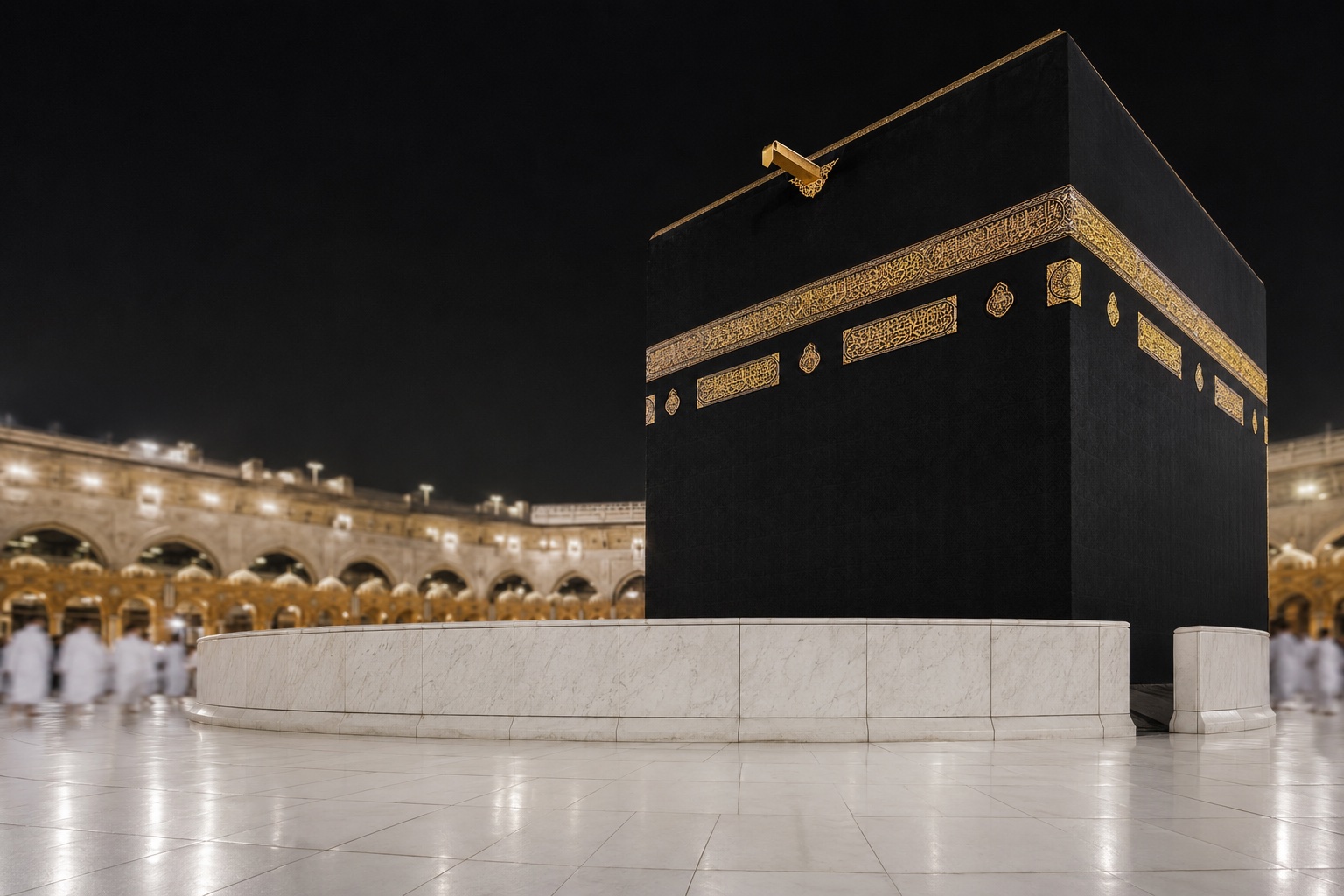
Stand in the mataf and look at the Kaaba from the north side. You will see a low curved marble wall out in front of it, forming a half circle on the open floor, with a gap at each end.
That is the Hijr. Many people call it the Hatim. Part of the ground inside it belongs to the Kaaba itself. That one fact explains almost everything about how pilgrims treat the place.
What the Hijr is
The Hijr is a semicircular wall of white marble on the north-western side of the Kaaba, between the corner known as the Iraqi corner and the Syrian corner. It curves out from the Kaaba's wall and back again, enclosing an open, paved area.
The wall is low, roughly waist height, and it has a gap at each end so people can walk in. Saudi reference sources give the distance across from the inside of the wall to the Kaaba's northern wall as about 8.4 metres.
The marble floor inside has been laid and relaid many times. The first marble paving is recorded in the year 757 under the Abbasid caliph al-Mansur. The current cold Greek marble dates from work in 1977, and the area was renovated again in 2014.
Two names, one place. "Hijr Ismail" is the common name. "Hatim" is also widely used, and in ordinary conversation the two are treated as the same thing.
Why part of the Kaaba is outside the Kaaba
This is the heart of it, and the explanation comes from the Prophet ﷺ himself.
When the Quraysh rebuilt the Kaaba before Islam, they insisted on paying for it only with lawful money. They did not have enough. So they built a smaller building than Ibrahim's foundation, and left a section of the original ground outside, marking it off with a wall.
Aishah reported that the Prophet ﷺ said to her: "Had your people not been recently in disbelief, I would have demolished the Kaaba and rebuilt it on the foundation of Ibrahim, and I would have added to it six cubits from the Hijr, for the Quraysh reduced it when they rebuilt it." This is in Sahih al-Bukhari (1583) and Sahih Muslim (1333).
So the wall is not decoration. It marks a piece of the House that got left out because a community ran short of money, and a Prophet who could have corrected it chose not to, in order not to unsettle people who had only just entered Islam.
What happened afterwards
Abdullah ibn al-Zubayr did rebuild the Kaaba on Ibrahim's foundation, taking the Hijr inside the building. Some years later, after his defeat, al-Hajjaj ibn Yusuf had it returned to the Quraysh layout, and the Hijr was put back outside. That is where matters have stood since, and later caliphs chose to leave it rather than keep changing the House. This is well-documented history rather than a matter of dispute.
How much of the Hijr is actually part of the Kaaba?
Not all of it, and this is where you should be careful with what you read online.
The hadith above names six cubits. That is a portion of the enclosed area, the part nearest the Kaaba, and not the entire semicircle out to the wall. Scholars have discussed the exact measure and do not all land in the same place.
What everyone agrees on is the practical consequence. Because the boundary is not marked on the ground and the exact extent is debated, the whole Hijr is treated as if it were part of the House for the purposes of tawaf. You go around the outside of the wall, all of it, every time.
Tawaf must go outside the wall
This is the one rule on this page that can cost you a tawaf, so be precise about it.
When you make tawaf, you circle the Kaaba and the Hijr. Your path goes around the outside of the curved wall. If you cut through the gap and walk across the inside of the Hijr, you have not gone around the House, and that circuit does not count.
Scholars are agreed on this. It is not a school-by-school difference and it is not a matter of caution. A tawaf performed through the inside of the Hijr is not valid, and it has to be repeated.
In practice the floor markings and the crowd flow keep you outside without any effort. The risk is mostly for people making tawaf in the quiet hours, when the mataf is empty and a shortcut looks harmless.
Praying inside the Hijr
If you cannot enter the Kaaba, and almost nobody can, the Hijr is the answer.
Aishah said she wanted to pray inside the House. The Prophet ﷺ took her by the hand, led her into the Hijr, and said: "Pray in the Hijr if you want to enter the House, for it is part of the House. Your people shortened it when they built the Kaaba, and they left it outside the House." This is narrated by Abu Dawud (2028), al-Tirmidhi (876) and al-Nasa'i, and scholars have graded it authentic.
That is why you see people praying two rak'ahs in there whenever the space opens. It is a voluntary prayer, not a required one, and there is no fixed number of rak'ahs and no special wording attached to it.
A few honest cautions
- It is not obligatory. Your Umrah is complete without ever setting foot in the Hijr. Do not let anyone make you feel your trip was incomplete.
- Do not injure people getting in. The Hijr fills up, and pushing through a packed crowd for a voluntary prayer is a poor trade. Scholars have said this plainly for centuries.
- Do not pray facing away from the Kaaba. You are inside the House, in effect. Face the Kaaba wall.
- Beware of specific claims about rewards. Praying there is like praying inside the Kaaba, which is what the hadith supports. Precise multipliers and guarantees you may hear from other pilgrims are not from an authentic source.
Mizab al-Rahmah, the golden spout
Look up at the Kaaba's roof on the Hijr side and you will see a golden waterspout projecting outward. That is the Mizab al-Rahmah, the spout of mercy. Its job is simple: it drains rainwater off the flat roof of the Kaaba, and the water falls into the Hijr below.
Makkah does not get much rain, but when it does rain hard, water pours from that spout onto the marble. Pilgrims who happen to be there at that moment consider it a rare thing to witness. The spout has been replaced and re-gilded many times over the centuries.
Are Hajar and Ismail buried in the Hijr?
You will hear this often, and it deserves a straight answer.
Reports in classical Islamic history state that Hajar and her son Ismail were buried in the area of the Hijr. These reports are found in respected early sources and many scholars have transmitted them. However, this is a historical report, not something established by an authentic hadith of the Prophet ﷺ.
So the fair way to say it is: the Hijr is traditionally associated with the graves of Hajar and Ismail, and that association is old and widespread, but the exact location is not confirmed by the strongest class of evidence.
What follows from that matters. You do not pray to them, ask them for anything, or treat the Hijr as a shrine. You pray to Allah, in a place the Prophet ﷺ identified as part of His House. That is the whole point of the space.
When can you get in?
There is no schedule. Access depends entirely on how busy the mataf is and what the mosque staff decide on the day.
Rope barriers have been used at the two entrances since work in 1996, and they are put across whenever the crowd makes standing prayer inside unsafe. In peak Umrah season, Ramadan and Hajj, the Hijr is often closed for long stretches. In the quiet middle of the night, or in the low season, it may be open and calm.
| Question | Answer |
|---|---|
| Where is it | North-west side of the Kaaba, inside the mataf |
| Fixed opening times | No. It depends on crowd levels |
| Best chance of entering | Late night, and outside peak season |
| Required for Umrah | No |
| Tawaf goes | Outside the wall, always |
| Prayer inside | Voluntary, counts as praying inside the Kaaba |
Practical advice: do not build your trip around it. Watch it during your stay, and if you find it open and uncrowded, go in, pray two rak'ahs, and leave space for the next person.
Arriving at Jeddah on a late flight and hoping to reach the Haram for the quiet hours? A pre-booked car from Jeddah Airport to Makkah saves the queue at arrivals.
The rest of the mataf
The Hijr sits within arm's reach of everything else you will want to know about:
- The Holy Kaaba — the building itself, its structure and its covering.
- Hajar al-Aswad — the corner where every circuit starts and ends.
- Maqam Ibrahim — the station a few steps from the Kaaba's door.
- The Zamzam well — beneath the floor you are standing on.
- Masjid al-Haram, a complete visitor guide — gates, levels and getting oriented.
If this is your first Umrah, our first-time Umrah travel guide walks through the whole trip, and the Makkah Ziyarat guide covers the sites outside the mosque.
Getting there
The Hijr is inside Masjid al-Haram, so there is no car ride to it. You walk in from whichever gate is nearest your hotel.
Cars matter for the rest of the trip: the run from Jeddah Airport, the road to Madinah, and the Ziyarat sites spread around the outskirts of Makkah. Our Makkah Ziyarat round by private car starts at SAR 200 for a sedan and SAR 280 for a Hiace van, priced per vehicle rather than per seat, with the driver waiting at each stop.
See Makkah Ziyarat by private car, or how to book a private car for Umrah if you are planning your first trip.
How we checked this page
The reason the Hijr lies outside the Kaaba, and the mention of six cubits, is from the report of Aishah in Sahih al-Bukhari (1583) and Sahih Muslim (1333). The instruction to pray inside the Hijr is narrated by Abu Dawud (2028), al-Tirmidhi (876) and al-Nasa'i, and is graded authentic by scholars of hadith.
The rebuilding by Abdullah ibn al-Zubayr and its reversal by al-Hajjaj ibn Yusuf are documented Islamic history. The burial of Hajar and Ismail in the Hijr is a widely transmitted historical report and we have marked it as traditional rather than presenting it as established by authentic hadith, because that is what the evidence supports.
Measurements, the marble paving of 757, the 1977 and 2014 works and the rope barriers introduced in 1996 come from Saudi reference sources, and figures are approximate. Access to the Hijr has no published timetable and is managed by mosque staff according to crowding. Fares quoted are our own published rates, per vehicle, reviewed periodically. Verified August 2026.
Frequently asked questions
Planning a Saudi trip?
Pre-book a private car, find a stay, or ask us anything on WhatsApp.
Last updated: 25 August 2026·Sources reviewed by the Wadana Go editorial team.