Masjid Namirah: The Mosque Half Inside Arafat and Half Outside
Short answer
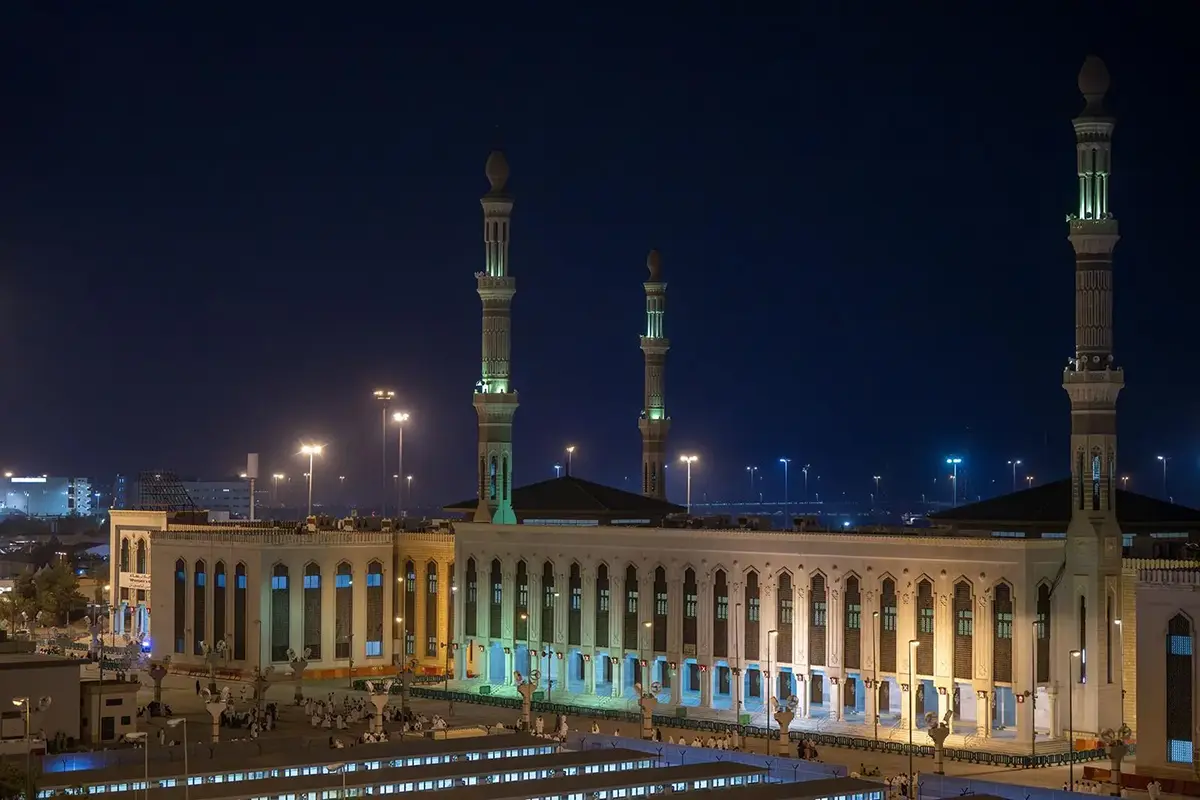
Masjid Namirah stands at the edge of the plain of Arafat, on the Makkah side. It covers more than 110,000 square metres and holds around 350,000 worshippers. On the ninth of Dhul Hijjah the Hajj sermon is delivered there and Dhuhr and Asr are prayed combined and shortened. Part of the mosque lies outside the boundary of Arafat.
Key takeaways
- ✓Masjid Namirah covers more than 110,000 sq m and holds about 350,000 worshippers.
- ✓Its front section lies outside the boundary of Arafat and its rear section inside.
- ✓That split follows the ground: Wadi Uranah, where the sermon was given, is outside Arafat.
- ✓On the ninth, the Hajj sermon is delivered there and Dhuhr and Asr are combined and shortened.
- ✓Its origins go back to the early Abbasid period, around the ninth century.
- ✓Praying there is not required. The standing at Arafat is what the day depends on.
- ✓It is used for one afternoon a year and stands empty the rest of the time.
Quick facts
- Where
- Western edge of the Arafat plain
- Area
- More than 110,000 sq m
- Capacity
- About 350,000 worshippers
- Origins
- Early Abbasid period, around the 9th century
- Used
- Mainly on 9 Dhul Hijjah
- Boundary
- Front outside Arafat, rear inside
- Required for Hajj?
- No. The standing is what counts.
- Part of Umrah?
- No. Arafat belongs to Hajj.
A very large mosque with one busy afternoon
Masjid Namirah stands on the western edge of the plain of Arafat, facing the road in from Makkah. It covers more than 110,000 square metres and holds around 350,000 worshippers, which puts it among the largest mosques anywhere.
Its origins go back to the early Abbasid period, most likely the ninth century, and it has been rebuilt and expanded many times since, most substantially in the Saudi era.
And it is used, properly, on one afternoon a year.
For the other three hundred and sixty-odd days it stands empty on an empty plain. That is not a criticism. It exists for the ninth of Dhul Hijjah, and on that day it is not big enough.
The split that confuses people
Here is the detail that makes this mosque unusual, and it is worth understanding rather than memorising.
Part of Masjid Namirah lies outside the boundary of Arafat and part of it lies inside. After successive expansions, the front section, which corresponds to the original mosque, sits outside the boundary. The rear section sits within it.
The reason is the ground. The mosque stands at Wadi Uranah, and Wadi Uranah is outside Arafat. When the Prophet delivered the sermon on the Day of Arafah, he did so in Uranah, and then moved into Arafat proper for the standing.
So the mosque was built where the sermon was given, and the boundary runs through it.
What this means practically: praying in the front section does not put you inside Arafat. Nobody should treat time spent in the mosque as fulfilling the standing. Pilgrims pray there and then move into the plain, which is exactly the sequence the Prophet followed.
Our page on Wadi Uranah covers the boundary question in full.
What happens there on the ninth
Two things, in order.
- The Hajj sermon. Delivered from the mosque at around midday, and broadcast and translated to the whole of Arafat and far beyond it.
- Dhuhr and Asr, combined and shortened. Two units each, prayed together at the time of Dhuhr, with one adhan and two iqamahs.
After that, pilgrims move out onto the plain for the standing, which runs until sunset.
This combining is specific to the day. It is not what happens in Mina on the eighth, where the four prayers are shortened but kept separate. People mix the two up constantly.
You do not have to pray there
Worth saying plainly, because a mosque this size creates the impression that reaching it matters.
Praying in Masjid Namirah is not a condition of Hajj. No reward specific to praying in this mosque is established in authentic evidence.
Three hundred and fifty thousand places sounds enormous, and it is a fraction of the pilgrims at Arafat. The overwhelming majority pray in their camps, hear the sermon on a broadcast, and are not missing anything.
What the day depends on is the standing, anywhere inside the boundary of Arafat, between the required times. The Prophet said that all of Arafah is a place of standing. Everything else on the ninth sits below that.
What it is like
Modern, plain and built for volume. Wide arcades, a very large open courtyard, six minarets, and the infrastructure a crowd of that size requires: cooling, water, washrooms, and broadcast systems.
The Saudi authorities have added comfort systems in recent years aimed at heat management, which is the dominant problem on that plain in that month.
Outside the season it is usually closed. You can see the exterior easily from the road and drivers stop for it, but do not count on getting inside.
Visiting outside Hajj
- It is on the Makkah side of Arafat, so you pass it on the way in.
- Ten minutes is enough unless the mosque happens to be open.
- Combine it with the plain and Jabal al-Rahmah, which are a short drive further on.
- Go early. There is no shade anywhere on that plain.
Arafat is about twenty kilometres out, the furthest of the three holy sites, and comes last on the road past Mina and Muzdalifah. All three fit into one leg of a Makkah Ziyarat round, from SAR 200 per vehicle with waiting at each stop. Fares reviewed August 2026.
Nearby
| Place | What it is |
|---|---|
| Arafat | The plain, the day and the boundaries. |
| Wadi Uranah | The valley the mosque stands in, outside Arafat. |
| Jabal al-Rahmah | The hill in the middle of the plain. |
| Masjid al-Sakharat | Stood at the foot of the hill. No longer exists. |
Our Hajj step by step guide sets the Day of Arafah in order.
Accuracy note
The mosque's area of more than 110,000 square metres, its capacity of about 350,000 worshippers, its origins in the early Abbasid period around the ninth century, and its expansions in the Saudi era are drawn from published descriptions of the mosque, including Saudi press material and Saudipedia's coverage of the Arafat sermon.
That the mosque stands at Wadi Uranah, that Uranah lies outside the boundary of Arafat, and that after expansion the front section falls outside those limits while the rear section falls within them, is the position recorded in the descriptions of the mosque and follows from the Prophet's own statement excluding Uranah from the standing, recorded in Sahih Muslim.
That the Prophet delivered the sermon on the Day of Arafah in Uranah and then moved into Arafat for the standing, and that Dhuhr and Asr are combined and shortened at the time of Dhuhr on the ninth, is established from the accounts of the Farewell Pilgrimage in the authentic collections.
No reward specific to praying in Masjid Namirah is established, and praying there is not a condition of Hajj. Access outside the Hajj season is not guaranteed. Fares are our own published rates, reviewed August 2026. Verified August 2026.
Frequently asked questions
Planning a Saudi trip?
Pre-book a private car, find a stay, or ask us anything on WhatsApp.
Last updated: 11 October 2026·Sources reviewed by the Wadana Go editorial team.