Safa: The Hill Where Sa'i Begins, and Why It Begins There
Short answer
Safa is a small rocky hill at the southern end of the sa'i gallery inside Masjid al-Haram in Makkah. The Quran calls Safa and Marwah symbols of Allah (2:158). Sa'i always starts here because the Prophet said, “I begin with what Allah began with” (Sahih Muslim). You climb the steps, face the Kaaba, say the takbir and make dua, then walk towards Marwah. Safa to Marwah is one length of seven.
Key takeaways
- ✓Safa is the starting point of sa'i, and the order is fixed. Safa to Marwah is one length, and the seventh ends at Marwah.
- ✓The Quran names Safa and Marwah as symbols of Allah in 2:158.
- ✓The Prophet began at Safa saying, “I begin with what Allah began with”, recorded in Sahih Muslim.
- ✓Sahih al-Bukhari records that Hajar's search between the two hills is why people walk between them.
- ✓The first open call to Islam was made from Safa, also recorded in Sahih al-Bukhari.
- ✓Safa is the end of the rock of Mount Abu Qubais, enclosed inside the mosque by the Saudi expansions.
- ✓Seven lengths is roughly three kilometres and takes most people forty minutes to an hour and a half.
Quick facts
- City
- Makkah, Saudi Arabia
- Where
- Inside Masjid al-Haram, southern end of the mas'a gallery
- What it is
- A small rocky hill, the end of Mount Abu Qubais
- In the Quran
- Surah al-Baqarah 2:158
- Part of Umrah
- Yes, sa'i starts here and is required in every school
- Distance to Marwah
- About 400 to 450 metres, one length
- Seven lengths
- Roughly 3 km, usually 40 to 90 minutes
- Can a car reach it
- No, it is inside the mosque and reached on foot
- Accessibility
- Central lanes for wheelchairs and carts, four floors
- Non-Muslim access
- No, Makkah is closed to non-Muslims
What Safa is
Safa is a small rocky hill in Makkah. It is the point where sa'i begins, and today it sits inside Masjid al-Haram at the southern end of the long walking gallery called the mas'a.
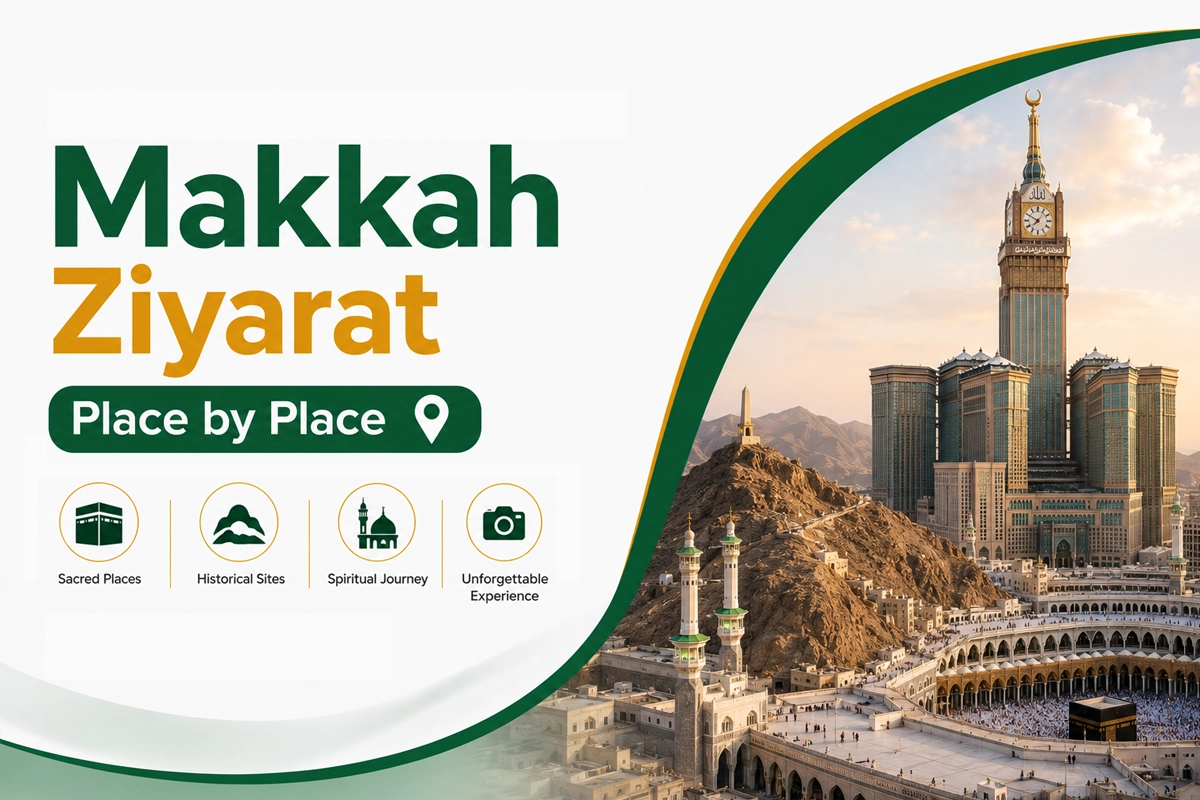
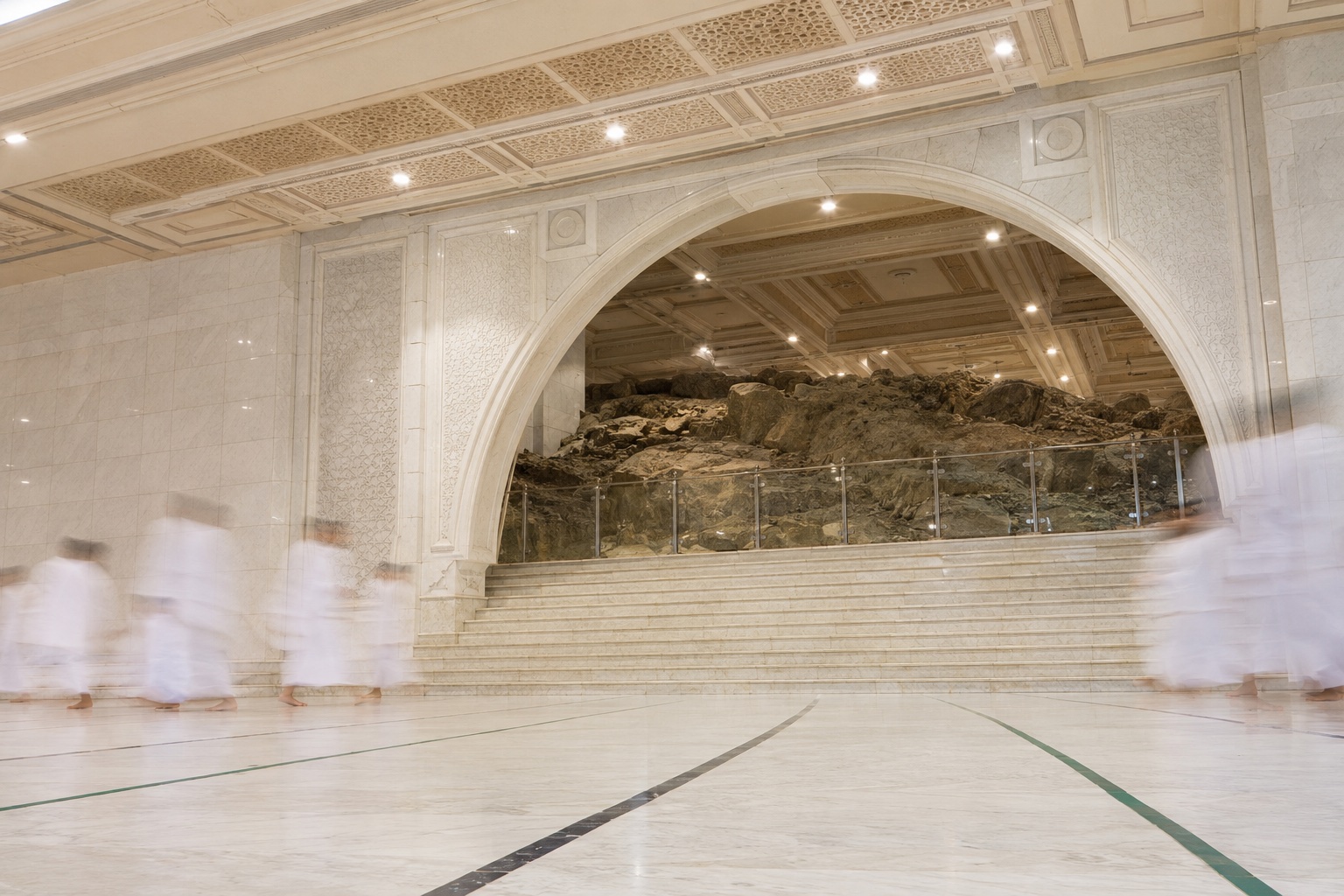
It was not always inside the mosque. Safa is the end of the rock of Mount Abu Qubais, and Marwah at the other end of the gallery belongs to Mount Qu'ayqi'an. The Saudi expansions of the Grand Mosque enclosed both hills and the path between them, so what was once open ground between two rises is now a covered, air-conditioned hall on four floors.
Some of the original rock is still there. You reach it by a short flight of marble steps under a large arch, and part of the hill is left exposed and railed off so pilgrims can see it.
What the Quran says about Safa
Surah al-Baqarah names it: "Indeed, Safa and Marwah are among the symbols of Allah" (Quran 2:158). The verse continues that there is no blame on the one who walks between them for Hajj or Umrah.
That verse is the reason sa'i exists as an act of worship rather than a custom. It is a direct Quranic statement, so this is settled.
It is also the verse pilgrims recite as they approach Safa for the first time, followed by the words of the Prophet, peace and blessings be upon him: abda'u bima bada'a Allahu bih, "I begin with what Allah began with." That wording is recorded in Sahih Muslim, in Jabir ibn Abdullah's account of the Prophet's Hajj.
Why sa'i starts at Safa and not at Marwah
Because Allah mentioned Safa first in the verse, and because the Prophet said so plainly. In Jabir's hadith he came out of the mosque towards Safa, recited the verse, and said, "I begin with what Allah began with." He then climbed Safa.
This is not a small detail. The order is fixed. Safa to Marwah is one length, Marwah to Safa is the second, and the seventh length finishes at Marwah. If you start at Marwah by mistake, that first stretch does not count, and you begin again from Safa.
The running that started here
Sahih al-Bukhari records the account of Ibn Abbas about Hajar, the mother of Isma'il, may Allah be pleased with them. Left in a dry valley with a small child and her water finished, she went to Safa and looked out for anyone who might help. Seeing nobody, she went down and crossed the low ground to Marwah and looked from there. She went back and forth seven times.
The hadith then says that this is why people walk between the two hills. Not as a re-enactment for its own sake, but because Allah made her search into an act of worship for everyone who came after.
The story is worth carrying with you when you stand on Safa the first time. The first person to stand there in distress was a woman with nothing left, and her search was answered.
The day the Prophet called out from Safa
Safa has a second story that belongs to it alone, and it is also in Sahih al-Bukhari.
When the verse "And warn your closest kindred" was revealed, the Prophet, peace and blessings be upon him, climbed Safa and called out to the clans of Quraysh by name. They gathered. He asked them whether they would believe him if he said an army was about to attack them from behind the hill. They said yes, they had never known him to lie. He then warned them of a punishment to come.
Safa was used as a public platform because that is what it was in old Makkah: a raised rock at the edge of the settlement where a voice carried. The first open call to Islam in Makkah was made from the same stone you climb before sa'i.
What you do when you reach Safa
Climb the steps, turn to face the Kaaba, and raise your hands. Sahih Muslim records that the Prophet said Allahu akbar and then the words of tawhid three times, making long dua in between.
Then walk down towards Marwah and begin counting.
Two things people ask about. First, can you actually see the Kaaba from Safa now? Sometimes, through the opening towards the mataf, and often not, depending on where you stand and how busy it is. Facing the direction of the House is what is asked of you. Do not climb railings or push forward to get a sightline.
Second, is there a fixed dua for each length? No. The transmitted words are the verse on approaching Safa and the takbir and tahlil on the two hills. Everything in between is your own dua, in any language. We have collected only what is authentically transmitted in our Umrah duas guide, and the full step-by-step order is in the first-time Umrah guide.
Is sa'i part of Umrah?
Yes. Every school of law requires it, though they classify it differently. The majority treat sa'i as a pillar of Umrah, meaning the Umrah is not complete without it. The Hanafi school treats it as obligatory with a compensation if it is left out. Either way, you do it, and you do not skip it.
Being in a state of wudu is recommended for sa'i but is not a condition for it, which is why a woman in her menses can complete sa'i once her tawaf has been performed at a valid time. If your situation is unusual, ask a scholar rather than a group leader.
What Safa looks like today
Coming from the mataf you pass through the Safa gate area and into the mas'a, a long hall running roughly north to south. Safa is the southern end.
The mas'a today is about forty metres wide and spread over four floors, with a total area of more than eighty-seven thousand square metres, after the widening carried out in the reign of King Abdullah that doubled it from around twenty metres. The middle of the gallery carries lanes for wheelchairs and mobility carts, which is why the walking crowd stays on the outer lanes.
Distance between Safa and Marwah is roughly four hundred to four hundred and fifty metres depending on which measurement you use, so seven lengths comes to about three kilometres. On a normal day it takes most people between forty minutes and an hour and a half.
Practical notes
- Pick your floor before you start. The ground floor is closest to the original hills but busiest. The upper floors are far quieter and the walk is longer per length. You cannot switch floors halfway without losing your count.
- Count out loud or on your fingers. Losing count is the single most common problem in the mas'a. Remember that Safa to Marwah is one, not two.
- Wheelchairs and carts. The central lanes are for them, and free manual wheelchairs are available at several Grand Mosque gates. Electric carts on the upper level are paid, from around SAR 57.5 per rite as of 2026. Our Haram accessibility guide has the detail.
- Water. Zamzam coolers run along the gallery. Three kilometres in a hot building with no food since the flight is how people faint. Drink at Safa before you start.
- Elderly parents. Do the sa'i in the quiet hours, use the upper floor, and stay close. A hotel near the Safa side of the mosque saves a long walk twice a day. See how far from the Haram to stay.
What is near Safa
Safa is a few minutes' walk from the mataf. The Kaaba is on the other side of the Safa gate, with the Black Stone at its eastern corner and Maqam Ibrahim a few metres from it, where you pray two rak'ahs before coming out to Safa.
The other end of your sa'i is Marwah, and above Safa on the eastern side lies the rock of Abu Qubais. For the layout of the whole mosque, its gates and its floors, read the Masjid al-Haram visitor guide.
Getting to Makkah, and to Safa
Safa is inside the Grand Mosque, so no car goes there. The walk is from your hotel or from whichever gate your group uses. What a car does is get you into Makkah and to your hotel door, and take you out to the sites beyond the Haram.
From Jeddah airport, our fixed fare to Makkah is SAR 260 in a standard sedan, SAR 280 in an SUV and SAR 330 in a Hiace van, plus parking, as reviewed in August 2026. If you are also planning the outer sites, the Makkah Ziyarat round is a fixed-fare half day from SAR 200, with the car waiting at each stop. What that round covers is set out in the Makkah Ziyarat guide.
Accuracy note
Quran 2:158 is quoted directly. The words on approaching Safa, the climbing of the hill and the takbir and tahlil there are from the hadith of Jabir ibn Abdullah in Sahih Muslim. The account of Hajar and the origin of the running is from Sahih al-Bukhari, narrated by Ibn Abbas. The Prophet's call to Quraysh from Safa is also in Sahih al-Bukhari.
The connection of Safa to Mount Abu Qubais and Marwah to Mount Qu'ayqi'an is historical documentation, not a Quranic or hadith statement. Measurements of the mas'a and of the distance between the two hills follow Saudipedia and Saudi expansion records, and different sources give slightly different figures, so treat them as approximate. Transport fares are our own fixed prices, reviewed August 2026. Facts verified August 2026.
Frequently asked questions
Planning a Saudi trip?
Pre-book a private car, find a stay, or ask us anything on WhatsApp.
Last updated: 23 August 2026·Sources reviewed by the Wadana Go editorial team.