Masjid al-Kabsh: The Mosque of the Ram, Gone for Centuries
Short answer
Masjid al-Kabsh, the Mosque of the Ram, stood in Mina between the first and middle Jamrah. Historians describe it as having three open arcades and five doors. It has not existed for centuries, and Saudipedia lists it among the mosques of the holy sites that no longer exist. It was associated with the ransom of Ibrahim's son.
Key takeaways
- ✓Masjid al-Kabsh stood in Mina between the first and middle Jamrah.
- ✓Historians describe three open arcades and five doors. It vanished centuries ago.
- ✓Saudipedia lists it among the holy site mosques that no longer exist.
- ✓Kabsh means ram, and the mosque was associated with the ransom of Ibrahim's son.
- ✓The Qur'an records the sacrifice and the great ransom, in Surah al-Saffat.
- ✓The Qur'an does not name the place, and the son is not named in that passage either.
- ✓The sacrifice of Hajj is a rite. Finding the exact spot is not part of it.
Quick facts
- Where it stood
- Mina, between the first and middle Jamrah
- Status
- Gone for centuries
- Described as
- Three open arcades, five doors
- Name means
- The ram
- Associated with
- The ransom of Ibrahim's son
- Named in the Qur'an?
- The event yes, the place no
- Anything to see?
- No
- Part of Umrah?
- No. Not a rite of Hajj or Umrah.
What is left of it
Nothing.
Historians of Makkah record that Mina once held a mosque called Masjid al-Kabsh, the Mosque of the Ram, standing between the first and the middle Jamrah, with three open arcades and five doors. It has not existed for centuries.
Saudipedia lists it among the mosques of the holy sites that no longer exist, together with Masjid al-Kawthar, Masjid al-Mursalat and Masjid al-Sakharat.
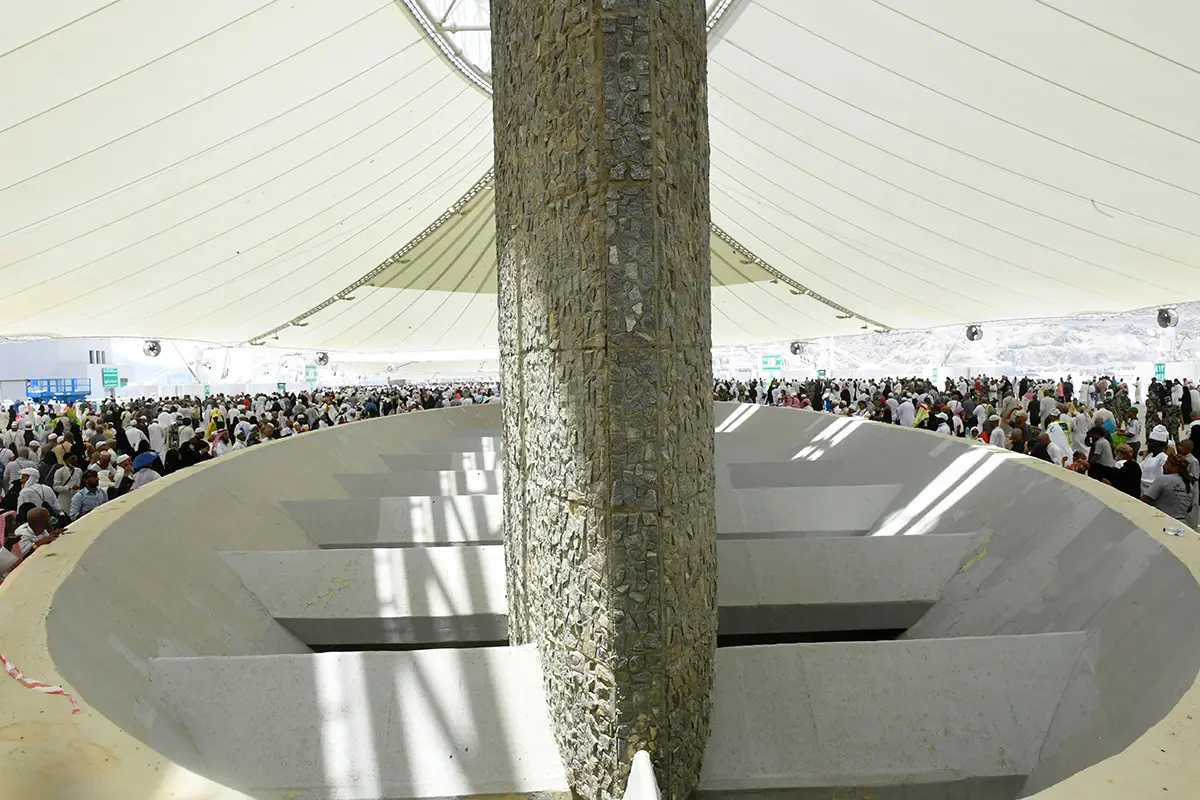
There is no ruin, no foundation and no marker. The ground between those two pillars is now roads, service buildings and the approaches to the Jamarat complex.
Why it was called the Mosque of the Ram
The mosque was associated with the ransom: the ram that was given in place of Ibrahim's son when he had been commanded to sacrifice him and had submitted to the command.
That association is what put a mosque on that spot, and it is why the name survived even after the building did not.
What the Qur'an actually says
This is the section to read slowly, because the popular telling adds several things the text does not contain.
Surah al-Saffat records the account. Ibrahim tells his son that he has seen in a dream that he is to sacrifice him, and asks him what he thinks. The son tells his father to do as he has been commanded, and says that he will find him, God willing, among the patient.
Both of them submit. Ibrahim lays him down. And then he is called, and told that he has fulfilled the vision.
The passage says this was the clear trial, and that he was ransomed with a great sacrifice.
Now, three things the passage does not say.
- It does not name the place. No location is given for the event in that passage.
- It does not name the son in that passage. Commentators have discussed the question at length, and the majority position among later scholars is that it was Ismail, but the passage itself does not settle it by name.
- It does not describe the ram or where it came from beyond calling the ransom great.
So the identification of a specific patch of ground in Mina as the place is a traditional attribution. It may reflect a very old understanding. It is not something the Qur'an establishes, and no authentic hadith fixes the spot either.
That is the difference between a story that is certain and a location that is not, and it is worth keeping straight even when the building has gone and the question is academic.
What this has to do with your Hajj
The connection is real, and it does not depend on a location.
The sacrifice on the tenth of Dhul Hijjah is a rite of Hajj, performed by pilgrims after stoning Jamrat al-Aqabah. It is tied to what happened in that account, and it is performed because it is commanded, not because a particular field is holy.
In practice today the sacrifice is handled through licensed abattoirs and booked through official channels, with the meat distributed to those in need. Pilgrims do not slaughter by hand in the valley, and have not for a long time.
So nobody needs to find the ground where the ram came down. The rite is the rite wherever the animal is slaughtered within the permitted area and time. Our Hajj step by step guide sets out the day of Eid in order.
Is there anything prescribed at the site?
No. No prayer is prescribed there, no reward for finding or standing on the spot is established, and it is not part of Hajj or Umrah.
The mosque's disappearance has cost nobody anything religiously. That is worth saying plainly, because pilgrims sometimes feel a loss on hearing that an old site is gone. A building that carried no prescribed act is a piece of the city's history rather than a piece of anyone's pilgrimage.
What is still in Mina
| Place | What it is | Still there? |
|---|---|---|
| Masjid al-Khayf | The main mosque of the valley. | Yes |
| Masjid al-Bay'ah | Built in 761, near Jamrat al-Aqabah. | Yes |
| The Jamarat | The three pillars in the bridge complex. | Yes |
| Masjid al-Kabsh | This mosque, between the first and middle Jamrah. | No |
| Masjid al-Kawthar | Another Mina mosque, also gone. | No |
Our Mina page covers the valley, its boundaries and the days spent there.
Visiting the valley
Outside the Hajj season Mina is quiet and open. Twenty to thirty minutes covers it, and you will drive right past the ground where this mosque stood without there being anything to point at.
Mina, Muzdalifah and Arafat lie one after another on the same road out of Makkah, so all three fit into one leg of a Makkah Ziyarat round, from SAR 200 per vehicle with waiting at each stop. Fares reviewed August 2026.
Accuracy note
The description of Masjid al-Kabsh as standing between the first and middle Jamrah in Mina, with three open arcades and five doors, and as having disappeared centuries ago, comes from the historical literature on Makkah. Saudipedia's list of holy site mosques places it in Mina and lists it among those that no longer exist.
The account of the command to Ibrahim, the submission of both father and son, and the ransom with a great sacrifice is recorded in the Qur'an in Surah al-Saffat. This is established evidence.
The Qur'an does not name the place in that passage, does not name the son in that passage, and does not describe the ram beyond calling the ransom great. The identification of a particular site in Mina is a traditional attribution and is not established by the Qur'an or by authentic hadith, and we have marked it as such. The identity of the son has been discussed at length by commentators, and we have reported the majority position among later scholars without presenting it as settled by the text.
Nothing marks the site today, no prayer or reward is established there, and the sacrifice of Hajj is performed through official channels rather than at any particular historical spot. Fares are our own published rates, reviewed August 2026. Verified August 2026.
Frequently asked questions
Planning a Saudi trip?
Pre-book a private car, find a stay, or ask us anything on WhatsApp.
Last updated: 12 October 2026·Sources reviewed by the Wadana Go editorial team.