Masjid al-Kawthar in Mina: A Mosque That Is No Longer There
Short answer
Masjid al-Kawthar was a mosque in Mina that no longer exists. Saudipedia lists it among the mosques of the holy sites that have gone. It took its name from Surah al-Kawthar, a Makkan surah revealed to console the Prophet Muhammad after he was mocked for having no surviving sons.
Key takeaways
- ✓Masjid al-Kawthar was in Mina and no longer exists.
- ✓Saudipedia lists it with three other holy site mosques that have gone.
- ✓It took its name from Surah al-Kawthar, the shortest surah in the Qur'an.
- ✓That surah was revealed in Makkah, in reply to a taunt about the Prophet having no surviving sons.
- ✓Al-Kawthar is described in authentic hadith as a river the Prophet was given in Paradise.
- ✓No authentic evidence connects the revelation of the surah to this particular spot in Mina.
- ✓There is nothing to visit, and nothing marked on the ground.
Quick facts
- Where it stood
- Mina, near Makkah
- Status
- No longer exists
- Named after
- Surah al-Kawthar
- Surah revealed in
- Makkah, before the Hijrah
- Link to this spot
- Not established by authentic evidence
- Anything to see?
- No
- On our Ziyarat round?
- No
- Part of Umrah?
- No. Not a rite of Hajj or Umrah.
Start here
Masjid al-Kawthar no longer exists. Saudipedia's list of holy site mosques places it in Mina and puts it among the mosques of the holy sites that have gone, together with Masjid al-Sakharat in Arafat, Masjid al-Kabsh and Masjid al-Mursalat in Mina.
If it is on an itinerary you have been given, there is nothing to arrive at, and nothing on the ground marks where it stood.
That is a short answer to the practical question. The rest of this page is about what the name refers to, because that part is well documented and worth knowing.
The surah it is named for
Surah al-Kawthar is the shortest surah in the Qur'an, three verses, and it was revealed in Makkah.
The occasion recorded in the commentaries is a taunt. The Prophet's sons had died in infancy, and in a society that measured a man's future by his male line, a leader of Quraysh said that he was cut off, that he would leave no one behind him and would be forgotten.
The surah answers that. It tells the Prophet that he has been given al-Kawthar, instructs him to pray to his Lord and sacrifice, and states that it is the one who hates him who is cut off.
Fourteen centuries later, the taunt is remembered only because the reply to it is in the Qur'an. That is the whole shape of the thing, and it needs no elaboration from us.
What al-Kawthar is
The authentic collections record the Prophet describing al-Kawthar as a river he was given in Paradise, and connect it with the basin from which his community will drink.
Commentators discuss whether the word carries a wider sense of abundant good given to him, of which the river is part. Both readings are found in serious tafsir, and the surah's own wording, abundant good, supports the breadth.
What matters for this page is that the meaning of al-Kawthar is well established. The mosque named after it is a different question.
What is not established
Being direct about this is the reason the page exists.
We could not find authentic evidence connecting the revelation of Surah al-Kawthar, or any specific event in the Prophet's life, to the particular place in Mina where this mosque stood.
The surah is Makkan, revealed in the years before the Hijrah, and the occasion recorded for it is a conversation in Makkah rather than anything in the valley of Mina. A mosque later carrying that name does not establish that the revelation happened on its site.
Mosques acquire names for many reasons: a surah recited there, a patron's preference, a local association that grew over time. Without a source we can point to, we are not going to invent one.
So the honest position is: the mosque existed, it stood in Mina, it is gone, and what connected it to the name is not something we can document.
Why we still wrote this page
Because the name is on the standard lists of holy site mosques, and a pilgrim who searches for it deserves a straight answer rather than a paragraph of invented significance.
There is a pattern worth recognising in Ziyarat material. Where the record is thin, writers fill the gap, and after a few rounds of copying, the filler is indistinguishable from the record. We have flagged the same thing at Jabal Abu Qubais, at Jannat al-Mu'alla and at Jabal al-Kaaba.
Saying we do not know is not a failure of research. It is the result of it.
What is actually in Mina
If you are building a list for the valley, these are the things that are still standing.
| Place | What it is | Still there? |
|---|---|---|
| Masjid al-Khayf | The main mosque of Mina, 25,000 capacity. | Yes |
| Masjid al-Bay'ah | Built in 761, near Jamrat al-Aqabah. | Yes |
| The Jamarat | The three pillars and the bridge complex. | Yes |
| Masjid al-Kawthar | This mosque. | No |
| Masjid al-Kabsh | Between the first and middle Jamrahs. | No |
Our Mina page covers the valley itself, its boundaries and the days of Hajj spent there.
Visiting Mina
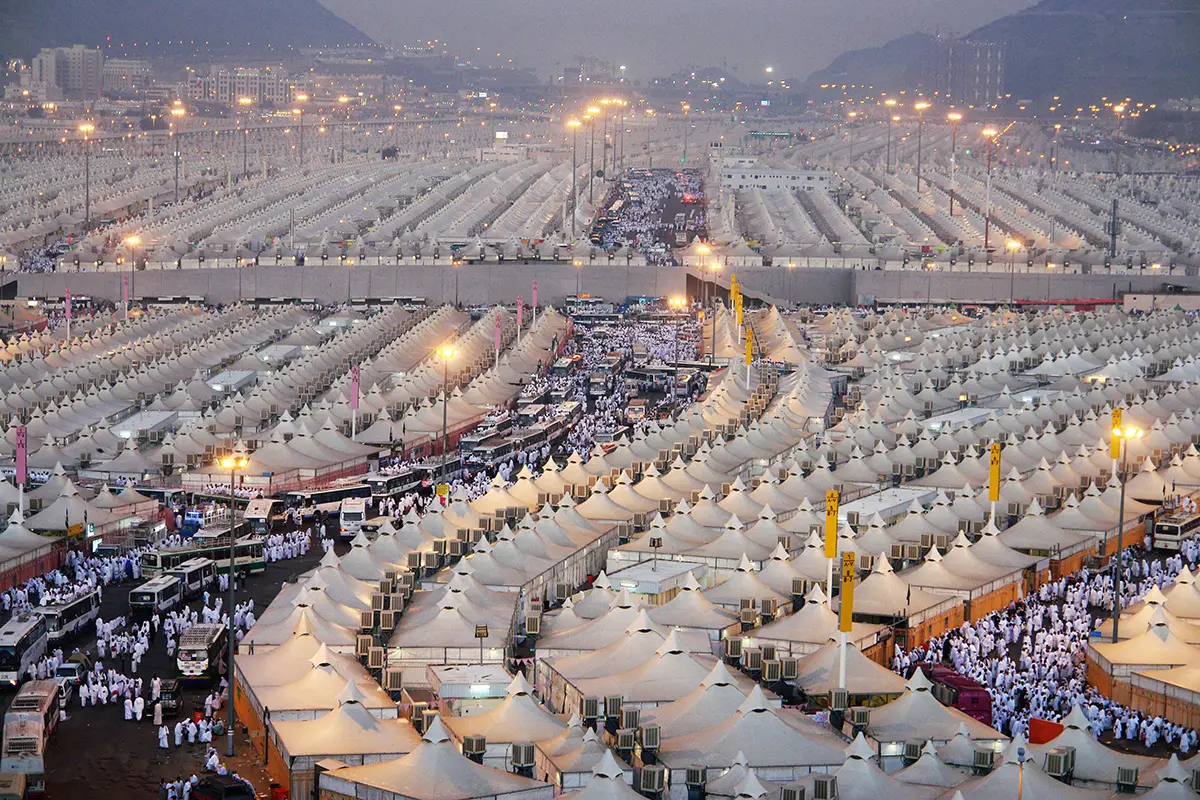
Outside the Hajj season Mina is open, quiet and easy to drive through, and it is a standard stop on a Makkah Ziyarat round together with Muzdalifah and Arafat.
Twenty to thirty minutes covers the valley. There is no rite to perform there outside Hajj and no prayer prescribed for a visitor.
All three holy sites lie one after another on the same road out of the city, so they fit into one leg of a Makkah Ziyarat round, from SAR 200 per vehicle with waiting at each stop. Fares reviewed August 2026.
Accuracy note
Saudipedia's list of holy site mosques places Masjid al-Kawthar in Mina and lists it among the mosques of the holy sites that no longer exist.
Surah al-Kawthar is a Makkan surah. The occasion of its revelation, a taunt by a leader of Quraysh that the Prophet was cut off after the deaths of his sons, is recorded in the standard commentaries. The description of al-Kawthar as a river given to the Prophet in Paradise, and its connection with the basin, is recorded in the authentic collections.
We found no authentic evidence connecting the revelation of the surah, or any specific event, to the site of this mosque in Mina, and the article says so rather than supplying an explanation. If a Saudi heritage source or a reliable early history establishes the connection, we will update the page.
Nothing marks the site today. Fares are our own published rates, reviewed August 2026. Verified August 2026.
Frequently asked questions
Planning a Saudi trip?
Pre-book a private car, find a stay, or ask us anything on WhatsApp.
Last updated: 11 October 2026·Sources reviewed by the Wadana Go editorial team.